The American Typecasting Fellowship's fifth
conference is taking shape with Dave Churchman
as coordinator. A full itinerary of practical
sessions relating to the ancient and honorable
process of making type is being arranged.
The event is scheduled for July 11-13, 1986,
with the Marriott Hotel at 7202 East 21st
Street, Indianapolis, Ind. 46219 being
headquarters for all activities.
Rates for the hotel are $55.00 per night,
whether single or double. Dave points out that
less expensive hotels also are available in the
vicinity and he will provide more details if
requested. Registration fee for the conference
will be $125.00 per person, and will include
buffers, snacks, a luncheon and other
amenities.
An intense, two-day technical session is
tentatively set for July 9–10, to precede the
conference.
The July 9 session will concentrate on the
American material maker and the English Super
Caster. All day July 10 will be devoted to the
Thompson Caster. These two sessions will be
held at the Sterling Type Foundry at 470 North
Warman Street; an additional fee of $50 will
cover both sessions.
That evening (Thursday), an early bird
reception and registration will be held at the
hospitality room. The conference will begin at
9 a.m. Friday.
In keeping with the group’s heavy orientation
toward historic, artistic, technical, and
mechanical aspects of making metal type, the
following sessions already are planned:
Herb Harms, accompanied by Dave Churchman, will
give a report complete with slides of their
continuing efforts to document the various
pinmarks used by typefounders (a brand-name
practice quite prevalent before the turn of the
century).
Stan Nelson, with technical, financial and
moral support from Columbia University, has
only recently completed a videotaped discourse
on driving and fitting a matrix for use with
the hand mold and he will bring that
presentation with him to the conference.
Responding to folks who “merely buy type,” Rich
Hopkins has agreed to put together a slide
presentation on “making a font of type” which
will include a discussion of matrices,
machines, fonting schemes, and related
subjects.
A roundtable discussion will be held on the
subject of “what is good type?” to include both
users and type casters to provide a balanced
forum.
Other tentative arrangements include a
discourse on John Thompson by Steve Saxe, a
discussion of “scale in type design” by John
Schappler, matrix style and electrotyping
matrices, and visits to area shops, including
Dave Peat’s Press, Dave Churchman’s shop, and
their jointly owned Sterling Type Foundry.
At least one hands-on session will be held at
the Sterling Type Foundry.
All persons attending the conference are asked
to come prepared for three separate events:
(1) A photographic tour of all shops
represented at the conference will be conducted
Sunday and toward that end, all are urged to
bring three to five 35mm slides of their own
operations for inclusion in the slide show—each
will get a brief opportunity to discuss his or
her own operation as slides are shown.
(2) An auction will be held either Friday or
Saturday. The proceeds will go to persons
bringing items for sale, or to the
organization, as desired. Each attendee is
urged to bring spares, duplicates, or unwanted
items relating to typecasting or typesetting to
be included in this auction.
(3) Keepsakes (which in the past have been most
impressive and extensive in their execution)
are to be gathered and distributed Saturday.
All participants are encouraged to bring
keepsakes—at least 75 copies—and all are asked
to keep items to a 9×11 format or smaller, to
facilitate distribution.
A response postcard is included with this
Newsletter addressed to Dave Churchman which
will be used to help firm up plans. For
example, the pre-conference “journeyman’s
session” will be cancelled unless sufficient
interest is shown.
Please fill out the postal and forward it to
Dave so that he may use your response in
firming up plans for ATF’s fifth biennial
conference in Indianapolis. Let’s all be there!3
American Type Founders Company has been sold.
George Gasperik, former manager of typecasting
operations for ATF, says the typecasting
division has been sold to the Kingsley Machine
Company of Hollywood, California. Kingsley
management took control March 1, 1986.
Kingsley has been a major customer of ATF for
several years. The foundry has manufactured
special chrome-plated wire-marking type for
Kingsley and, apparently, the Kingsley company
saw it advantageous to acquire the organization
to assure a continuing supply of type.
Details as to whether Kingsley-ATF will
continue to manufacture printers type, the fate
of its invaluable matrix and pattern inventory,
and whether its near-100-year-old facility will
be moved to California all remain unanswered.
3
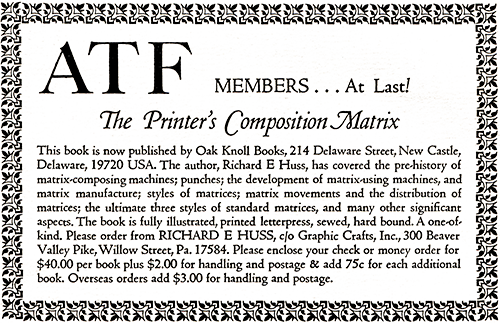
ATF members... at last! The Printer’s
Composition Matrix book is now published by Oak
Knoll Books, 214 Delaware Street, New Castle,
Delaware 19720 USA. The author, Richard E.
Huss, has covered the prehistory of
matrix-composing machines; punches; the
development of matrix-using machines; and
matrix manufacture, styles of matrices, matrix
ornaments and the distribution of matrices; the
ultimate three styles of standard matrices, and
many other significant matters. The book is
fully illustrated, printed letterpress, sewn,
and hardbound. A one-of-a-kind. Please order
from Richard E. Huss, c/o Graphic Crafts, Inc.,
300 Beaver Valley Pike, Willow Street, Pa.
17584. Please enclose your check or money order
for $40.00 per book plus $2.00 for handling and
postage & add 75¢ for each additional book.
Overseas orders add $3.00 for handling and
postage.
3
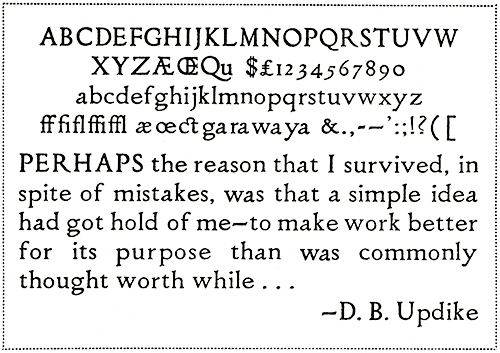
On this page you see a specimen of a truly rare
typeface called "Montallegro," designed in 1904
by Herbert P. Horne of London at the request of
Daniel B. Updike of the Merrymount Press. E. P.
Prince cut the punches.
Revival of this face has been brought about by
Wilbur Doctor of Kingston, R. I., who borrowed
original matrices from the Updike Printing
Collection at the Providence, R.I., Public
Library.
Casting was done by Pat Taylor at his Out of
Sorts Foundery at Larchmont, N.Y.
Wilbur reports that punches for the face also
are at the library, along with matrices and
punches for an equally rare “Merrymount” face
done for Updike by Bertram Goodhue, designer of
Cheltenham.
Montallegro was done in 14 point only. A note
on the sparse font held at the library
indicates all remaining cast type was destroyed
when the Updike Press was sold in 1949. Wilbur,
who has a collection of over 270 Merrymount
Press imprints plus much of its printed
ephemera, intends to retain the font for his
personal use only (and for use by the
Providence Library).
He indicates one matrix, a double-letter matrix
“va,” seemed to be missing from the font and,
though the punch might have been available, (“I
can’t be sure because the business ends of the
punches are covered with what looks like
sealing wax!”) no effort was made to have it
driven and a new matrix prepared.
A few accented characters also were not cast,
though matrices were available for such
characters.
Wilbur has issued a limited edition specimen
showing of Montallegro wherein he notes the
face was used to print only a restricted number
of items at the Updike shop between 1906 and
1914, and then not again until 1924. Thereafter
it received limited use.
Congratulations, Wilbur, on coordinating such a
noteworthy effort. Wonder if the font ever
would have seen the light of day once again had
it not been for this revival, instigated by a
hobbyist? OK, Wilbur. Now let’s Merrymount!3
Carl Schlesinger, who was largely responsible
for documentation on film of the last day of
hot metal at the New York Times, writes
indicating he has just completed conversion of
three English films to videocassette.
Titles are: Making Sure, a 27-minute tour of
the English Monotype factory demonstrating the
precision and pride which goes into building
Monotype machinery. Shows keyboarding and
casting.
Monotype: Handle with Care & Understanding, is
a 25-minute demonstration of Monotype mold
operation and precision.
Casting Good Type is a 35-minute examination of
poorly cast type which gives tips on how to
improve machine casting.
The three films, on one cassette, are available
from Schlesinger for $45 plus $2 shipping
(specify VHS or BETA). Write 45 Myrtle St.,
Rutherford, N.J. 07070.
3
Merely because we are interested in preserving
the older hot-metal processes is no excuse for
not making efforts to improve on the processes
or the machinery we use to cast our type.
A change that might even make a machine safer
to operate? Just tell us how!
Paul Duensing has devised an operating lever
for the Lanston Thompson typecaster which is so
simple one wonders why a similar device was not
incorporated into the original machine.
Installation is so easy you should never again
run your machine without it.
Installation might take you 20 minutes, and
you’ll save that much time the first time you
operate your machine. Ease of operation is one
factor, but even more important is your
protection from possible squirts.
Leaning down to the right front of a Thompson
to get it in gear, to stop it, or to turn the
machine over by hand always has given the
nightmares because I know from experience that
squirts (our British friends call them
splashes) often go in that very direction. But
leaning down was precisely what every Thompson
operator had to do—before Paul Duensing came
forth.
(The procedure outlined is for the
American-made machine. The British operating
mechanism surely can be modified also, but it
won’t go exactly as indicated below.)
You’ll need a simple hinge, screws for the
hinge, a piece of lumber about 30 inches long
(a 2×4 will do fine), a 3⁄8–24 machine screw
about 2½ inches long, and tools for drilling a
couple of holes in the wood and a couple of
holes to be threaded in the Thompson’s base.
Another very important item is a copper brace
used to hold half-inch copper pipe up to the
ceiling (from the side it looks like an Omega
[Ω]) and should be available at any hardware
store. You could use bent brass rule, but the
copper brace fits onto the machine with a quick
snap and works perfectly.
The copper piece is necessary to disable your
machine’s high-speed option. Surely you have
accidentally put your machine in high gear when
you wanted to stop the machine. Well, simply
open up the front of the machine and reach
inside adjacent to where the operating rod
comes out of the machine on the right, and snap
the copper piece around the operating rod
shaft. This serves as a stop, preventing you
from pulling the rod out to the right and thus,
disabling your high-speed option (who uses it
anyway?).
Now you can safely mount Paul’s device. Attach
the hinge on one end of the board and also
attach the hinge to the base of your Thompson
so the board (soon to become your new operating
lever) swivels right and left from its
floor-level mount. Next, secure the board to
the end of your operating lever. This is done
by drilling a hole in the board at the proper
alignment and then screwing it into the
existing threads in the handle with the 3/8–24
screw. A couple of washers might be used to
take the play out of the connection though it
does not have to be snug. These few steps
complete installation.
Now you can operate the machine from a standing
position. You can operate with your face up and
away from possible squirts, and you can
instantly stop or start just by moving the new
handle right or left.
Paul says he no longer uses the “stop
action”—he starts and stops the machine by hand
using the lever. I have tried it and feel it
works better than stop action because you are
in charge, rather than some fickle device which
often fails to work consistently.
But just as important, you can start and stop
with much greater precision—such as when you’re
making test casts to check alignment and
horizontal position.
The spring which holds the operating rod in the
“go” position should be disabled. A very light
leftward pressure on the new lever keeps it
running (I use a rubber band). I unhook the
band when I wish to stop the machine
intermittently rather than let it run
continuously.
Believe me, once you’ve attached this lever,
you’ll never detach it. You’ll never turn the
machine by hand, and you just might sleep with
fewer nightmares.
3
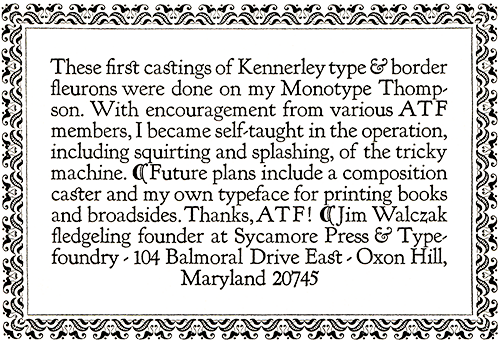
These first castings of Kennerley type & border
fleurons were done on my Monotype Thompson.
With encouragement from various ATF members, I
became self-taught in the operation, including
squirting and splashing, of the tricky machine.
(Future plans include a composition caster and
my own typeface for printing books and
broadsides. Thanks, ATF! (Jim Walczak
fledgeling founder at Sycamore Press &
Typefoundry - 104 Balmoral Drive East-Oxon
Hill, Maryland 20745
3
Is there a future for this effort so many of us
have put forth in saving hot metal typesetting
equipment and letterpress technology?
A few years ago, perhaps I could have been
accused of being “stuck” in the past with no
interest in the future, though I was making an
effort to keep my commercial shop current in
typesetting and other technology.
Now, however, being the owner of six different
computers, I can boast of being somewhat on top
of things, familiar with buzz words like
operating systems, baud rates, hex, and ASCII
as well as all the other jibberish one must
understand to interface word processors with
typesetting systems to “capture keystrokes.”
The effect technology is having on typesetting
is profound. By all predictions, soon
typesetting—which once was such a distinct
profession—soon will be no more than a function
of an office staff equipped with a computer and
a laser printer.
The PC World magazine I am looking at right now
has advertised a fairly nifty typesetting
package for the IBM Personal Computer for $150.
The Apple Macintosh is now used by several
newspapers as their only source of
typesetting—including the weekly newspaper
office of the Pocahontas Times at Marlinton,
W.Va., which was by general consensus, the last
hand-set weekly in the U.S. (Talk about a
technology time warp—picture a Mac sitting on
top of a stand full of type cases!)
I find my basement activities with the Monotype
to be very foreign to my daily role as a modern
printer. So much so that I find it increasingly
difficult to explain why the system ever
existed, for it seems such a waste of time and
effort when compared with modern laser printers
which don’t even rely on phototypesetting
paper. (At last, the image is being created and
put directly onto paper with none of those
bothersome intermediate steps involved in hot
metal or even cold type back in the days of
pasteup and phototypesetting.)
More than ever before, I fear that hot metal
technology will completely disappear because
the efforts of individuals—by themselves—are
mortal. This is painfully evident every time
another of our ATF associates passes away and
his or her shop is junked. Plainly, we have yet
to find a way of perpetuating ourselves, our
shops and—most importantly—the technology we
admire.
I find it difficult to explain why the system ever existed
As an employing printer who recognizes at least
a limited application for letterpress and hot
metal work, I find it “cost prohibitive” to
take the time myself and pay another person to
be my apprentice. General production work won’t
cover the investment.
Key ingredients to present-day letterpress work
are “appreciation, respect and dedication.” If
an apprentice were to be found with these
attributes, real progress could be made toward
perpetuating our craft. But an enthusiastic
individual soon would grow tired of working
“around” the schedule of an experienced
letterpress hobbyist who is busy with a job,
family, and other interests.
At least a partial solution is available at the
various colleges offering study in the “book
arts.” Yet many of these programs are woefully
inadequate when it comes to equipment and
knowledge of its proper use. Indeed, many times
only the worst habits are taught using the
lousiest equipment.
But where does the truly interested student go
to further an education—to really learn about
letterpress printing so that, in the future, he
or she might be able to carry on the grand
tradition by taking over shops of retiring
printers and pursuing notable projects?
I look at my shop, which would have exceeded
the very best commercial Monotype shop in the
1960s (indeed, it combines the equipment of at
least four such shops). And I look at equipment
owned by others in our organization and I get a
sinking feeling when I consider the fate of it
all.
The solution I envision is more hot air than
anything else at present, but with others
enthused by the idea, it may become a reality.
I propose an “Institute for the Traditional
Graphic Arts.” Such a facility would offer a
work-study environment to a restricted
enrollment of students already “turned on” to
instruction elsewhere. Its role would be the
production of limited editions as a team effort
between qualified instructors and students
having a flair for book design and a yearning
to learn letterpress. Hopefully, sufficient
income could be gained from the sale of their
products to offset some student expense.
Disciplines covered might include book design,
illustration techniques (including wood
engraving, photengraving, etc.), hand
composition, Monotype and/or Linotype,
imposition, presswork, bindery work (to include
case making, marbling, etc.). Indeed
independent student study could encompass other
disciplines such as type design, machine
operation, matrix making, papermaking, and the
list could go on and on.
The faculty could be developed from members of
our organization and retired professionals
interested in perpetuating the craft. I would
envision four- to six-month periods of intense
study and work, definitely outside the
structure of formal classes for credit.
Instead, they would be goal oriented with a
“forget the clock” intensity.
My career is nearing the juncture where I could
make the move to devote myself fully toward the
development of such a plan, and I know others
with similar interest. During the upcoming ATF
conference, I will be asking for ideas,
recommendations, funding suggestions, etc.,
from those attending. Perhaps with your support
we can take solid steps toward preserving our
craft into the next generation. The
hand-crafted book deserves to live into the
21st century and we should be the ones to
assure that it will.
3
The Imperial Type Metal Company of Philadelphia
no longer is in the business of selling type
metal, according to Jim Walczak, who contacted
the firm in this regard recently.
Existing accounts have been turned over to the
Pittsburgh Metal and Equipment Company, P.O.
Box 14, Jersey City, N.J., 07302. Contact
person at the firm is Werner Meier at
(201) 435-8747.
Meier has been in the business for 50 years, as
he told Jim, and never has known anyone to die
from fumes from a metal pot. Jim reports
Meier’s current prices at 75 cents per pound
for Monotype metal if picked up in person, and
he currently is paying 20 cents a pound for
metal dross.
Although Imperial did not provide details,
implications were that stiffening OSHA
requirements precipitated the company’s
departure from the graphics industry it once
served “exclusively.” As early as 1918,
Imperial was publishing manuals on care, use
and formulation of printers’ type metal.
3