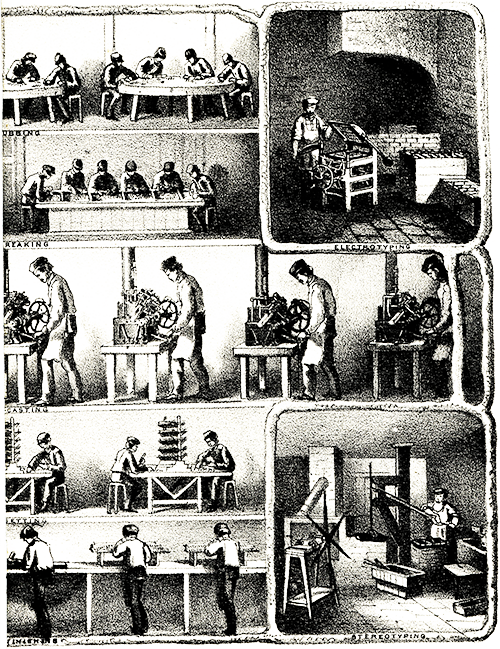
The illustration used on the cover of this
edition was meticulously copied (at 144%) from
an original lithograph done by Philadelphia
lithographers Duval & Hunter. The lithograph
was tipped into J. Luther Ringwalt's American
Encyclopaedia of Printing, published in 1871.
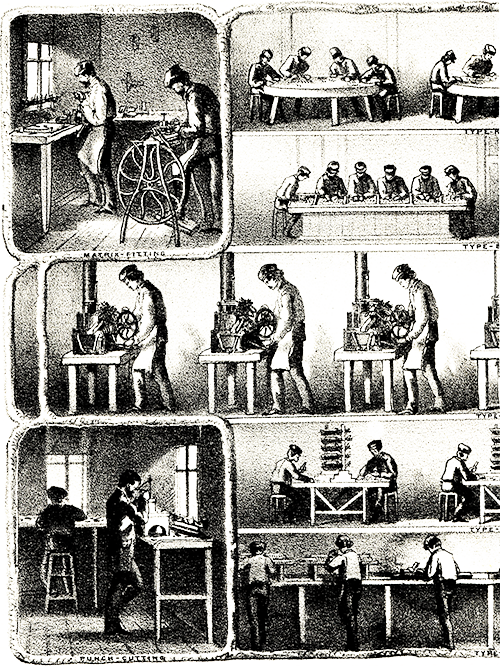
The complete type-making process shown in this
illustration is fully documented in the
Encyclopaedia, and includes punch cutting,
matrix making, casting, breaking, rubbing,
setting and finishing, along with the two
"duplicating" processes commonly found in a
foundry of that time: stereotyping and
electrotyping.
David Bruce's typecaster, patented March 17,
1838, is shown, with Ringwalt's commentary:
"Encouraged... by the vastly increased demand
for type, inventors were... induced to enter
the field, and among them none were so entirely
successful as David Bruce, the inventor of the
presently used type-casting machine; it being
used, either in part or wholly, throughout
Europe and America.
"Looking into a type-foundry now, and beholding
the rapidity and ease with which type is cast,
either turned by steam or hand, the mould
throwing out at an average rate of 100 types
per minute, contrasts strangely with
typefounding in 1832, when the casting was
performed by the hand process, and the highest
average speed of an expert workman was but
fifteen per minute."
A limited number of copies of this historic
lithograph have been reproduced on 100% rag
paper, unfolded, and may be obtained ($8.50
each, postpaid in the U. S.) by writing to the
editor. For the record, the black pressrun on
the front cover of this Newsletter is done by
offset. All else is lovingly impressed into the
sheet using the traditional letterpress
process. Long may she live!
Although precise details of Conference
speakers, meeting times, and other matters are
yet to be fixed, plans are moving ahead briskly
for the American Typecasting Fellowship’s sixth
biennial Conference, to be staged at Terra
Alta, West Virginia, July 14 through July 17,
1988.
Terra Alta was the scene of the first
Conference, organized ten years ago and
attended by 33 persons. Preliminary
registration for the 1988 Conference already
stands at 59 individuals, from 24 states,
Canada, West Germany, England and Austria.
Excitement has increased with the announcement
that Harry Wearn, chief hot metal instructor at
the Monotype School, Salfords, England, will be
with the Conference itself, and will conduct
technical sessions on the English Composition
Caster and the Supercaster following the
Conference, July 18-20.
Scene of the event will be Alpine Lake Resort
and Conference Center, which has offered a
fixed rate per room based on the length of
stay. Each room is equipped with two double
beds; if desired, persons can “team up” to
share a room and thus, halve the effective
rate. Rates will be $130.00 per room for the
three nights of the Conference itself, or
$255.00 per room for the six nights to include
both the Conference and technical sessions.
These rates average less than $44.00 per night.
Campground facilities are available, but only
for self-contained vehicles. There are no
dumping facilities nor are there water or
electrical hookups. No reservations will be
necessary for campers.
Rich Hopkins, Conference coordinator, notes
that Alpine Lake will provide quiet, restful
surroundings for the meeting. The facility,
although open to the public, is booked
“completely” for the ATF meeting, meaning there
will be no interruption from other meetings or
groups.
There will be no organized program for
non-participating spouses. However, Alpine Lake
will make available all facilities for an
additional fee. These include golf, tennis,
miniature golf, sauna, hot tubs, lake and/or
indoor swimming, boating, fishing, and ample
room to stretch out and wander in the woods.
Spouses are encouraged to join the Conference
group for all meals and social
sessions—non-participant fee will be $65.00 for
these activities.
Registration fee for the Conference itself will
be $125.00 per participant and includes all
meals during the three days. Virtually the only
added expense (other than lodging) will be
travel (unless one gets carried away at the
auction). Several sessions also are to be held
at the Hill & Dale Private Press and
Typefoundry, located about one mile from the
Alpine Lake facility; the Saturday night
banquet will be at the Wisp Ski Resort at Deep
Creek Lake, Md. Deep Creek Lake was recently
labeled one of the fastest-growing resort
locations in the East. The Wisp is
approximately 28 miles from Alpine Lake.
Fee for participants at the technical sessions
will be $60.00. This fee covers instruction
sessions all day Monday and Tuesday, and
Wednesday morning, as well as breakfast and
lunch each day.
A detailed map will be sent to all registrants
showing the best auto routes to Terra Alta. It
is a four-hour drive from Baltimore or
Washington, and is just over two hours by car
from Pittsburgh.
Those traveling by air most likely will make
connections through the Greater Pittsburgh
International Airport. There are several
commuter flights from Pittsburgh to Morgantown,
W.Va., daily via Allegheny Commuter Airlines.
Allegheny is a USAir affiliate; those traveling
via USAir can add the Morgantown flight for
about $20.00 round trip. (Flights from
Washington may connect to Morgantown via
Clarksburg, W.Va., but one would change
airlines.)
A fixed-wing 25-minute charter flight from
Greater Pitt to McHenry, Md. (the nearest
airport to Terra Alta) will be available if
there is necessary demand. Arrival and
departure must be coordinated so that arrival
in Pittsburgh is no later than 5 p.m. Thursday.
Departure from Pittsburgh is no earlier than
3 p.m. Wednesday, July 20. Space would be
available for five persons at $70.00 round
trip.
Each person traveling by air should forward
his/her itinerary to Rich Hopkins for travel
coordination; limousine service from Morgantown
to Terra Alta will be set up to meet each
flight Thursday, July 14; similar return
limousine service will be provided.
Accompanying this Newsletter are reservation
forms for Alpine Lake lodging and for the
Conference itself. In that lodging space is
limited, late registrants may face the dilemma
of not having confirmed reservations for
lodging. For this reason, early reservations
are very strongly advised.
3
The memory of our American Typecasting
Fellowship’s Conference at Indianapolis during
the summer of 1986 is beginning to fade in the
wake of 1988 Conference preparations. Yet that
meeting should be recalled as a strong mixture
of camaraderie and good atmosphere.
There is no simple way to describe the
environment provided at the pre-Conference
training sessions and the Friday-night visit,
all held at Dave Churchman’s boutique de
junque, which also serves as the home for the
Sterling Type Foundry. The 58 registered
attendees marveled at the vast collection of
printing paraphernalia, and virtually everyone
was moved to dicker with “Col. Dave” for some
treasure discovered in the midst of it all.
Items of equipment in various conditions—from
like-new to virtually useless—lined the aisles
adjacent to the typesetting area, which
featured two Thompson machines and an English
Supercaster, used in training sessions and for
demonstrations. A Giant Caster, a Material
Maker, two Universal Casters and other
Thompsons were in storage but available for
inspection.
Make-shift arrangements (a large plastic barrel
high above the equipment with hoses connected
to the two machines) provided water for cooling
the two casters actually used. At the start of
technical sessions, it was hot; during the
Conference it was hot and heavy thunderstorms
confronted the Friday-night cookout. And both
the water barrels and the ceiling leaked.
Yet adverse conditions did not hamper the
group’s enthusiasm. Indeed, it was not
altogether evident that many were even
conscious of the forces of nature outside.
Facilities at the Indianapolis Marriott,
headquarters for the event, were far more
gracious, yet the constant chatter of
participants was undaunted at both locations.
It is safely said that participants gained
equally as much from informal chatter as they
did during the formal sessions held both in
pre-Conference sessions and also the
Conference.
Bob Halbert of Tyler, Texas, who had originally
enrolled as a student in the Supercaster
sessions, graciously stepped in as the
instructor at the last minute. His experiences
in buying and operating Supercasters provided
very useful insight to those seeking increased
knowledge of the machine. Bob had many stories
to tell regarding the difficulty in obtaining
components, even when they are well-identified
and known to the potential buyer, because
sellers often are not aware of the need for
accuracy in these details.
Bill Riess, owner of the Quaker City Type
Foundry, which he described as a
third-generation company which grew from
workers at the old Keystone Type Foundry at
Philadelphia, handled construction and
instruction sessions on the Thompson caster. At
the Sterling Foundry, an early Thompson-made
machine was awaiting use at the demonstration,
but because its antique system for set-width
adjustment was foreign to Bill, he opted to
“construct” another caster for the demo, with
help from Pat Taylor, Dave Peat, Jim Walczak,
Dale Dippre, and many others.
The cooling arrangement demonstrated the need
for water pressure and adequate cooling
capabilities. The gravity-fed water supply was
insufficient to cool properly. Bill
demonstrated procedures for changing sets,
changing type sizes, and general operation.
Because the machine was virtually dismantled
and rebuilt during the pre-session, many had
opportunity to view detached components and
study their functioning.
During three nights at the Conference, Dave and
Mary Peat opened their home to visitors who
delighted in the famous Peat’s Press collection
of specimen books, presses, and antique type.
Dave’s restored Model T Ford truck provided
excursions through the neighborhood and back to
the hotel.
Formal Conference sessions included: A
discussion of “Typesetting Equipment, Past and
Present,” by Steve Saxe complete with slide
illustrations. Rich Hopkins presented a
home-prepared video explaining the processes of
“Casting a Font of Type,” oriented to the user,
not the typefounder.
John Schappler, formerly with Ludlow Typograph,
spoke on the long-forgotten concept of “Scale
in Type Design,” wherein proportions in letter
designs are significantly altered as their
point sizes increase.
Paul Duensing offered a discussion of “Matrix
Forms and Uses,” complete with a very detailed
handout providing technical specifications on
the most common type-casting matrices. Stan
Nelson’s presentation was on the subject of
“Driving and Fitting a Matrix,” a “how it’s
done” lecture complete with slides.
Dave Churchman offered a discussion of old
foundry pinmarks, complete with slides prepared
by Herb Harnish.
There were two panel discussions: one concerned
“What is Good Type,” moderated by Harold
Berliner; and another on “The Future of Our
Technology and Equipment,” moderated by Rich
Hopkins.
Unsung hero of the conference was Charlene
Churchman, Dave’s most tolerant wife, who (with
the help of her children) fearlessly completed
preparations for the Friday-night picnic in a
drenched tent beside the warehouse/foundry,
withstanding the thunder and lightning and
getting very wet in the process.
Many thanks to Bill Jackson for the original
lino cuts which illustrate this report.
One can only be amazed at the contrast between
what we experienced at the Oxford Conference in
England and Indianapolis. It is evidence enough
that our common bond of preserving the third
dimension of type surpasses all other
considerations. Dave Churchman, Dave Peat, and
all others who helped, are to be congratulated
on a very successful meeting.
3
There’s plenty of planning going on in
preparation for the 10th-anniversary Conference
in July. If you will be attending, you also
need to do preparation in three ways.
Keepsakes. One of the greatest joys of past
meetings has been the exchange of keepsakes and
we hope this Conference will be no exception.
Keepsakes have ranged from full-color posters
depicting the traditional hand mold and
Caslon’s specimen sheet to lengthy
letterpress-printed booklets and Xerox reprints
of pertinent documents.
Because many attendees travel by air, all are
encouraged to keep their keepsakes to a
finished size not to exceed 9×12 inches. A
packet for holding keepsakes will be made to
that size and we hope you will contribute a
significant piece for that distribution. At
present, it is anticipated attendance will be
about 65; a pressrun of 100 would cover every
contingency.
(All persons participating as speakers or
discussion coordinators are urged to prepare
their handouts to the 8½×11 size for three-ring
drilling and insertion in the Conference
manual. Again, 100 copies would cover every
need. Even if you are not a speaker, if you
have a technical information sheet to
contribute, perhaps this would be your best
format.)
Auction goodies. Another featured event at past
ATF meetings has been an auction. Die cases of
matrices, boxes of display mats, molds, fonts
of Linotype matrices, Ludlow components, or
fonts of new or used type all would be welcome
at the auction. Individuals will be given ample
opportunity to “tailgate” their wares before
the auction. Good ’ole Col. Dave Churchman has
agreed to serve as auctioneer once again.
Proceeds can be retained by the owner or
donated in part or in full toward helping
finance future meetings.
Start a pile in the corner of your shop now and
be sure to bring it for the auction.
Show and tell. Once again, we’ll have a time
period set aside for “show and tell.” Each
person attending will be encouraged to bring
either a sample of a printing or type making
project, or a 35mm photo of his/her shop. Each
will be encouraged to take a few minutes to
discuss these items.
As can be seen, individual participation is a
key part of every Conference. Be sure to come
prepared to do your part in making the 1988
Conference a resounding success!
3
Warm weather is likely in July—at least in most
of the United States. But old-timers up in the
West Virginia hills at Terra Alta speak with
pride of having snow showers during their
Fourth of July celebrations several years ago.
Snow is not likely. But extremely warm weather
is not likely either. In fact, Alpine Lake
Lodge doesn’t even have air-conditioning
because temperatures in excess of 80 degrees
are quite unusual.
That means one thing to persons packing for the
ATF Conference—it would be a good idea to bring
along a sweater or light jacket, for we will be
out in the evenings and sometimes it gets quite
chilly, dipping into the low 40’s.
While on the subject of dress, it should be
mentioned that informality is the norm at ATF
Conferences. Bring comfortable clothing. It
might be a good idea to bring work clothes for
the times when we will be working with
machinery.
Only one session might be labeled even remotely
formal, and that will be the Saturday night
banquet. Sports jackets for the men and slacks
or a dress for the women might be in order that
evening, but no one will dictate what another
might wear.
3
There are several things about Mac McGrew’s
book, American Metal Typefaces of the Twentieth
Century, which—if not unique—are rather rare.
It has been issued in a “preliminary edition”
with typed text and perfect binding in the
expectation that the author will receive
additions and corrections before type is set
and a final, hardbound edition is issued. The
idea of passing around a technical manuscript
to colleagues is almost standard among
scientists and other scholars, but is rarely
encountered in a field such as typography.
Another feature is the scope of this work: a
comprehensive compilation of every metal type
design or those cut in matrix form for either
single type or linecasting production during
this century in America. Whenever possible, a
specimen in 24 point illustrates the design.
The text not only identifies the designer,
foundry, and date of issue, but also the range
of sizes and closely similar designs by other
foundries.
There is an extensive appendix of punchcutters,
matrix engravers, designers, and numerical
lists of American Type Founders, Monotype, and
Ludlow series numbers. Finally, the author
gives a very useful list of common pseudonyms
(the names under which essentially identical
designs have been issued by others).
Mac McGrew’s encyclopedic knowledge of type
history is not to be duplicated in this country
and it is logical that he should be the author
of this work. Mac has built a monumental
contribution to the history of type taxonomy.
We—and future scholars for many years to
come—are greatly in his debt.
The preliminary edition, 8½×11 inches, 395
pages, is available from Myriade Press, New
Rochelle, N.Y. for $36.66 including postage in
the United States.
3
Perhaps you have come in contact with the
American Typecasting Fellowship but you don’t
understand precisely what it is or how it
operates. Much of what is printed here was
written by Paul Hayden Duensing and printed by
E. H. “Pat” Taylor soon after the 1980 ATF
meeting. It is reprinted here to document the
group’s origin. Reprinting the applauded
BY-LAWS will give a better understanding of the
“non-organization” concept which has guided ATF
since its founding.
Avocational typecasting in western society has
experienced a marked increase in activity since
1971. With the rapid expansion of photographic
and electronic typographic composition systems,
traditional hot-metal typesetting decreased in
commercial popularity. As hot-metal equipment
became available at attractive prices, there
was intense interest in its acquisition by both
private press proprietors and by proponents of
fine edition book printing via traditional
methods.
There was a strong need for an organization
within which individuals could share
information, exchange ideas or equipment, and
find support or solutions to technical problems
in the traditional processes. In early 1978,
Prof. Richard Hopkins invited interested
individuals to congregate at Terra Alta, West
Virginia, for the First National Conference on
Hot Metal Typesetting and Design. The
Conference took place on July 17-19, 1978, and
was attended by 33 enthusiastic amateurs. The
formal program consisted of presentations on
typecasting, using both hand-molds and
machines, matrix-making, the economics of
amateur typecasting, historic overviews of
letterform development and typefounding
techniques, and similar matters. Informal
discussions supplemented presentations and
attendees reported the Conference to be a
source of great satisfaction to them.
Predicated upon the success of the first
Conference, a second meeting was held in 1980
in New Rochelle, New York, for which Mr. E. H.
“Pat” Taylor acted as host. In addition to a
significant number of first-time attendees,
representatives of Mergenthaler Linotype,
Monotype Corporation Ltd., and Hartzell
Machine Works, Inc., were present. Several
papers were presented from the first
Conference, but new topics and activities also
took place, including a field trip to the
American Type Founders plant at Elizabeth,
New Jersey.
In 1982, ATF joined forces with the British
Printing Historical Society at a combined
meeting at Oxford University. Theme of the
Conference was “Typefounding, Past and Future,”
and helped expand interest in ATF’s fledgling
efforts to an international field. Messrs. John
Dreyfus, James Mosley, and Michael Turner
served as the British organizing committee with
United States liaison being provided by Mr.
Stan Nelson.
Two years later, in 1984, Mr. Nelson and Dr.
Elizabeth Harris invited the Fellowship to join
them at the Smithsonian Institution in
Washington, D.C., for the group’s fourth
meeting. Again both practical demonstrations
and historic papers provided a good mix of
subject material and visits were made both to
the Smithsonian and to Mr. Nelson’s authentic
re-creation of an ancient pre-machine hand
foundry in his basement at Columbia, Maryland.
ATF joined Mr. Dave Churchman and Mr. Dave
Peat, proprietors of the Sterling Type Foundry,
for the next meeting in 1986, reported
elsewhere in this Newsletter.
At the first Conference a consensus established
the title of the society, coincident with which
was the adoption of the By-Laws, which read as
follows:
ARTICLE I
The name of this Association is the
American Typecasting Fellowship.
ARTICLE II
There will be no officers
of this Association.
ARTICLE III
There will be two committees:
a meeting committee and
a communications committee.
ARTICLE IV
There will be no dues and the committees
are urged to use their imagination in
raising what little money they need
for expenses.
ARTICLE V
There will be no other By-Laws.
Strict observation of these provisions has been
maintained since the organization’s inception.
Shortly after the first Conference, Prof.
Hopkins generously undertook the editing and
printing the Newsletter, which is issued
“occasionally.” It has been a pivotal medium of
communication and technical information in its
subject field; indeed, the issue subsequent to
the American Type Founders plant visit included
a stunning pictorial insert of duotone
photographs of the foundry of great interest
and archival value (copies still available at
$3.00 each).
There are no requirements for formal
membership, other than evidence of interest,
attendance at the occasional meetings, and
support through a modest contribution to the
Newsletter. There are no exclusionary
precedents to membership and hot-metal
linecasting or other type-producing and
typesetting methods are equally welcome as
bases for joining with the Fellowship in its
attempt to preserve, conserve, extend and
delight in the history and practice of the
production of typographic printing surfaces.
3
In the final days of the Stempel Type Foundry,
the talented Dutch photographer, Ronald
Schmets, was given the assignment of carefully
documenting each step of every major process in
the founding of metal types.
vom Schriftgiessen (on typefounding) is
convincing evidence of his success. His
excellent photos are accompanied by a
non-technical essay on the methods employed in
making type by Prof. Walter Wilkes. Sized
12 × 9 inches, 108 pages, black-and-white, the
book is available in the U. S. with a
supplemental English translation for $60.00
postpaid from Richard Hopkins, Box 263, Terra
Alta, W. Va. 26764.
Following the photos is a chronology of
highpoints in the firm’s history from 1914
until closing in 1986, with a long list of the
matrices in its possession at that time.
Typophiles will be grateful for the appearance
of this book and the farsightedness of Prof.
Wilkes and Dr. Walter Greisner, Stempel
president, who were responsible for its
production.
3
James A. Parrish has been involved with routine
and exceptional repair and maintenance of the
Ludlow Typograph since the early 1950’s. Still
today he offers machine service to numerous
customers throughout his region. He has
prepared the copyrighted article below to give
advice to the novice on what to look for when
buying a Ludlow machine. Parrish is author of
THE LUDLOW TROUBLE-SHOOTER’S GUIDE, 129 pages
fully illustrated, spiral bound, $65.00.
Richard L. Hopkins
It is very difficult in short form to advise a
potential seller or purchaser of Ludlow
equipment of all the important factors to
consider. Price generally is the most important
consideration. It also is the most difficult
factor to establish.
A good Ludlow can be bought from an anxious
seller for $300 to $750. Best buys are from
large companies which consider the equipment
surplus and want to be rid of it.
Most of us have a tendency to think only of the
machine, not realizing it is a “system” and its
market value is better established by what is
with the machine. These include:
■ Typeface selection. Matrices are a most
important consideration as to cost and use.
While the machine may be available at an
attractive price, purchase may not be wise if
accompanying mats are not proper for your
intended use. Most small fonts (6 through 18
point) are in demand and generally sell on the
open market for $300 or more if in good
condition. Larger fonts can be found for $35 to
$150 each.
■ Cleaning kit. This is an absolute requirement
for machine operation. One should avoid buying
from a seller who plans to continue using other
Ludlow machines. He may have several machines
but only one cleaning kit; a new kit costs
several hundred dollars.
■ Spare parts. Replacement parts and supplies
are quite expensive. The seller may place
little value on extra parts, but a well-stocked
parts drawer represents tremendous value to the
buyer.
■ The machine. Don’t consider buying a machine
without prior inspection. This should include
complete electrical tests of each heater and
control component, physical examination of each
cam, lever and gear and—if at all
possible—operation of the machine under power.
■ Mold and cooling system. Turn on the motor
and observe the water flow. On the Model L,
this can be observed by lifting the lid on the
rear of the water tank. The Model M requires
loosening of a fitting at the mold before
turning the motor on to insure flow. Cast a
line and listen for a hiss or sizzle when the
mouthpiece contacts the mold. This would
indicate a water leak on the bottom of the mold
where its two components join.
Cast three or four lines on re-cast. Lift the
top and feel the surface of the mold. Both left
and right sides of the mold should be equally
cool. If the left side remains hot, a water
flow problem is indicated. If the mold is not
seriously damaged otherwise, this can be
repaired for about $150.
■ Plunger. Observe its movement and its sound
when a cast is made. It should drop about
¾ inch and stop with a definite “thump.” If it
seems “mushy” and drops further, serious wear
is indicated; replacement will cost about $175.
■ Mouthpiece. With the motor turned off,
thoroughly clean the top surface of the
mouthpiece with a wire brush. The vents
(horizontal indentations on each side of the
slot) should be clearly defined. These vents
allow air to escape before any molten metal can
be pumped. If the mouthpiece is worn, the vents
do not function in direct proportion to wear.
Replacement will cost $335. Used mouthpieces
are available for $50 and up, but check before
purchasing. Inspect for vent definition.
Measure the top T-head. It should be at least
.315. If less than .310, the machine cannot be
adjusted to compensate.
■ Machine models. Most comments relate to
models L and M. I don’t have enough experience
with the newer Model N, introduced just a few
years ago. But my initial reaction to this
model is positive. Price is about $8,000 for
the Model N.
model l: Slanted table top, five-gallon water
tank on lower left end of machine frame. Single
crucible thermostat. Rheostat control for
throat/mouthpiece located above electrical
panel on the rear of machine. Plunger has
single spring. Original paint: dark blue-gray.
Best buy: serial number 12900 and up. Good buy:
10200 to 12300.
Very old machines have square electrical panel
box; electrical components almost impossible to
replace. Most have a “hole-type” mouthpiece
similar to the Linotype and cannot be converted
to the superior slotted type with funnel.
Manufactured prior to 1932 with serial number
under 3200.
Later models (serial numbers 3300 to 10100)
have a slotted mouthpiece and a rectangular
(vertical) electrical panel box. The panel
cover has a rounded top and top corners. This
panel includes two black resistors located
above the fuses. These control the on/off
position of the heavy-duty magnetic relay
(crucible heat) located at the top of the panel
and are, in turn, controlled by the thermostat.
All electrical components are hard to get and
very expensive.
Latest models, serial numbers 12300 and up,
have simplified electrical system in a
rectangular panel box. The panel cover has
squared corners.
Note: Any serial number preceded by a zero
indicates the machine has been factory rebuilt.
This could mean a machine with a low serial
number has been updated and may still be a good
buy.
model m: Flat (level) table top with one or two
lock-down knobs, self-contained refrigerated
2.5-gallon water cooler separate from machine.
Dual thermostat controls two magnetic relays
located in the electrical panel. Two plunger
springs. Original paint: light mottled gray.
Best buy: serial numbers 16000–16500, made from
1965 to 1966. Has rear table latch. Good buy:
serial numbers 16600 to 17900, made from 1966
to 1968. Has no rear table latch.
Poor buy: serial numbers 18000 and up. These
machines do not have a crucible spring (a large
heavy-duty spring at the front of the crucible
above the cam rollers). This design flaw
results in seriously worn cams and rapid
deterioration of the machine in general. If
wear has not been excessive, the missing spring
can be added for about $50, thus eliminating
the flaw.
■ Electrical configuration. Most Ludlow
machines were wired for 240-volt service. If
installed on a 208-volt service, they will
require nearly twice as much time to heat up
and the controls will deteriorate quickly. A
normal melt-out time is 45 minutes.
■ Gas pots. These are relatively rare. If a gas
machine has been well-maintained, it is
probably a good buy at a practical price.
Gas-fired machines can be difficult to operate
but are more trouble-free and less expensive to
maintain. Be sure your office is correct for
the gas you will be using. Most often commercial
areas had natural gas; it’s a simple procedure
to change an orifice to enable the use of LP
gas.
Further information is available from the
writer at 7582 Southwest Hunziker No. 2,
Tigard, Oregon 97223. Phone number is
(503) 639-6901 in evenings only.
3
There was really something unique in the
so-called type houses of yesteryear—“studios”
which set type primarily for the advertising
industry. Often they were referred to as
advertising typographers.
Edwin H. Stuart, Inc., was one such company in
Pittsburgh. It probably was the premier type
house in that city and was built largely on the
reputation of its founder, Edwin H. Stuart. I
never met him, but I did deal with his daughter
back when I first entered the trade, buying
typesetting for the Gravely Division of
Studebaker (remember them?), where I worked.
The firm was built on having answers, not
excuses. And turnaround was fantastic. Their
devotion to the craft could be better
understood by reading what surely was a classic
in the 1950’s and before, Stuart’s concise but
most informative book simply titled Advertising
Production.
I learned so much from the book I adopted it as
a text for my ad production classes when I
taught at West Virginia University in the
1960’s.
Perhaps only a memory of the Stuart firm exists
today. But its Monotype holdings are preserved
in my shop and recently I was reminded of their
concern for being ready to respond to customer
requests. I pulled from my shelf a font of flat
mats for 10-point Cooper Oldstyle (the font
never was made as cellular matrices). Can you
imagine a company willing to hand-set 10 point
when it had a shop full of Monotypes and Linos?
Well, some ad customer wanted the face, so they
put it in. And apparently the last time the
font was cast, the operator determined five
mats were defective. When I opened the box,
neatly wrapped in a faded green Lanston
Monotype shop order form were five brand-new
matrices ordered to replace the defective mats.
The order was dated Feb. 13, 1947.
The defective mats would have worked—I tried
them. But they wanted nothing but first-class
equipment in their shop, so the new mats were
put in stock to be ready when needed. For me,
using the mats for the first time 40 years
later, I sure did appreciate the concern for
such details.
3
As so-called amateur typecasters resurrect old
machines and try to get type out of them,
surely a recurring thought with many of us is
“how did the old-time pros run these
machines—how concerned were they with what was
being turned out and how good were they?”
We tend these days to cling to the idea that in
old days all were true craftsmen and
professionals, but I know for a fact that all
of them were not. I have banged-up mat cases,
matrices, and other paraphernalia to attest to
the fact that often casters were operated with
virtual disregard for their bad adjustments—mat
cases dragging on centering pins, jaw tops out
of timing, and so forth. The ripping sounds
which surely would have resulted would cause
most of us to shut down immediately, but that
must not have been the case in many production
situations “back then.”
What leads me to this conclusion is the
Supercaster I obtained from the U.S. Government
Printing Office. The serial number would
indicate it was acquired about 1973—virtually a
new machine. The first time I saw it, there was
still type in the galley and the pot was full
of metal—like it had been used the shift before
and just shut down.
When I got it to my shop, I discovered a matrix
was still in the holder, so when I hooked it
up, I was sure I would be making great type
immediately. After all, nothing had been
changed and surely not too much time had
elapsed between my first use of the machine and
its last use at the GPO.
Was I surprised! I had never run a Supercaster
before, but my experience with other machines
revealed the nozzle terribly mis-aligned, the
pump out of timing and with inadequate
pressure, and even the head (or “bridge”) was
screwed up. I spent over five hours making
adjustments before I got good type (excellent
type!) out of the caster. How anyone could have
operated it under those conditions was beyond
me, but then, maybe I care a lot more about the
machine and its product than the last operator.
That leads me to the observation that we all
probably underrate ourselves and our abilities.
We are obsessed with typecasting. We are
obsessed with type. And thus, we probably care
a whole lot more about what we’re making than
the guys who were just punching time clocks and
fighting production schedules. So, fellow type
nut, pause for a second and pat yourself on the
back. Perhaps you’re a better representation of
old-time craftsmanship than the old-time
craftsmen themselves!
3
I confess that I have been party to consciously
humiliating and then abandoning four Monotypes,
leaving them “bleeding” and utterly without
hope in a sun-drenched trash collection area.
I heard stories before. On one occasion, I even
witnessed the absolute distress unfeeling folks
had imposed on Monotype casters. But actually
having been a party to such vulgarity always
will haunt me.
The situation occurred at the U. S. Government
Printing Office in Washington. In its infinite
wisdom, the GPO had lotted up no fewer than six
separate casters as a single line item on a
complicated sale bill. Either I bid on all of
them or none of them. There was no alternative.
Having ten casters in my basement already, I
was certain I could not adopt six more
machines. But I did want another Supercaster
and I knew I never again would have a chance to
acquire one—not in the U.S. anyway. So I
submitted my bid.
These six machines were the absolute last of
the hundreds of Monotype machines which once
graced the GPO. Indeed, the GPO once had the
largest Monotype installation in the world and
the record probably still is unsurpassed.
Much to my surprise, I won the bid. Before I
went to claim my reward, I found that the GPO
had a formal procedure for successful bidders
to abandon equipment—once they had paid for it.
So there they were—six machines all lined up in
a row. The man who’d been assigned to help me
load my equipment complained: “Your truck’s not
big enough for all these machines.” I confessed
that I was going to abandon four of them. He
protested: “They look like damn good machines.
Why don’t you take them all?”
He was only making it tougher on my sad heart.
An old 15×15 used only for sorts, a filthy
Giant Caster, and two Material Makers were to
be left behind. I could only take the English
15×17 and the Supercaster—indeed, the 15×17
would be a surprise to my wife, who’d been
assured I was getting “only one more machine,
please.”
“What the hell you want me to do with these
others,” he asked. “I don’t know,” I replied,
indicating that he surely had some place to put
them for the junk men to pick up. He sighed,
conferred with a supervisor, and I heard the
word “dumpster.” Then I followed his forklift
as he carried away the first caster. I couldn’t
believe it. Up in the air it went. Then he went
through bouncing action trying to dislodge it.
Oil was splattering everywhere. Finally, it
crashed into the steel container below. My
heart sank.
The next three machines wouldn’t fit, so he
piled them, very ungracefully, next to the
dumpster. As he pulled away after the last
machine was on my truck, I glanced back to
observe the distressed positions of the four
casters, their oozing oil, and realized that
though they had served well, they never again
would cast anything. I was torn apart, but took
refuge in the thought that had I not been
around, all six of the machines would have met
the same fate.
3
Interest in the preservation of traditional
graphic arts is not limited to the U.S.A. I
would guess interested people exist in many
countries. So I suggest you put the word
“International” in front of the “Institute” you
propose. I see no reason why foreign
corporations cannot be approached for funds and
support...
Juzo Takaoka
33-10 Nishigokencho
Shinjuku-ku, Tokyo 162 Japan
Your article on perpetuating hot metal is most
riveting. You bring special perspective having
feet in both worlds. As one of the few around
who is still earning a living printing almost
exclusively by letterpress, I am constantly
asking myself if it makes sense to continue...
Darrell Hyder
23 High Street
North Brookfield, Mass. 01535
I did the linoleum cut (reproduced on page 6).
The illustration is a loose parody of a 1499
“Dance of Death” woodcut. My whole shop is an
adjunct of my graphic design and illustration
business, and consists of a few fonts of ATF
Garamond and a Chase Adapter Press (blueprints
gotten from J. Ben Lieberman).
Michael Silberman
235 West End Avenue
New York, N.Y. 10023
I really appreciate your talking with me on the
phone. Adjusting the Thompson choker as you
suggested seemed to work. Sometimes just
talking to someone with experience can save
hours of reading the manual, which seems poorly
arranged though certainly thorough. Actually,
every time I work on the Thompson, I discover
something new that I understand, but I also
come up with several more questions.
We really enjoyed the last meeting held in
Indianapolis so much we have decided to travel
to the next one being held in the wilds of West
Virginia. Send us all the info so we can plan
on attending...
Michael & Helen Desjardins
87 Berkshire Avenue
Toronto, Ontario M4M 2Z6
Now that I am 64, retired and single, I think I
shall go ahead and start a small-scale printing
operation... I have an Intertype that will be
able to start setting slugs as soon as it’s on
gas and 220. I just have to quit my
procrastinating...
Ralph Ahlgrem
3335 Becerra Way
Sacramento, Calif. 95821
The cover itself (Newsletter 10) was
fascinating—a work of technical skill and art.
Far more than reportorial, I read and learned
from every article...
Carl Darrow
5602 Newington Road
Bethesda, Md. 20816
The closest I’ve come to typefounding is to
acquire four sizes of Intertype Garamond. My
house/shop building project prevents me from
spending any time or money acquiring a Thompson
or Intertype, but someday...
Paul W. Bohne
87 LaSenda Drive
Alta Loma, Calif. 91701
The ATF Newsletter gives me more pleasure per
page than any publication I receive. I read and
re-read. It’s very unselfish of you to put so
much time into this when I know how busy you
are...
Carroll Coleman
111 Lusk Avenue
Iowa City, Iowa 52240
Your publication is quite beautiful. I am
running a Monophoto typesetter (one of three
remaining in operation in the U.S.) but am also
interested in hot metal...
Stephen Pollard
1021 Center Street
Santa Cruz, Calif. 95060
I am looking for someone who can cast from the
old foundry-style mats and someone who can
replace some of the mats which were lost in the
last 80 years from a proprietary font in my
possession. I am not interested in giving the
mats away, nor am I adverse to an arrangement
that might be mutually beneficial to a caster
and myself. Interested?
Clifford L. Helbert
Post Office Box 97
Milwaukee, Wisc. 53201
I always look forward to the ATF Newsletter, a
bright spot in an otherwise bleak letterpress
world. Best regards...
Among the many fascinating topics to be covered
at the forthcoming ATF Conference will be a
presentation by Carl Schlesinger on Ottmar
Mergenthaler’s “secret” mats. Carl has indulged
in extensive research that corroborates the
notion that Mergenthaler electrotyped his first
matrices.
Carl also is completing work on producing a
hardcover book to contain complete reproduction
of Mergenthaler’s rare biography/autobiography,
along with illustrations from Mergenthaler’s
own machine-shop catalog, reproduction of the
first article on the new Linotype machine, and
answers to a 100-year-old mystery created by
first use of the Linotype.
The New York Tribune “hid” Linotype slugs
amongst all else which was hand-set, and
challenged readers to distinguish the two.
Reproduction of that page will accompany Carl’s
book, along with his answers to the mystery.
You may reserve an advance copy by sending a
check for $26 made out to “Mergenthaler Book
Reserve”; mail to Carl Schlesinger, 39 Myrtle
Street, Rutherford, N. J. 07070.
3
19th Century Industrial Trade Museum Envisioned by Writer from Staten Island
Richard L. Hopkins
Francis J. Cardamone is in the preliminary
stages of developing a museum devoted to the
preservation, restoration and operation of
various industrial trade machinery of the late
19th and early 20th centuries.
“While it will include many machines, its
nucleus will be printing, bookbinding, and
typographic equipment,” he explains.
Typesetting equipment in his possession
includes a Monotype keyboard and caster, a
Thompson, and a Material Maker. If you can
offer technical assistance, contact him at the
Iron Age Machine Museum, 160 Canal Street,
Staten Island, N.Y. 10304. Phone (212)
448-3732.
3
A constant question posed between participants
at the Indianapolis Conference was “what makes
us want to fiddle with typecasting equipment,
anyway?”
Bob Halbert alluded to folks in his area
calling him the crazy guy who loves hot metal
equipment, and implied that several of the same
persuasion in the same place at the same time
should be leery of the possibility that they
all might be “put away.”
On the other hand, I got my batteries fully
charged and immediately went home, went to work
on my Material Maker and succeeded in getting
it to operate.
There’s a common bond of “mechanical aptitude”
among those who like to cast type. Monotypes
and Linotypes provide great fulfillment for
such inclinations by constantly presenting
“problems” that are solved with logic and
perseverance.
When working with casting equipment, it’s a
one-on-one situation. The devices are totally
mechanical and if one is adamant about finding
solutions, eventually the old machines can be
made to work. At times one must make
replacement parts, and there is always a lot
of adjusting being done. But you can get the
machines to work if you stick with them long
enough!
Don’t get me wrong. I would have given up and
said “it can’t be done” on more than one
occasion had I not known the darned caster did,
at one time, really work!
Another big bonus for working with the
machines: you end up with tangible evidence of
your success and you can use the product for
years to come.
When you shut down a computer, you may have a
hard-copy printout, but waving a floppy disk at
someone and saying, “I did this all by myself!”
provides evidence of nothing. But a galley of
type off a typecaster—well, that’s visible
accomplishment!
Typecasting adds a second exciting dimension of
“creativity” to the process of personal
printing. You first create by making type,
dingbats, borders and strip rules, and then you
create again when you assemble these items into
forms for printing books or other ephemera.
The process is every bit as much an art as the
artist with his/her canvas, or a sculptor with
his/her clay. There is a tremendous sense of
personal satisfaction from the whole process.
What more could one hope for from a hobby—or
a profession?
3
Perhaps none among us carries the banner of
modern-day typecasting with greater enthusiasm
than Harold Berliner, 224 Main Street, Nevada
City, Calif. 95959.
Harold recently was featured in an article in
The Sacramento Bee wherein he confessed to a
life-long fascination with fine letterpress
printing and printing paraphernalia. He also
admitted he carried on his legal profession
essentially to better support his lust for
printing and typecasting.
His typefoundry aggressively promotes its
Monotype composition services for fine
letterpress printers, offering an excellent
variety of fine English and American faces. In
addition to stocking fonts, the foundry offers
an extensive variety of ornaments and borders,
several from electrodeposited mats made at the
foundry. Periodic promotional pieces are always
well-designed, printed by letterpress, and
newsy in nature.
Berliner is among the very few typefounders
offering the Monotype 272 system which can
convert computer floppy disk files into ribbons
for driving Monotype Composition Casters.
Should you not be among those privileged to
receive his mailings, you should contact the
foundry immediately.
3
The National Aeronautic and Space
Administration (NASA) was making a genuine
effort to afford opportunity for space
experimentation to widely varied disciplines
aboard its miraculous space shuttles before the
Challenger disaster.
You heard of kids sending their ant colonies
into space, and other such seemingly pointless
experiments. Well, I had an idea for an
experiment which, though not too relevant to
the 1980’s, would nevertheless fascinate
typecasting enthusiasts no end.
After casting type over the past dozen years
using four or five different machines, I have
come to realize the biggest problem facing any
typecaster is the problem of getting rid of the
air that’s in the mold cavity just prior to
casting. With the Monotype, the problem is
compounded somewhat because air has become
compressed even before metal enters the mold
because the pump body also contains air which
must be forced into the mold ahead of the
molten type metal.
My NASA experiment? Let’s launch a Monotype and
send it outside the craft to float in a total
vacuum. Imagine—no air in the mold at all.
There’d be nothing to resist the movement of
metal throughout the mold cavity. Imagine 100
per cent solid type. That’s been the dream of
every typecaster since Gutenberg!
Of course there would be other problems — we’d
need a lid on the pot to keep the type metal
from floating off into space. Here on earth we
have to be alert to avoid squirts. Up there, we
might have to watch out for floating globs of
molten metal. With no air to cool it, it might
remain molten longer—a frightening thought.
And I wonder how well a guy could manipulate
tweezers in a spacesuit?
Too bad typesetting has moved to computers,
relegating hot metal typesetting to museums
alongside the Wright brothers’ flying machine.
Nevertheless, it fascinates this frustrated
typecaster to think of the possibilities of
making type in space. I trust the idea would be
eagerly endorsed by ATF.
3
The many and varied ways individuals use their
collections of antique printing equipment—often
in commercial endeavors—is, indeed, amazing.
A most recent report is from a correspondent in
California whose business is restoring early
motion picture films, especially old silent
movies.
He has an extensive collection of old ATF
faces, mostly made before 1920, along with a
10x15 platen. These fonts are used to precisely
match old film titles and captions which have
been damaged and need replacement. Because of
his type collection, generally he is able to
match originals in every detail.
Presently, he has need of Artcraft, which was
available in Monotype matrices as well as from
American Type Founders. Anyone with fonts or
matrices should contact Rich Hopkins
(Newsletter editor).
3
Way back in 1916, before the Lanston Monotype
Company took over the Thompson Machine Company
of Chicago, a little manual was published
entitled Instructions to Operators of the
Thompson Typesetter.
It was sized 4⅜ inches for handy keeping in the
operator’s vest pocket, and contained
information on proper lubrication, changing
molds, and general operation.
This rare, early booklet has been reproduced
“for the Fellowship” by David C. Churchman and
now is available at $6.75 per copy. Dave asks
that you make your check payable to the
American Typecasting Fellowship. His address is
P.O. Box 50234 Indianapolis, Indiana 46250.
3
METAL for the taking. If you are in my area, I
have 500 pounds of foundry and Monotype metal
properly sorted available at scrap prices. I
don’t want to box or ship it so come and get
it. Dave Norton, 876 Westmoreland Ave.,
Syracuse, N. Y. 15210. Phone (315) 474-8383.
AMERICAN Monotype display mats 50 cents a mat
in fonts. Send SASE for list and information.
Robert Halbert, P.O. Box 848, Tyler, Tex.
75710.
FOR SALE: Reprints of Denis Diderot’s
Encyclopedia pages on typefounding. Eight
plates plus original French and English
translation. $20.00 postpaid. Also reprint of
1848 Bruce Specimen Book, 32 pages, $4.00
postpaid. D. W. Peat, 1225 Carroll White Dr.,
Indianapolis, Ind. 46219.
VICTORIAN type designs again available. Glyptic
and Glyptic Shaded, 24 point size. 12A Glyptic
$41.50 or 6A pony font $26.50. Glyptic Shaded
12A $51.50 or 6A pony font $31.50. UPS
postpaid. West Coast add $1 postage. Sterling
Type Foundry, Box 50234, Indianapolis, Ind.
46250.
LUDLOW and Linotype service. Machine repairs,
restoration, rigging. Patrick Burns. Call (717)
328-3092.
SOS LINOTYPE SERVICE. David E. Seat, Nashville,
Tenn. Used and rebuilt equipment sales and
service almost anywhere in or out of the
country. (800) 367-3804.
LUDLOW—routine and exceptional repair and
maintenance. Factory-trained. James A. Parrish,
Tigard, Oregon. (503) 639-6901.
WANTED—Intertype auxiliary composing stick
attachment for hand-setting linecasting display
matrices. Please advise of condition, price,
etc. Fred C. Williams, 25667 Heather Court,
Hayward, Calif. 94545. Call (415) 782-3674.
PANTOGRAPH PUNCHCUTTER. Seeking to buy. C. D.
Fitzharding-Baliey, 15 Dutton Street,
Bankstown, N.S.W. 2200, Australia.
Being considered as an article for a future
issue of the ATF Newsletter will be the matter
of typefounding and patriotism in the World War
II era. If you have references or cuts which
would help with the article, let me know. I
have Baltotype’s whole series of mats such as
“V for Victory,” “Buy War Bonds,” etc., plus an
interesting ad reprint which reads “Boycott
Nazi Type” which gives specimens of German
faces and the American equivalents. Would
anyone like to take on the research for this
project?
Also, a most fascinating contact was made two
years ago with Warren H. Faust of Coupeville,
Wash. “I worked on my first Monotype machine in
1915,” he started off. He knew J. S. Bristol
Bancroft, mechanical engineer and general
manager of Lanston Monotype (the man who
designed the first practical Monotype for the
company), J. Maury Dove, president, and many
other key personnel in the early Lanston
organization. Faust was a machinist for Lanston
in the West, and retired many years ago to an
island in Washington state. If you know of his
present whereabouts, please encourage him to
write his recollections. He spent much time in
the Philadelphia plant and had personal
observations about Frederic Goudy, Sol Hess,
and many other legendary figures of the era.
His letter was tantalizing, but I have not been
able to convince him to write more.
3