AFTER THE PRIME necessities of life, nothing is
more precious to us than books. The art of
typography, their creator, renders a signal
service to society and lends it invaluable
support, serving, as it does, to educate the
citizens, to widen the field for the progress
of sciences and the arts, to nourish and
cultivate the mind, to elevate the soul, and,
generally, taking upon itself to be the
messenger and interpreter of wisdom and truth.
It is, in fine, the portrayer of mind.
Therefore we may call it essentially the art of
all arts and the science of all sciences...
Those who habitually use books should surely
not be unfamiliar with the theory of so useful
an art. Indeed, it is greatly wished that every
literary man were in a position to form a sound
judgment upon the typography of his books, for
in that case the artists concerned with it
would be obliged to have sufficient respect for
their work not to disfigure it, as they too
often do, with the results of their ignorance
and lack of taste.
The quotation [above] is from Harry Carter's
translation of Manuel Typographique (1764-66)
by P. S. Fournier. Carter's translation was
titled Fournier on Typefounding and was
published by the Soncino Press in London, 1930.
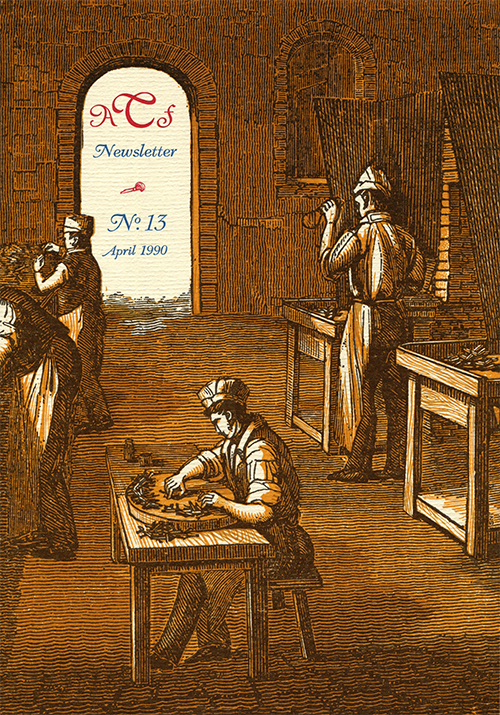
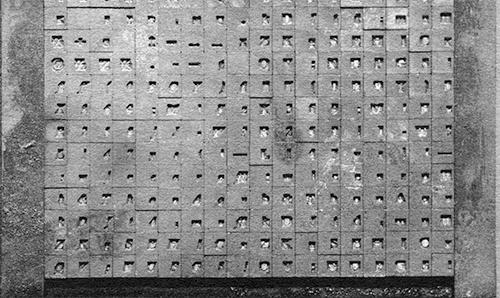
The cover illustration is a modification of an
original wood engraving of a "typical
nineteenth-century type-foundry" from the Penny
Magazine, London, 1833, modified and
letterpress printed by Stan Nelson using zinc
engravings. Thanks, Stan!
The seventh biennial ATF Conference is on
starting July 19, 1990, to be staged at the
now-legendary Typefoundry of Harold Berliner at
Nevada City, Calif.
Registration will begin Thursday afternoon,
July 19; the Conference will begin Friday
morning, July 20, and run through Sunday
afternoon, July 22, 1990.
Our able host, Harold Berliner, notes “we will
discuss and demonstrate Monotypes, the Super
Caster, Thompson typecaster, and the Linotype,
as well as the influence of hot metal type
design on digital faces, and the current use of
hot metal as well as the ways it needs to be
preserved and is being preserved.”
A two-day technical session will run Monday and
Tuesday, July 23–24. Again this year (as at the
Terra Alta Conference in 1988), Harry Wearn, a
man with over 40 years’ experience at the
Monotype School in England, will conduct the
sessions.
Harold says lodging and accommodations have
been set at $46.44 and up, and that 70 rooms
are reserved in the Northern Queen, a hotel in
downtown Nevada City.
A preliminary announcement already has been
sent out by Berliner. It is important that
reservations be made as early as possible
because of the great interest in letterpress
printing on the West Coast.
Full details regarding the Conference will be
forwarded to all registrants as they are firmed
up.
Those planning to attend are reminded of the
group’s tradition for keepsakes. Try to keep
yours to a 9” x 12” maximum folded size so it
can be easily transported.
As with past meetings, time will be reserved
for buy, sell and swap (preferably of items
related to typecasting and letterpress
printing) followed by an auction, hustled by
Dave Churchman.
Nevada City is less than two hours from the
Sacramento Airport, two hours from Reno, or
three hours from San Francisco.
Harold recommends arrival at Sacramento and
hints of the possibility of group
transportation from that airport.
He notes that accommodations are limited and
fears he will need to turn folks away. So,
check your calendars and send notice to him now
of your intentions to “be there.” Write to
Harold Berliner, 1990 ATF Conference, 224 Main
Street, Nevada City, Calif. 95959.
3
Among the equipment on display at Harold
Berliner’s shop during the 1990 Conference will
be a large portion of the holdings of Pat
Taylor’s Out of Sorts Typefoundry, Larchmont,
N. Y.
Pat hastens to note he has retained his
extensive collection of Goudy faces, a comp
caster, keyboard, and a Thompson, but he has
retreated significantly from commercial
activities.
“We were being eaten alive by rent,” he says.
“We were working like crazy just to meet
overhead and that had to stop.” He sold the
equipment last fall.
3
At the meeting in Indianapolis, Rich Hopkins
said, “Those with linecasting machines are as
much a part of the group as are those with Mono
equipment.” This means Linotype, Intertype and
Ludlow. Welcome!
Let’s say you have a chance to pick up one of
these wonderful machines and you know little of
what you might be getting into. Ask, what kind
of work do you want to do? Books? Commercial?
Large type? There are linecasters that will do
the above but you should know what you are
about to acquire. We favor Linotype models 5,
8, 31, or Intertype V or C4. Older models will
generally show more wear, be apt to break-down
with parts being harder to come by. Find out as
much as you can about your caster; take a
flashlight and go all over and jot down model
numbers, serial numbers, and be careful about
electrical info on the motor. If it’s 3 phase
and you don’t have it you will need some sort
of phase conversion unit or a motor change.
While you’re looking around, see how it can be
removed. Will other equipment have to be moved?
Or, will it have to be stripped for clearance
or weight if it must be lifted. If you don’t
know how to take a caster apart, this might be
a job for you.
Ask to see the machine run and cast. If not
operable ask why. Talk to the operator, the
owner, anyone who might know something, and
make notes. If it’s for the taking that’s one
thing but if money is involved, then how much?
Fifty bucks is one thing but $1,000 should get
you an exceptional machine. How will your entry
be? Up or down a few stairs? This makes it all
more challenging and costly. Is it gas fired?
Do you have gas? I would favor an electric heat
source for ease and better control. Yes you can
move a caster with help and some rental
equipment, if you have experience in moving
heavy equipment. Be careful! Better to hire
someone to rig it for you than to get hurt. We
had a rigger move our model 31. I didn’t know a
thing about it, with a little instruction it
has been most enjoyable. My son, in high school
at the time, quickly picked it up. There are
several good books on operation and
maintenance.
Sometimes it is possible to hire a flat bed
auto truck from a towing company, with an
operator-driver that will move equipment for
you. Our local tower will do this but you must
tell the operator what to do. Prior experience
dictates here of course. The best bet as
mentioned before is hire a good rigger and let
them make the move.
If you currently are setting hand type you will
likely have the necessary galley cabinets etc,
but if you plan to start with a linecaster with
no other equipment then you are in for a big
job. I would advise someone to consider
expanding if they are printing now, and have
adequate space for a machine. This almost
suggests that you own your place; a landlord
may object to this type of installation unless
it’s an easy ground level entry such as your
garage. Do think about the day you may move and
the disposition of your prize.
Let’s look at the shop and the intended spot
for your machine. How is the floor? Wood?
Concrete? Will the floor support the unit? The
caster should be level and rest on a sturdy
floor. Allow space to work around the unit.
Three feet all around should be good unless you
load magazines from the rear, then more space
must be provided. Be guided by where the
machine came from.
Do you have a comfortable source of heat, so
you and the machine can operate in comfort? A
cold machine isn’t the easiest to operate.
What about a supply of metal? Some units have
the additional pot mounted on top of the
machine that melts and feeds clean metal to the
pot below. This is called a Monomelt and is a
handy item eliminating the need for a furnace
and the casting of bars for the bar feeder if
your machine is so equipped. You should have a
supplier or smelter you can ship your dross and
metal chips to. They reclaim your metal,
formulate it to the proper alloy and ship a
replacement back, all at some cost. Use metal
for linecasting. Used linotype slugs or bars
cast into ingots for this purpose. Avoid mono,
foundry, battery or plumber’s lead. If you
contaminate your pot you will not get good
slugs. Stick with the proper metal. Skim the
top surface of dross and dirt depositing these
skimmings in a closed box for this purpose.
Avoid dust, handle with caution and wash your
hands after handling since lead compounds are
poisonous.
Many of the circumstances above apply to the
Ludlow. While they are essentially a hand
operated system—no keyboard to learn here—you
can produce some nice typography. This is the
way to go if you need large faces—24 point and
up. Smaller faces are also available from 6
point up.
Consider also the possibility of obtaining a
caster and sharing time and expense with
someone of like mind. Get others interested;
produce some fun printing and nice typography.
This is what “ATF” is all about.
3
Robert Schladetzky
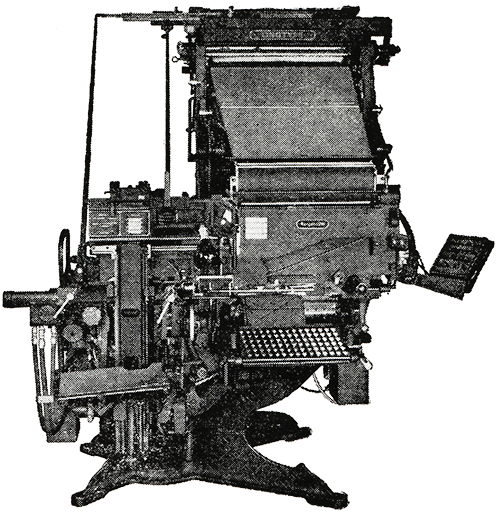
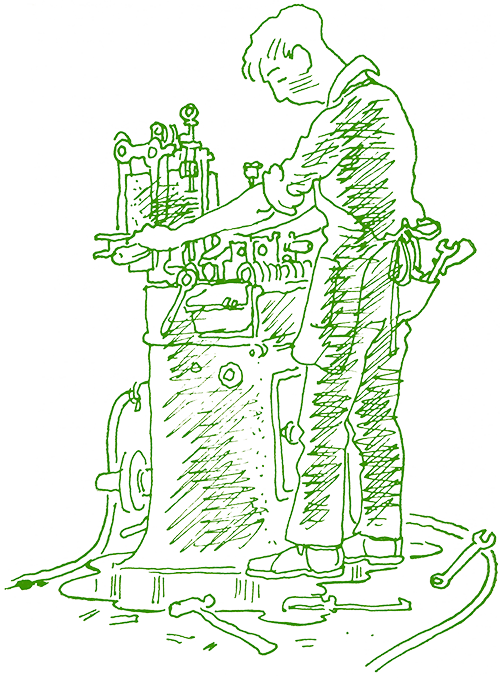
Since both articles on these pages deal with linecasters,
it's only appropriate that this illustration be used, even
though it is of a Linotype instead of an Intertype. It is
an original electrotype, salvaged from a Mergenthaler ad
published in the late I95os and directed to weekly
newspaper owners. I think it's a Model 31 Linotype.
It looked authentic, but I never really
believed it would do what they said it could.
But I couldn’t pass up the seemingly logical
next step in the evolution of my letterpress
printing hobby.
And talk about a bargain: two of these imposing
relics, in “working shape,” with several
magazines and mats for $125.00.
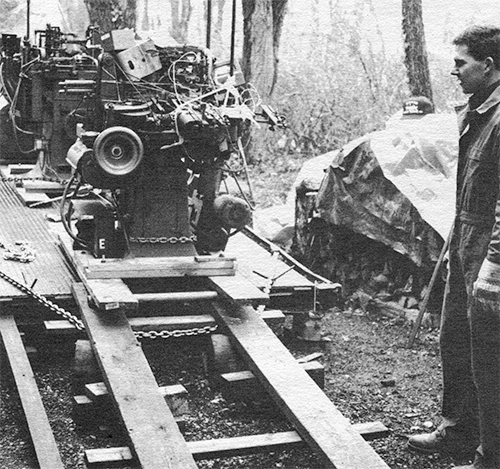
The bargain paled a little as I and an
unsuspecting friend coaxed the reluctant
behemoths inch by inch up an inclined ramp from
the basement printshop with a come-along and
pipes for rollers. Teetering up the planks and
onto the bed of the trailer, they were lashed
with chain and tighteners ‘til the boards
beneath them groaned. Magazines were crammed in
here and there and then the whole mountain
enveloped in tarps and crossed ropes.
As the gray afternoon darkened and the
inevitable northwest winter drizzle wrapped
around us, we lurched and clanked from the
small hamlet of Bothell, Wash., towards my home
across Puget Sound to the Olympic Peninsula.
That was November, 1986. With a small library
of Intertype manuals and the naiveté of a Boy
Scout at a fraternity panty raid, I sat down in
front of the machines several times during the
ensuing weeks. With each episode, I became more
intimidated.
Odd and deformed partial slugs vomited from the
mouth of the thing; the repeated cacophony of
brass mats flying out of the vice jaws and from
the distributor bar and careening off the
concrete floor were a frequent experience. I
became as agile as a puma, lunging from my
castered chair at the keyboard and pouncing
upon the catwalk behind the machine to unjam
mats from the distributor screws.
Various belts would fly off a variety of
pulleys... the sickening moan of the tired
motor just prior to a lockup in mid-cast...
searing my fingers while trying to rescue
errant mats from around the pot... blackened
holes in the left knee of my trousers from hot
lead spewing out from a loose line.
I got to where I avoided looking at the
machines when passing through the room. One
rainy afternoon, slipping into the shop to
retrieve a stack of paper, I swore I heard what
sounded like a sinister sneer emanate from the
shadowy far end of the building.
The machines evolved—in my description to
curious friends—from ‘ingenious pre-computer
examples of man’s inventiveness’ into ‘machines
requiring constant vigilance, oft' cantankerous
assemblages of levers, cams and detents,
ludicrous tributes to man’s absurd isolation to
typesetting.’ And finally to “those two black
bastards in the back of the shop”!
Never two usable slugs in a row. Coffee cans of
assorted mats lined the window ledges. Broken
belts dangled like garlands on a holiday
tree...
Enter Ralph Babcock, that patriarch champion of
letterpress and the hobby printer. I mentioned
my disenchantment. Who would have guessed
within a few miles of Ralph’s home resided a
letterpress practitioner actively publishing
books, setting type on an Intertype linecaster
no less. He turned out to be a willing and
compassionate soul. Having made 79 trips around
the sun and I suspect 50 of them in newspaper
plants drawing lines o’ type from linecasting
machines, I saw that he had respect for, but
was definitely not intimidated by, the things.
Mark Adams’ sinewy steps are like a 30-year-old
and, irritatingly, has more hair than I do,
three decades his junior. He looks at you
sometimes through his glasses and sometimes
over the top of them—usually when driving home
a point. His sense of humor runs deep.
I led the way to the back of my barn-museum to
the two dusty hulks standing defiant and smug.
Mark didn’t take the time for formal
introductions. With authority, he pulled open
the maw exposing the mold wheel and mouthpiece.
Further opening up, he pulled globs of wayward
metal and gunk from countless crannies and
proceeded to deftly tweak the various
mechanisms.
I rattled on about hair-raising episodes
attempting to run the things. I wasn’t sure he
was listening.
Then the lessons started as he pointed out this
problem and that. Cleaned out gear teeth and
peered deep into the bowels of the thing. “Oh,
gawd,” uttered under his breath. I quit
talking, awaiting horrifying news. Nothing. He
resumed probing and cleaning. Then Mark seemed
satisfied.
He sat down at the keyboard and brushed across
the keys like a concert pianist. The mats rang
musically as they filled the stick. The little
finger of his left hand artistically stroked
the spaceband key. He cautiously raised the
line to the delivery slide, eyes scanning the
machine for any unruly activity.
The line slid smoothly to the first elevator.
Heavy metal parts slammed here and there doing
their assigned tasks. I wasn’t breathing.
Before I could follow it all, mats were
clacking back into the magazine and Mark was
inspecting a perfectly cast slug. Mark didn’t
appear particularly impressed, but I sure was.
I glanced up to the large cast nameplate at the
top of the machine that said ‘Intertype’ and I
said to myself, ‘now take that, you black
bastard.’
Once humbled by these machines, I now can look
them squarely in the pot and savor a taste of
victory.
3
(The article above was first published by
Robert Schladetzky, Great Beaver Valley Rd.,
Port Ludlow, Wash. 98365, triumphantly set on a
1930 Model C Intertype. His leaflet, “Notes
from a Horse Doctor’s Linecaster,” dated
October, 1989, was circulated in the National
Amateur Press Assn. bundle.)
Richard L. Hopkins
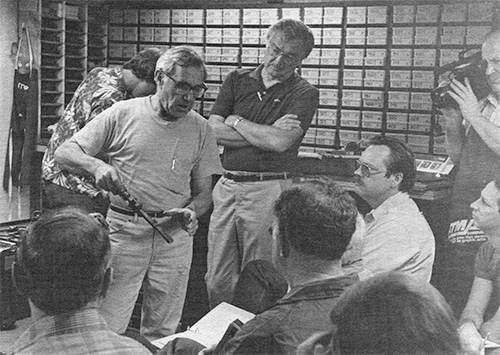
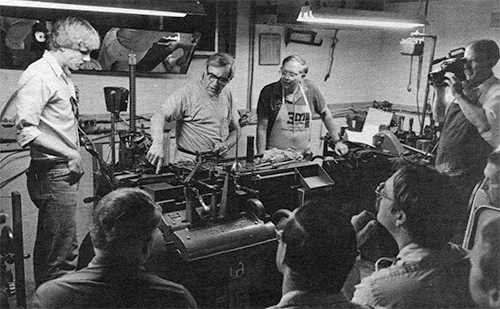
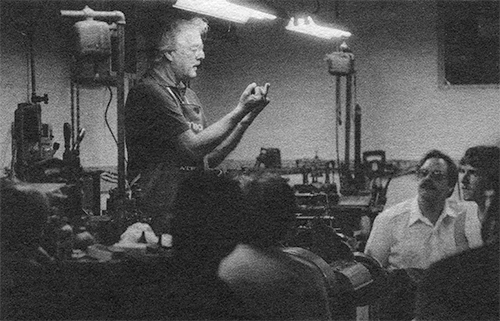
Harry Wearn of Avon, England, makes a point about the pump piston during a technical session. Scott Holt, Nevada City,
Calif, behind Harry, assisted during the sessions. Pat Taylor, Larchmont, N.Y., is beside Harry. Others shown are Roy Rice,
Atlanta, Ga.; Bob Halbert, Tyler, Tex.; David Holmes, Annapolis, Md.; Ed Rayher, Amherst, Mass.; and Rich Hopkins with
the video camera. Photo by Jim Walczak
Since our 1990 ATF Conference at Nevada City,
Calif., will be the first meeting in that part
of the country, many interested Westerners will
find the meeting to be their first practical
opportunity to interact with our group.
What should they expect?
Although academic or “bookish” subjects may be
on the agenda, there’s always an effort to
emphasize the practical and technical aspects
of type making.
It is, indeed, an “awesome” experience when you
realize you’re in one room with a great number
of the major players in hot metal typography
today. The law of averages demands that we be
very few in number, and necessarily widespread
across this vast globe.
If it were not for ATF, we’d have no real
excuse to come together—and the social aspects
of coming together probably are more important
to us than the technical information.
We operate for the most part in a vacuum—as
loners in our personal shops valiantly pursuing
a technology that’s been trashed and scorned by
the rest of a world consumed by high-tech
computer insanity. We need the reassurance we
get by talking with other nuts at least once in
a while—like every two years.
To set the stage for the Nevada City conclave,
several reports of the 1988 Conference are
presented starting on page 22:
(a) A summary of what happened at the 1988
meeting, from reports by Paul Duensing of
Kalamazoo, Mich., and Guy Botterill, of
Baltimore, Md.; (b) A news reporter’s coverage
of the meeting, published initially in the
Morgantown (W. Va.) Dominion-Post and written
and photographed by Nancy Abrams, who (I must
admit) was once an employee and perhaps an
understudy a dozen years ago when I owned a
weekly newspaper; and (c) A discussion of how
two newcomers viewed the Conference, written by
Greg Walters of Piqua, Ohio, and Ed Rayher of
Northampton, Mass. Both came to the meeting
with no prior knowledge of what might be in
store.
3
A first showing of a figure font which punchcutter Dan Carr of Ashuelot, N. H., has produced.
Photo by Nancy Abrams
Dan looks on as Stan Nelson (another punchcutter),
Columbia, Md., critiques the specimen at the 1988 Conference.
Photo by Nancy Abrams
Jim Rimmer
Steven at Ho Sun Ring's Man-Nen Caster.
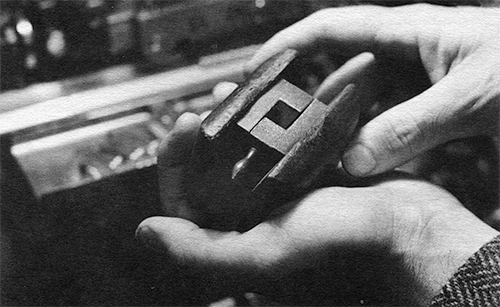
The original brass and wood hand mold
which was the Ho Sun Hing Foundry's heart
in the early days.
Vancouver’s Chinatown is a fascinating spot to
visit—a place alive with colors, smells and
customs. Its commercial center of stores and
businesses covers an area of roughly four by
six blocks. In addition, there is a large
Chinese population spread among different areas
throughout the greater Vancouver area.
Vancouver is the extreme western terminus of
Canada’s first transcontinental railway, which
was completed about 100 years ago. During its
construction, Chinese people came to Canada
because of the opportunity of work on the line,
and in the gold fields.
As the Chinese worked and prospered, families
were later brought to join them. The result of
this influx of new citizens is a Chinatown
nearly as large as that of San Francisco.
Over the decades there have been many
Chinese-language job printers and newspapers,
some daily and some weekly. Because of the
great distance and the cost of shipping type to
Canada from China, some of these printing
houses naturally formed their own
typefoundries. Beginning about 1952, I came to
know three or four printers who possessed
casting machines and did casting work for them
on a casual basis. There have been periods of
perhaps two years at different times when I did
not hear from them, but every once in a while I
would get (and still do) a call to drop in to
do a little work. The following are a few lines
about such shops.
Charlie Young Printing
I became acquainted with Mr. Young and his
shop in the fall of 1952. As a second-year
apprentice in the office of J. W. Boyd & Sons,
I had been sent to the Chinese shop to borrow
a line of type. The minute I reached the
bottom of the stairs to his basement shop on
Pender Street, I was hit by the perfume of
burning mold oil and the unmistakable sound of
a Monotype. A young composer greeted me and
handed me the paper-wrapped bit of type. As he
was doing so, I was craning my neck in the
direction of the sound of the machine, and the
compositor asked me if I was interested in the
Monotype. I told him I ran one, so he escorted
me over to the corner of the shop.
The Monotype room was no more than eight by
ten feet. Over the door was tacked a newsprint
galley-proofed sign which said “TYPE FOUNDRY.”
I peeked into the room. Through a heavy mist
of smoke, I spotted Mr. Young standing at the
caster. He was a very tiny, very thin little
man with an immense gold tooth in the center
of his broad smile.
Around his feet were strewn hundreds of bits
of unwelded strip material. Without looking,
the outward appearance of the caster told me
it was a low serial number. Although he was
having a terrible time with the caster, Mr.
Young showed no signs of frustration. He
merely kicked a path through the bits of metal
and offered his hand. He asked if I knew
anything about the machine. I said “a little.”
He shook my hand harder, pulling me into the
room and shoving me up to the caster. “You do
him slocks,” he said, “time I go for tea. I
pay you,” he shouted over his shoulder as he
headed for the tea pot. Things were slow at
Boyd’s, so I thought I’d stay for fifteen
minutes or so.
The trouble he was having was an incorrect
positioning of the fusion point. Fortunately,
a Monotype rep had come to our shop a few
months before, and I learned how to adjust
this fault. I made the adjustment, and drilled
out the nozzle. In no time, I had it casting
fairly good slugs. It was probably more by
luck than skill, but the caster was running in
any event.
When Mr. Young came back from tea, he was
flabbergasted and pleased. He kicked his way
through the type-metal on the floor and shook
my hand some more. “I pay you two dollars for
hour, you come Saturday.” He did and I did for
two or three years. Later on, I switched the
machine over to American type mats, and still
later, to Chinese foundry mats. His need for
Chinese type was endless. Because of the vast
amount of characters, it seemed that I could
never catch up to the demand.
When I came in on a Saturday or after work on
a week night, there would be a string of
Chinese mats laid out on a galley with a bit
of paper under each mat, reading 1, ½, ¼,
meaning me to cast a candy bag either full or
half or a quarter full. Mr. Young possessed
mats for about 3,500 Chinese characters, all
in the common body size popular around
Chinatown: 13.8 point. All type is in the
muttom format and for this purpose they had
had a 14-point sorts mold blade ground down to
the correct size, and the loose side of the
mold was brought up against the blade.
Although some machinist had lapped the blade
down completely by hand on an oil stone (and
the job was far from perfect) the mold ran
surprisingly well. The type was a little
tapered, but seemed to cause no trouble.
His matrix holder was another matter. The same
machinist had merely taken a Monotype display
matrix holder and attached a lip to one side
to come closer to the side of the narrower
foundry-style matrix. Between this lip and the
mat, you merely wedged a bent bit of spring
steel—much like a leaf spring on a car—between
the lip and the mat. In some instances, the
type didn’t leave the mat too easily and this
bit of pull would drag the matrix out of the
holder and all hell would break loose. Because
of this, it was never possible to leave the
machine. I always stood there peering at the
top of the mold with one hand on the pump trip
handle.
The shop operated completely on Linotype metal
and, because of this, the type was awful, but
Mr. Young was pleased.
Our arrangement went on for three years until
Mr. Young’s sudden death. Immediately, the
shop was sold off to various printers in
Chinatown and the doors closed. All the
printers I have met in Chinatown are the most
amiable of people; but I think Mr. Young was
the most pleasant of them all. I can’t
remember a time when he wasn’t chattering and
smiling, showing his big gold tooth.
New Republic Press
At about the time of Charlie Young’s death, I
became acquainted with the people at the New
Republic Press, and began operating their
Monotype type and rule caster. The machine had
lain idle for quite a long time. Before it was
possible to run it, I had to dig it out from
under a pile of skids and waste paper. The
machine has become covered with a layer of
black paper fibre and grease, but a few hours’
clean-up, and it was away and running.
The paper was printed on a web-fed Hoe press.
I can’t recall if it had a pit under it, but
do recall that it was very low to the floor,
the web criss-crossing back and forth through
the printing cycle and winding up in the
folder and cutter. The press printed directly
from the locked-up type forms. As the name
implies, the chief piece of printing was a
daily newspaper.
Like the Chinese Times, they possessed a
massive stock of text type, which stood in
angled stands, face out. These two-sided
stands were in sections of about 24 feet in
length, much like the ones in the picture of
Ho Sun Hing's shop.
My main function was to cast Chinese type for
the paper, which I did for some months until I
was able to teach one of the comps to run it.
Like other shops I worked in, the NRP used
Linotype metal in the caster. As a result, the
soft metal made rather short-lived type and it
was necessary to cast constantly. Since their
caster had not been in operation for years,
the type they set the paper with had become
very mushy. As the new type was stocked up,
they became very happy with the result.
The paper operated on a vocabulary of over
4,000 characters, so one could imagine what a
task the caster operator had ahead of him.
About a year after I left NRP, I got a call
for help, and when I arrived at the shop, I
was shocked to see that part of the speed rack
had fallen out on the floor. At first glance I
assumed that the caps had merely worked loose
and the split shaft and main drive gear had
fallen out. A closer look showed that the
cross-pieces that were part of the caps in the
speed bracket had actually broken and the caps
came with the shaft. With the help of the
castermam, I placed the shaft back in place,
matching the broken faces, and we jammed it
together by driving some lengths of wooden
furniture under it to serve as props. I told
him to call in a welder and see if he could do
anything with it, and the castermam smiled and
nodded in agreement. We started the caster up,
and it ran with no trouble, and I thought he
might as well go ahead and make some type,
since he couldn’t damage it any more than it
was. A long time after that incident, I was
called back for some reason, and was pleased
to see the old Monotype casting away in the
corner. When I went over to look, there were
the wooden props still in place. No welding
had been done.
One day, while I was operating the machine, I
noticed something that looked like a casting
machine, but I couldn’t figure out what it
was. It was obviously intended to be
bench-mounted and I noticed that it had about
a fifty pound pot full of type metal. There
was what appeared to be a mold of some kind,
but I couldn’t figure why it should have one
part on a long hinged arm. The main frame of
the device had Chinese characters cast into
it, and it was quite fancy—almost like a
Singer sewing machine frame. At the time, I
had never heard of the Bruce caster, but I am
certain it was some sort of adaptation of the
Bruce. In the late sixties the NRP decided to
switch from the old process, and the Monotype
was cannibalized by Ho Sun Hing Printing for
parts.
Ho Sun Hing Printing
Ho Sun Hing Printing has been in operation
since 1906, operating in very much the same
manner. Even today the shop is predominantly
letterpress. The business is a family
operation, and they all take an immense pride
in the shop and its long history. On the wall
hang pictures of the crew dating back to its
earliest days. The senior member of the family
is now retired, but nonetheless spends the
better part of his day at the shop. The duties
of operating the two casters falls to one of
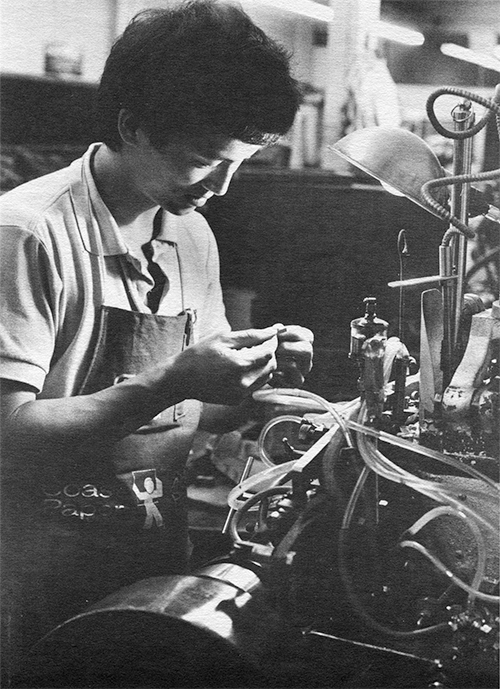
the sons, Steven. My first meeting with the Ho
Sun Hing company was in the summer of 1954. At
the time Steven was just beginning to walk and
toddled around the safe areas of the shop in
diapers. The family works long hours, spending
most evenings at the shop.
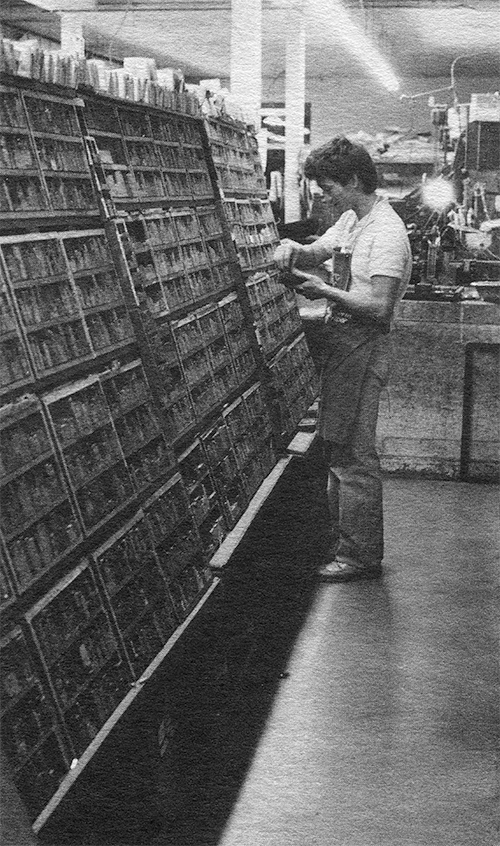
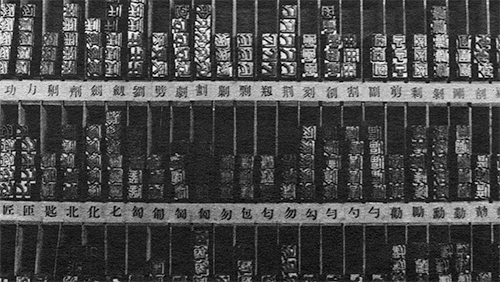
Steven at one of the long two-sided standing cases. This is the
common type of the printing house and is all cast on the
premises. There are three or four rows like this one.
A closeup of part of one of the leaning type
stands holding type cast at Ho Sun Hing.
Although I was never more than a casual
employee at Ho Sun Hing, I did spend a lot of
time running the Monotype, and eventually
taught the caster to Steven. In the fifties,
the Monotype type and rule caster was split
about half time casting 13 point Chinese type
and the other half casting strip material.
These days its main function appears to be to
supply strip material, only rarely being used
to cast English type.
A newer caster is truly a prize. Ho Sun Hing
bought it when it was landed in the United
States, but not accepted by the buyer. As a
result, Ho Sun Hing got a great deal and a
complete set of mats. The only drawback was
that it had no instruction book. They brought
the caster in, and Steven soon learned how to
operate it by his own initiative. This
machine, called a Man-Nen, is capable of
casting up to 18 point only. It came with two
molds: a 10 point and a 13 point (Chinese
measure). They have mats for the 13 point
size, and this seems to be the standard text
size for most of the work they do. Although
they use only Linotype metal, the Man-Nen
casts wonderfully dense type.
Like the New Republic Press, Ho Sun Hing has
an immense holding of Chinese type, as
accompanying photographs attempt to show. It
seems that the bulk of their type is cast in
the shop. They use but very little from the
Orient.
They do have a large stock of larger sizes, up
to what is roughly equivalent to 72 point.
These larger characters have been imported,
and like most of the imported Chinese type I
have ever seen, the alloy is almost completely
lead. In spite of the sluggish quality of the
soft metal, the type is very dense and heavy.
The face on some of the larger characters has
a few wrinkles caused by the flow pattern of
the metal, and the sides of the quad are very
rough and wrinkled.
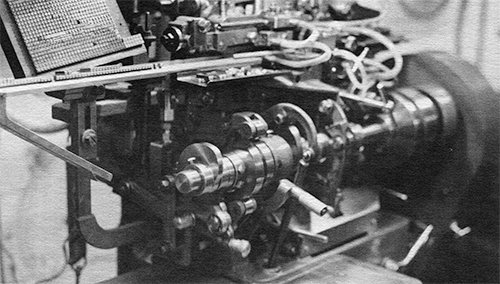
The exposed cam system of the Man-Nen. Note the fine finish of the cams.
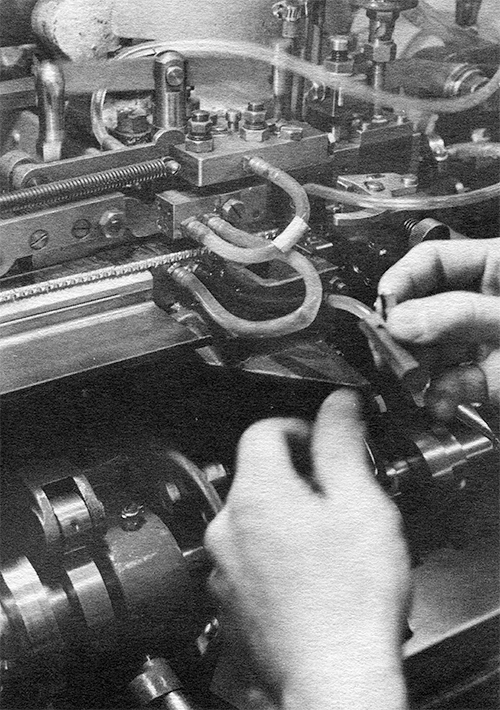
Type advancing onto the delivery stick of the Man-Nen.
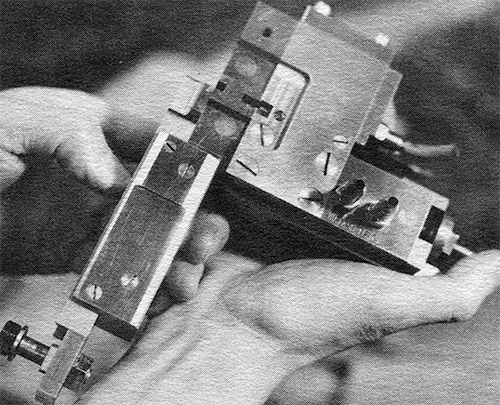
One of the individual point size molds for the Man-Nen casting machine.
The matrix holder being lifted from the machine.
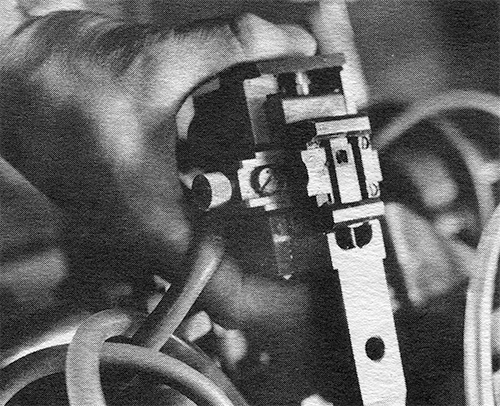
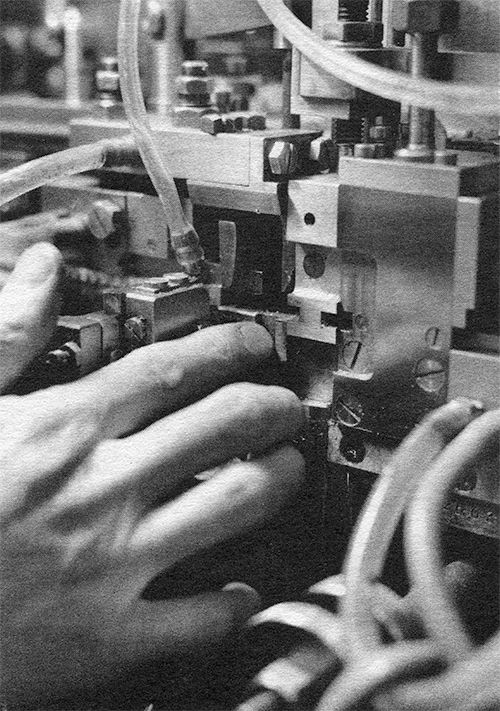
The Man-Nen caster is a marvelous piece of
engineering. Every machined surface is
polished to a finish like chrome. The cams
which run across the front at waist height are
beautifully finished. Though each point size
requires its own separate mold, the changing
of the mold is accomplished by undoing only
two screws. The caster is very much like the
Thompson in configuration, and operates on the
nozzle and choker principle. Unlike the
Thompson, the Man-Nen has a roomy work table
at the left of the machine, and a neat little
angled galley at the left of the machine and
at shoulder height.
A method once used at Ho Sun Hing to copy borrowed
matrices-a Bakelite impression was made of several matrices.
Then it was dusted with a conductive powder and
electroplated. The copper shell was backed up with lead, and
the individual matrices then cut apart and finished.
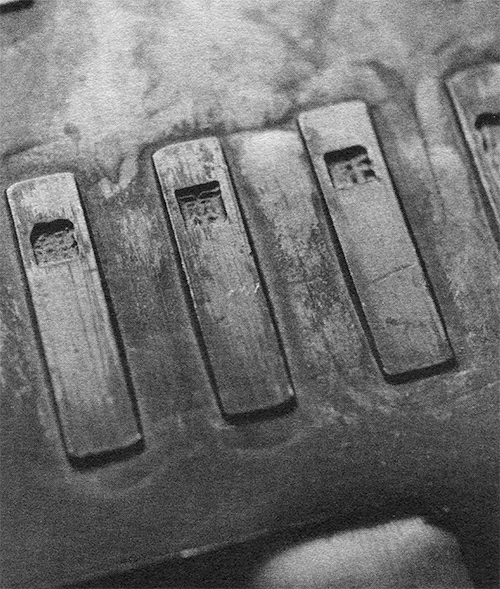
Like the other Chinese shops, Ho Sun Hing’s
matrices are of the foundry style, having been
electroplated in copper, and dovetailed into a
brass blank.
Many years ago, I recall coming across a box
of bits and pieces while searching for a pin
wrench. In the box was a most beautiful little
brass and wood hand mold. When I visited to
take pictures for this article, I asked about
the mold and they quickly found it covered in
thirty years of dust. Steven recalls that his
father once cast all their Chinese type with
the mold, but he could not recall ever having
seen the mats that worked with the mold. We
searched for them, but were unable to find any
trace of them.
The matrix holder and its relationship to the mold.
One other curiosity that I found among the
dust was an electroplate about six by seven
inches in size. They had obviously borrowed
some Chinese mats, and rolled them through an
electro matrix moulder, making a Bakelite or
wax mat, then copper plating this and backing
the copper shell with lead. The mats were then
sawn out and used on the caster. This is
obvious, as you will see in the picture,
because one has been sawn out of the plate.
The atmosphere of Ho Sun Hing’s shop is of
general clutter, but everyone knows precisely
where everything is. There is a very friendly
and warm feeling about the shop. The concrete
floor has worn to a marble smoothness in the
traffic areas. I think the paint on the walls
has been there for at least fifty years.
The Chinese Daily Times
The Chinese Times is the only Chinese shop I
never had the opportunity to work in. They
have been in the same corner location for
seventy years. The corner shop is more or less
a store front, with windows running around the
two sides of the building. Pages of the paper
are hung daily on wires in these windows. When
there are no papers in the windows, it is
possible to see the printing process from a
very good viewpoint. Sadly, the paper is now
offset, and has been for about five years. At
one time it was possible to see the
compositors rushing up and down the rows of
type stands with their wooden composing
sticks, and to see the Hoe (like the one at
the NRP) operating. A few years ago the press
was offered to a friend, but he was unable to
find a home for it. It went to the scrap yard.
The shop has a small job printing section, and
they have a Heidelberg platen and a small
stock of type, but largely, even the job work
now is done offset.
In the early days, the Times cast its type
with hand molds, and there is rumor that they
once owned a Chinese Bruce caster and later a
Monotype, but I never saw either.
I do remember that in the early sixties they
rolled a brand new casting machine onto the
floor. I remember seeing them installing it,
and was always curious to ask if I could have
a look at it, but hesitated because they
didn’t look as though they would appreciate a
visitor.
When I approached the Times to let me shoot
some pictures for this article, it was
difficult to get any co-operation, and I had
to persist to finally get past the front end
of the shop. As I was taking pictures of the
caster (which had happily survived the hot
metal purge), the shop foreman came up behind
me and tapped me on the shoulder. He said he
would be willing to sell the caster if the
price were right. I now own it!
The machine was made in Taiwan, and is called
a Hua Nan Casting machine. I am told that the
machine is still being manufactured, and that
molds are available, as well as any parts one
would need. This particular machine has only
one mold—a 12 point. The main drawback is that
the mold’s height is completely incompatible
with any kind of English or American matrices
of either composition or sorts style. A person
could make a holder for .050 drive English
composition mats, and this would work because
the mold would have to be ground down to .868.
There is no possible way to cast American
composition mats, because the mold isn’t tall
enough. What I intend to do is create a 12
point display mat at .050 drive with a right
hand side bearing and cast these on it. This
will work well since I have neither a 12 point
body piece or 12 point mats for my Thompson.
When I get some hard metal into the pot, I’ll
get good type from the caster. The piston on
the Hua Nan is almost 1½”, which seems like
overkill for a 12 point mold. Generally the
engineering and finishing of the Hua Nan is
much inferior to the Man-Nen, the Monotype or
Thompson. Even the mold is not of the best
finish or hardness. However, I feel that with
a little careful handling, the machine should
stand up well.
One ingenious thing about the caster is the
melting pot heater. Unlike all other existing
machines, the heating elements are not
immersed in the melting pot, but are outside
and under the pot in a special compartment.
All that is required is an ordinary electric
stove heating ring, and when this burns out
you just go to the appliance store and get
another one. It takes about five minutes to
change the element. If one wanted to switch to
gas heat, all that would be required would be
an ordinary gas stove heating ring in the
compartment under the pot.
When I bought the Hua Nan caster, I got about
6,000 12-point Chinese mats. I have traded
these to a member of the American Typecasting
Fellowship, who will no doubt do something
surprising with them.
In a world that is fast abandoning a valuable
part of man’s technological history, it’s
comforting to know that the pieces at Ho Sun
Hing Printing seem to have a safe and welcome
home. This collection and the caster now in my
possession are all that remain of a once
lively typefounding scene in Vancouver’s
historic Chinatown.
3
Acquisitions, Gripes, Museum Notes, Comments Clippings from Correspondence Received
William Danner of Kennerdell, Pa., noted after
receiving some new type from the Hill & Dale:
“I found one ‘x’ in your font that had no
face. Big deal. Do I get a refund? The wonder
is not that these things happen but that those
marvelous machines turn out billions of
precise die-castings that all work together so
perfectly.”
Regis M. Graden of Castaic, Calif., makes an
unnecessary apology for his “typefounding”
efforts: “You may look down on my casting
activities—I have a Ludlow. I have 40 fonts of
mats and I am, of course, looking for special
refinements and swash in smaller sizes.”
“After 20 years with Mergenthaler Linotype,
ending as vice president, engineering,” W.
Otto Grube of Cutchogue, N. Y., writes, “I am
now retired and printing as an amusement with
an American Monotype and a Model L Ludlow in
operation.” He also has expressed a strong
desire to work on the personal computer drive
for a Monotype.
“I do still have an interest in getting a
caster from you, but I should tell you what
I’ve acquired in the meantime,” reports
Gregory J. Walters of Piqua, Ohio. “I bought
the hot metal equipment which was at Bethlehem
Steel mentioned at the ATF Conference. The
heavy line consisted of two Intertypes, four
composition casters and a material maker. I
also have ‘Orphan Annie’ which belongs to the
Cincinnati Historical Society. I have fired it
up but have not succeeded in casting good type
because everything is out of alignment. My
comp casters include three 15x17 American
casters built in 1950 and rebuilt by Hartzell
in the 70s, and a newer English one, perhaps
from the 60s.”
“How about putting me on your mailing list.
I’m the last type metal manufacturer east of
the Mississippi—from Maine to
Miami—established in 1885 and still getting
the lead out.”
Werner Meier
Pittsburgh Metal & Equipment
Jersey City, N. J.
Ralph Babcock, in his Weaker Moments 312
displays evidence that beautiful ornaments
were not the sole domain of the typefounder.
He displays several lines of Linotype
Fairfield ornaments, cast by Martin Beilke,
Quintessence, 356 Bunker Hill, Amador City,
Calif. 95601. Beilke has hundreds of Linotype
border matrices and border slides.
Francis J. Cardamone is in the preliminary
stages of developing a museum devoted to
preservation, restoration and operation of
various industrial trade machinery of the late
19th and early 20th centuries. Typecasting
equipment in his possession includes a
Monotype keyboard and caster, Thompson, and a
Monotype Material Maker. If you are in his
area and can offer technical assistance,
contact him at the Iron Age Machine Museum,
160 Canal Street, Staten Island, N. Y. 10304.
Phone (212) 448-3732.
“Many thanks for your splendid Newsletter.
Simply amazing. You Americans have everything.
A burning question: Could one of my Intertype
Model C4’s be modified to cast individual
characters? My mechanic believes not because
of the ejector blade would have to be a pin
and would not survive the push. Any ideas? Has
anyone ever tried such an experiment?”
John Setek
7 Wills Court, Paradise Point
Queensland 4216, Australia
“Someday I hope to find a Thompson Caster and
mats for Goudy Text and Lombardic Caps.
Wishful thinking? I know, but I have found the
unexpected before. The above faces are
favorites of mine, and fit well with my
printing in a religious vein. Goudy’s text
face is one of the few ‘readable’ to we
moderns. To cast one’s own surely is to reach
a noble height in the works of men, but for
now I enjoy by proxy.”
When members of the American Typecasting
Fellowship visited British Monotype in 1982,
all were told the Corporation had a commitment
to support hot metal equipment for another ten
years. That time is rapidly running out.
A letter sent in 1989 by Duncan Avery, Spares
Manager, indicated the company was giving
notice production of new molds and matrices
would cease this year (1990).
“The supply of recognized composition caster
and D keyboard spare parts will not be
affected at this stage, but we suggest you
consider likely requirements for everything as
soon as possible,” Duncan noted.
Another turn of events also may severely
affect the company’s commitment to hot metal.
Word is out that the firm has been acquired by
a conglomerate of U.S. investors who, at this
stage, pledge to keep the present management
and policies in place. For how long?
The Monotype Lasercomp, first introduced in
1976, is a key component to many present
electronic imaging systems and the group
acquiring Monotype already has control of key
electronic imaging companies in the United
States.
Both English Monotype and American Type
Founders, it should be noted, have jumped on
the bandwagon making their original type
designs available in digital format for
PostScript and other desktop typesetting
systems driven either by the Macintosh or
IBM-compatible equipment...
Linotype, Compugraphic (now Agfa), and
Varityper, among others, also make their fonts
available for such systems, bringing to an end
the age-old situation whereby certain type
designs were tied to specific typesetting
systems. Somehow, real Gil Sans on Lino seems
like sacrilege...
3
“I had a dream one night last week that I was
back at the Government Printing Office. I was
at my Monotype keyboard and setting type for
the Congressional Record. The tabular matter
for the Record was our department’s
contribution to the daily printing of the
Record.
“I told my wife the next morning that I should
send the Printing Office a timesheet and
request payment of wages, as I really put in a
hard night.
“Thanks for sending the Newsletter. I do enjoy
reading it. I’m completely retired here in
Delaware and enjoying it every day. Again,
thanks for your efforts in keeping a part of
my past alive.”
3
(Roy Santmyer was the very last member of the
once huge Monotype Department at the U.S.
Government Printing Office to retire. Among
his unpleasant duties toward the end was the
dismantling and destruction of many of the
machines he once operated.)
Richard L. Hopkins
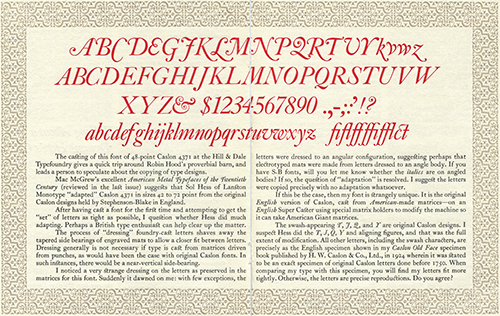
Text composed in 12-point Caslon337 (with long descenders) using two points of ledding
The casting of this font of 48-point Caslon
4371 at the Hill & Dale Typefoundry gives a
quick trip around Robin Hood’s proverbial
barn, and leads a person to speculate about
the copying of type designs.
Mac McGrew’s excellent American Metal
Typefaces of the Twentieth Century (reviewed
in the last issue) suggests that Sol Hess of
Lanston Monotype “adapted” Caslon 4371 in
sizes 42 to 72 point from the original Caslon
designs held by Stephenson-Blake in England.
After having cast a font for the first time
and attempting to get the “set” of letters as
tight as possible, I question whether Hess did
much adapting. Perhaps a British type
enthusiast can help clear up the matter.
The process of “dressing” foundry-cast letters
shaves away the tapered side bearings of
engraved mats to allow a closer fit between
letters. Dressing generally is not necessary
if type is cast from matrices driven from
punches, as would have been the case with
original Caslon fonts. In such instances,
there would be a near-vertical side-bearing.
I noticed a very strange dressing on the
letters as preserved in the matrices for this
font. Suddenly it dawned on me: with few
exceptions, the letters were dressed to an
angular configuration, suggesting perhaps that
electrolytped mats were made from letters
dressed to an angle body. If you have S-B
fonts, will you let me know whether the
italics are on angled bodies? If so, the
question of “adaptation” is resolved. I
suggest the letters were copied precisely with
no adaptation whatsoever.
If this be the case, then my font is strangely
unique. It is the original English version of
Caslon, cast from American-made matrices—on an
English Super Caster using special matrix
holders to modify the machine so it can take
American Giant matrices.
The swash-appearing T, J, Q, and Y are
original Caslon designs. I suspect Hess did
the T, J, Q, Y and aligning figures, and that
was the full extent of modification. All other
letters, including the swash characters, are
precisely as the English specimen shown in my
Caslon Old Face specimen book published by H.
W. Caslon & Co., Ltd., in 1924 wherein it was
stated to be an exact specimen of original
Caslon letters done before 1750. When
comparing my type with this specimen, you will
find my letters fit more tightly. Otherwise,
the letters are precise reproductions. Do you
agree?
3
Has Anyone Ever Considered Air-Cooling Thompson Mats?
Richard L. Hopkins
Upon installing my English Super Caster, I
noticed the machine was equipped with a
single, rather lonesome looking compressed air
connection. Having composition machines
already, I did have access to air, but almost
opted not to connect the air because of the
extra trouble.
My reasoning was simple: I intended to cast
only display type and since my Thompson was
not equipped with air, it obviously was not
mandated on the Super Caster either.
Fortunately, I decided not to follow this line
of reasoning. Instead, I gave it a try. After
all, comp machines had a blast of air hitting
the matrix case, supposedly to keep mats cool,
so why not try it with display matrices too?
I have operated the Super Caster many times
since. It amazes me how well the air-blast
works—matrices generally remain cool enough to
handle with your fingers, even after extended
casting. With the Thompson, the whole mat
holder becomes too hot to handle after a
while.
One minor complaint: The blast of air makes
more noise than the Super Caster itself. The
Super Caster is very quiet when compared with
a Composition Caster or the Orphan Annie
(sorts caster). My Thompson makes an awful
racket (because the motor is inside its metal
stand), and thus, added noise of air probably
would not be noticed.
The airblast is constant—no off and on. It
hits between the mold and matrix when the two
are separated as the type is being delivered
from the mold. It’s such a simple idea, I
wonder if I should try to incorporate it into
my Thompson operation?
Toward that end, I ask if anyone has tried or
has known of an air hookup for matrix cooling
on the Thompson. If so, I would welcome your
description and discussion in a future
Newsletter.
3
When Discarded Equipment is Discovered We're Obliged to Go and 'Check It Out'!
Richard L. Hopkins
There’s no question but that the supply of
discarded Monotype equipment still floating
around has all but dried up, and there’s no
question that many of us have no need for
additional equipment. Yet when calls come in,
we must respond.
I got such a call before Christmas from a guy
who had picked up a bunch of Monotype mats
from Westinghouse Electric’s in-house printing
facility near Pittsburgh. For a change, the
man knew Monotype. Fred Fruden’s father
started the first successful Monotype plant in
Pittsburgh before 1910 (called Mono-Lino).
Indeed, Fred had attended the Monotype School
in Philadelphia in the 1930s.
But he’d left his dad’s shop to his brother,
and had ventured into the printing equipment
business many years earlier. His recollection
of Monotype was a bit rusty.
Somehow, he’d gotten Paul Duensing’s name and
had called Paul. Paul didn’t want to run clear
to Pittsburgh, so he referred Fred to me.
I would have turned down the deal without
inspection, but he mentioned “405” as being
written on the end of several of the boxes.
Knowing this to be American display mats for
Bembo, I had to check them out. I ended up
buying over 40 boxes of Giant and flat mats to
get five fonts of Bembo mats.
Here's what one of the Monomatic mat cases looked like before being cleaned up. Fortunately,
most rust was from something else and the crud on the mats was little more than dirt.
(Monomatic I cases were a straight 18x18. Monomatic II cases had a divider between the left
and right quadrants.)
But after getting home with the “loot” and
inspecting it more closely, I found most of
the Giant mats were virtually new with shiny
faces—in much better shape than the ones
already in my inventory. So I had to transfer
all these fonts into my collection.
And in another box I found several fonts of
Helvetica comp mats in Monomatic I mat cases
(all coated with rust and dirt). They cleaned
up nicely, but served to suggest that other
fonts should have been in the lot.
So I headed out for another scavenger hunt at
Westinghouse to see if additional stuff could
be salvaged.
I was successful at locating three more fonts
of Bembo Italic, and one font of English large
comp Garamond, along with lots of parts for
the Monomatic keyboard.
Upon returning home, I compared and found the
Monomatic I parts matched my Monomatic II
keyboards and this has started me on a
semi-active venture to get my Monomatics
running (Monomatic I and II are not totally
compatible).
And I have a few more fonts of American
display and Giant mats in my collection.
Keep mind, boys and girls: It is our sacred
obligation to save as much of this stuff from
oblivion as humanly possible. That’s written
in our oath of insanity which we took upon
entering this avocation “back then.”
I’d like to hear of your “finds” for
publication in future Newsletters.
3
On several occasions, letters like this have
arrived in my mailbox. Since the answers are
of general application, I reprint my response
completely.
Question: I will be getting a Lanston Monotype
next week from a dealer in Omaha. The machine
number is 1377. A plate says, among other
things, 8 pt. 3E3877R. Do you have any
information on the operation and maintenance
of this machine? Also, where are supply
sources for repairs and the paper, etc.?
Reply: Yours is a most difficult letter to
answer because the few questions you ask can
be answered only by posing additional
questions.
You imply that you are getting only a machine.
A machine by itself is of very little value. I
must ask whether you also are getting a
keyboard, any matrices, any spare molds, a
nd/or the associated components such as
justification scales, wedges, stopbars,
keybars, keybanks, etc. These questions all
hinge upon the supposition that you are
getting a composition caster, which requires
all these components in order to be operated.
I make that assumption based on the fact that
the machine has mounted an 8-point mold (you
give its serial number as 3E3877R). Such a
mold could be mounted in a sorts caster, but
it far more likely for it to be used with a
composition caster.
This point is made because a sorts caster,
which has a large gearbox and a couple of hand
levers on the left end of the machine (as you
stand in front of the galley with the mold
numbers you mention facing you) does not
require a keyboard and all its associated
paraphernalia for operation.
Outside the caster and its components, you
will need an air compressor to provide air for
the caster and keyboard (not mandatory for a
sorts caster), and you probably will need to
devise a phase converter for the three-phase
motor which most likely is on the machine. A
phase converter is far more easily constructed
than getting a single-phase motor which will
fit the machine. If yours is an electric pot,
you will need 220-volt power, and if it is
gas, you’ll need natural gas or you’ll have to
reduce the gas orifice so you can use propane
fuel.
The four-digit serial number you give
indicates a very old machine. My oldest
machine has a number 4774 or thereabouts, and
I know it was up and running about 1925, so
you really have an antique on your hands.
That is not to imply that the machine cannot
be operated. Quite the contrary. Lanston
Monotype Company, which went out of existence
in the late 1960s, supported even its earliest
machines up until the 1950s, and most
improvements made to the machine could be (and
often were) retrofitted. The mold you have,
for example, is a 3E mold, which came out (I
think) in the 1940s and is a better mold than
the earlier 2E molds. The 4E molds are newer.
Nevertheless, any of the molds mentioned will
work in your machine and produce good type.
Lanston Monotype was eclipsed by outside
vendors with regard to many parts and
supplies; chief among these suppliers was
Hartzell Machine Works of Chester, Pa., which
actually purchased much of Lanston when it
went on the auction block. Realizing the
extremely limited demand for parts, Hartzell
no longer restocks as parts supplies are
extinguished, but does have a sizable quantity
of parts on hand. I know of no one in the U.S.
who seeks to do maintenance and/or repair work
on Monotypes. That is chief among the reasons
for our informal American Typecasting
Fellowship—ATF provides a forum for hobbyists
and professionals using the equipment, and
allows us to barter and exchange parts as
needs arise.
Lanston’s counterpart in England, Monotype
International, thrives in the cold-type
market, and still supports its hot-metal
customers in a limited way. The English
machine had numerous interchangeable parts
with the American machine, but one must know a
lot about each machine to know what parts can
be interchanged. It would be grossly unfair to
expect English Monotype to provide such
information, for personnel are not too
familiar with machines made in the U.S. (See
article on page 15 regarding English
Monotype.)
You ask about literature. It’s essential.
Knowing more about the machine certainly
enables you to better know and understand the
components you’ll need. If the dealer has no
manuals, I recommend you check your local
library for starters. The Monotype System was
published twice by Lanston and is a great
overview of the entire machine.
A second reference would be Casting Machine
Adjustments, which is the only mandatory
manual on the caster. Similar manuals were
done for the keyboard, as well as other
manuals made by Lanston.
I recommend that you re-negotiate your
arrangement with the dealer. A machine by
itself is virtually useless. Unless your
dealer can also provide the many parts,
accessories and other components, especially
matrices, you have an item which is worth very
little indeed.
If you already have the machine, I suggest you
put out the call to ATF members. Many of us
have duplicates on various parts and
components and surely one of us can help you
get all that is necessary to be up and
running.
There are a few shops still for sale and that
certainly is the best way to go—buy the whole
shop and take everything. That especially
includes the drawers full of parts,
components, and paperwork. Drag it all with
you for certainly you will find the paperwork
will tell you what is supposed to be there and
how it works together. Each Monotype operation
was “custom” to a degree, and without the
paperwork, it often is impossible to
reconstruct how things worked together. This
is especially true of keybars, wedges,
stopbars, and mat case arrangements.
Do not take this response as discouragement. I
am living proof that with the manual and
necessary components, a person can teach
himself/herself how the system is supposed to
work, and can actually get it to work. My
first contact with professional Monotypers was
nearly 18 months after I had successfully cast
my first galley of type.
By all means move ahead. And keep us apprised
of how you are progressing. Other members of
ATF want to know how you succeed.
3
Perhaps most folks on the Linotype and
Intertype scene already are aware that Merle
Langley, owner of Marlboro Mats, has moved his
whole operation from upper New York to
Coolin, Idaho.
Everything now is housed in a 40×70-foot steel
building erected for the purpose. He says he
moved 114,000 pounds of matrices westward, but
was forced to discard over 23,000 pounds of
brass matrices before the move.
“You just can’t keep everything,” he reported.
The first truck load of matrices left
Marlboro, N.Y. in August of ’86. Each of the
2,300 galleys had to be carried, one at a
time, by Merle and his wife and loaded into
the tractor and trailer. After loading the
huge truck—35,000 lbs., Merle said: “My wife
is still speaking to me,” adding that, “she’s
up for sainthood.”
The move was further complicated when Marlboro
purchased the huge stock of mats from the
Government Printing Office in Washington,
D.C.—about 31,500 lbs. of brass matrices. They
had to be sorted and unusable ones discarded.
Contact him at P. O. Box 188, Coolin, Idaho
83821. Phone (208) 443-2715.
3
As preparatory supervisor at a large printing
company, I have daily opportunities to witness
the unrelenting efficiency of high-tech
equipment. I appreciate offset/cold type for
its pragmatic usefulness, but my heart belongs
to letterpress and hot type. Modern printing
is my second language; letterpress is my
mother tongue. Thus, I looked forward to my
first ATF Conference like an immigrant
vacationing in the old country.
Letterpress involves turning back the clock to
another era, and what more fitting
introduction than a harrowing drive down West
Virginia byways in the wee hours of the
morning? The speed limit was 55, but the
tortuous road invoked certain laws of physics
which ensured that no automobile could hug the
asphalt long enough to get a speeding ticket.
Rich Hopkins started the Conference by
discussing the hot type bug which causes
victims to accumulate unconscionable amounts
of lead and iron. I pondered the question,
“Have I been bitten?” Hmmm. I just drove half
the night on a West Virginia roller coaster to
get here. I guess that’s a sure symptom...
Some people get the type bug worse than
others. Many attendees do not own any casting
equipment, but are entranced by the type and
its history. And then there are people like
Berliner, Churchman, Halbert, Hopkins, and
Taylor. They are paragons of typesetting
megalomania. Where will I fall in this scheme
of things? Hmmm. I think I could squeeze five,
maybe six, machines along the garage wall.
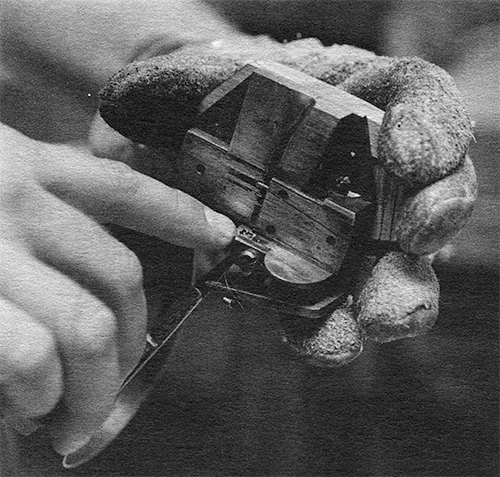
Stan Nelson demonstrated the ancient art of casting type with
the hand mold during the 1988 ATF Conference. With the
mold open, Stan shows where the matrix is positioned. The
heavy glove protects his hand from stray molten metal during
the casting process.
Photo by Nancy Abrams.
I was astonished by the range of interests and
talents our members displayed. I had no idea
that people still cut punches by hand, so it
was a revelation to discover the “craziest of
the crazies,” Dan Carr and Stan Nelson. The
West Virginia byway system had propelled my
mindset back in time, but I had no idea that
I’d be this far back. The 1980s returned the
next day when three members discussed projects
to use computers for input to Monotypes. I
think it is a great idea. Hmmm. I think I’ll
interface the computer to a punch, and then I
can run the tape on any of the six Monotypes
that will be in the garage...
The sell-n-swap meet and the auction proved
quite worthwhile for me. I had no idea what
hot metal equipment sold for. The prices were
most reasonable, and I very much regretted not
bringing more cash.
The technical sessions were great, even for a
neophyte like myself. I have never seen a
Supercaster before, but I came to understand
its operation and capabilities. Nor had I ever
seen a composition caster in action. I was
mesmerized. Then I thought back to Harold
Berliner’s discussion about disposing of your
shop. My roommate, Jack Murphy, thought the
problem moot, predicted that in another fifty
years, the typecasting hobby would probably
die out. Hmmm. In fifty years I’ll be 84 years
old; maybe I’ll be the only one left, and
there won’t be any cars in the garage, just
rows and rows of Monotypes and shelves of
mats; oh, I just hope I don’t go overboard on
these Monotypes...
3
To be honest, when I set out for West
Virginia, I figured a nice, low-key diversion
from my obsession with my 15×15 comp caster
would do me good.
Terra Alta seemed like a good idea. The
previous winter, I had bought a Thompson
(fire-engine red, no less) from Rich. I
arrived with a late-model LTD and a U-Haul
trailer.
The driver’s window fell into the door during
the trip, which didn’t bother me until we
passed over the Cumberland Gap to find
ourselves immersed in snow. Philadelphia had
been dry and warm, but at Terra Alta, we were
blinded, frozen, and in turning in front of
Rich’s house, the wheel of the trailer fell
into a snow-covered culvert. With the Thompson
holding the trailer close to the ground, we
were surely doomed, until passers-by literally
lifted the trailer back onto the road.
I figured this trip, given it likely would not
snow, had to be a piece of cake. Well, the
lecture sessions were too interesting to sleep
through. That meant I didn’t get much rest.
And then there was the jewel I had not
anticipated. Harry Wearn. The technical
sessions made me realize my obsession was
about to be given a boost.
Up to this point, I avoided doing anything not
absolutely required for the functioning of my
caster. Harry broke the mystique of the
machine. Whereas I was terrified of taking
anything apart, it now became clear that if
you are going to make type, you’ve got to take
the machine down, and adjust it for perfection
(or at least for damn good type). I couldn’t
wait to get home so I could adjust my pin jaws
and best of all, the pump and nozzle.
After my excited dismantling and re-assembly,
the application of new parts and the dawning
inkling about how the pump actually works, I
realized this caster was never going to make
another piece of type. The nozzle froze up.
The pump lever pin never revolved freely, no
matter how I adjusted the crosshead. My days
with hot metal were over.
I cursed, I oiled, I readjusted. Finally, I
called Dan Carr, hoping he could get me out of
my misery. Dan explained the virtue of
patience, and I went back to work.
Harry Wearn and Julia Ferrarie, of Ashuelot, N.H., seek out a problem with
Rich's keyboard prior to a technical session. Julia attended the Monotype School
in England, taught by Harry, prior to his retirement.
Photo by Jim Walczak
In the end, I added another caster to my
collection, a Type and Rule Caster. By then, I
had gotten the 15×15 to make beautiful
14-point type. By borrowing the display
bridge, the wedges, etc., I started casting
14- and 18-point display on the comp caster.
I still think of Harry, and what he would say
if he saw my machine. (All those worn parts,
lack of perfect timing and adjustment.) He
made me realize what a fine art typesetting
is. Watching him work made me realize that it
will take a lifetime to get this thing under
control. In the meantime, I do the best I can,
and enjoy it.
3
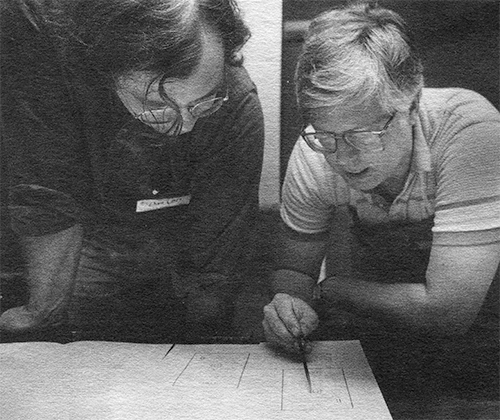
Nancy Abrams Morgantown (W.Va.) Dominion-Post
Mirror on the wall helps observers during the Super Caster
technical session. Scott Holt (left) and Dave Peat,
Indianapolis, Ind., look on while Rich Hopkins records on
video. In foreground: Paul Duensing, Kalamazoo, Mich.; Chris
Rule, London, England; David Holmes and Bob Halbert.
Photo by Jim Walczak
They’re in love with the printed word.
They’re in love with the printed word.
They’re in love with printing.
Members of the American Typecasting Fellowship
(ATF) met on a recent hot weekend at Alpine
Lake in Terra Alta. They came from England,
New Jersey, California, and other places,
sharing a passion for an ancient and dying
art, the use of metal type.
They crowded into small, warm rooms and melted
metal, flourished papers. They admired each
other’s work and learned.
The movable metal letter is the basis of
printing. The paper, the ink and design are
also important, but the entire character of a
printed piece can be determined by a typeface.
An example: Panorama is printed in Souvenir.
Compare it to the rest of the Sunday paper,
which uses Times Roman body copy.
All this type is computer generated. ATF
members might appreciate the typefaces but
sneer at the technology of it all.
They prefer to be machinists/artists,
tinkering with Rube Goldberg-type apparatuses
and fingering pieces of thick type metal to
produce impressions.
For some ATF members, their art is their
living. They are commercial printers. Others
are hobbyists. All of them, they admit, are
crazy.
“We all have to be crazy to do what we’re
doing," said Bill Riess of Honey Brook, Pa.
"That’s why we have to find people as crazy as
we are to hang around with.”
“The social aspect is far more important than
the technology,” agreed Pat Taylor of New
York. “It’s lies, stories and sociability and
a certain amount of expertise.”
The ATF was founded 10 years ago by Rich
Hopkins of Terra Alta, W.Va. “I called the
first meeting almost by accident and it’s
grown from that,” Hopkins laughed.
The group has also met in New York,
Washington, Indianapolis and Oxford,
England.
The ATF by-laws were created by Harold
Berliner of Nevada City, California. A lawyer,
Berliner works with type just for fun.
“It’s difficult to claim that I’m the craziest
in this crowd,” Berliner said. “I’ve got a big
ego but I wouldn’t go that far.”
Berliner scowled, trying to remember the
by-laws he claimed to know by heart. Then he
recited:
“1. The name will be the American Typecasting
Fellowship.
“2. There will be no officers.
“3. There will be two committees, publication
and meeting, and they are encouraged to
raise money as best they can.
“4. There shall be no further by-laws.”
Hopkins, a former West Virginia University
journalism professor, uses the latest
technologies—computers, phototypesetting—in
his business. But, as “head honcho” of the ATF
publications committee, he buries himself in a
basement filled with “at least a million”
matrices, or type molds, drawer upon drawer of
type and enough machinery to nurture his art.
Hopkins has edited and published the ATF
Newsletter for 10 years.
“Three hundred and fifty copies of each tract
circulate "all over the world,” Hopkins said.
Dan Carr of Golgonooza Letter Foundry in New
Hampshire and Stan Nelson of the Smithsonian
Institution crouched over a table, studying
papers.
Nelson started making type “when I was a kid.”
He twisted a matrix as he spoke, fingers
familiar with the gadget.
Carr is “the craziest of the crazies” at the
convention. He is a “punch cutter,” an artist
who designs and casts new typefaces. He
showed a sample of his work, a typeface called
Genesis, created for a collector’s edition of
the Book of Genesis.
He pointed at another page, also printed with
type he has carved. “That one hasn’t quite
told me what it wants to be named,” he said.
A great hulk of a man, he shows slides of his
workplace.
“To be able to cut punches is to allow the eye
of the printer creativity,” Carr told the
group. “My interest is in the touch of human
hands.”
The social aspects are far more
important than the technology.
Pat Taylor
One Sunday night, the group gathered in Rich
Hopkins’ basement. They watched Pat Taylor
twist the innards of a Thompson Caster. They
spoke at length on the merits of particular
lubricating oils for the machine.
In the back of the room, Harry Wearn watched.
Wearn, a guest from England, was the last
instructor of the Monotype School. He was with
the Monotype Corporation Ltd. for 47 years.
"Thompsons can be dangerous," Pat Taylor, Larchmont, N.Y.,
relates during his technical session, showing a partially
missing finger to prove his point.
Photo by Nancy Abrams
Wearn spoke softly. “They’re fantastic, to
preserve this as they’ve done, with this type
of craftsmanship. They go to any extreme to
keep it going.”
Although hot metal type is still popular in
Third World countries, where undependable
power supplies prohibit photo-typesetting, its
use is “dying in Europe like it did here 20
years ago,” Hopkins said.
But play no funeral dirge yet. As long as
there are cluttered basements, creative minds
and “crazy” type-freaks, hot metal type will
live.
3
(This article, along with all photos herein
attributed to Ms. Abrams, first appeared in
the “Panorama Sunday Magazine” of the
Morgantown, W.Va. Dominion-Post,
July 31, 1988.)
Paul Hayden Duensing
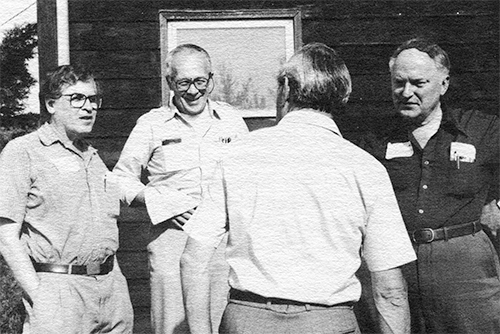
Enmeshed in casual conversation during the Friday picnic: Steve Saxe and Chuck
Klensch, both of New York City, and Paul Duensing. Guest of honor Harry Wearn
has his back to the camera.
The high country of the West Virginia hills
was not immune to the high temperatures
prevalent throughout the U.S. in mid-July,
1988. But neither temperature nor humidity
reduced the high levels of interest and
enthusiasm of the 78 attendees at the
tenth-anniversary meeting of the American
Typecasting Fellowship in Terra Alta, W. Va.
The first evening opened informally with a
showing of slides taken in the shops and
foundries of the attendees, narrated by their
owners and accompanied by free commentary from
the audience.
In the general sessions which followed, there
were lectures by Dan Carr on hand
punchcutting; Stan Nelson on casting type in a
composing stick; provisions for the
continuation of your shop by Harold Berliner;
Harry Wearn on English Monotype history; Jim
Walczak on waterways of the Thompson mold;
bringing computer technology to the Monotype
by Roy Rice; and Dave Peat on old-time
typeface patent applications.
There were also less structured sessions
devoted to the informal interchange of
information; status of research-in-progress;
and exchanges between those with spare parts
available and those in need. For the
semi-adventurous, there also was a free ride
in a tethered hot-air balloon.
The general sessions were followed by
typecasting workshops devoted to detailed
lectures on operation and trouble-shooting of
the English Super Caster and Composition
Caster conducted by Harry Wearn, and on the
Thompson typecaster by Bill Riess and Pat
Taylor.
The informal interchanges of anecdotes,
information, specimens of work and the more
formal exchange of printed keepsakes
provided—for many attendees—a most valuable
opportunity to interface with like-minded
souls. The auction of type, matrices,
specimens, tools and parts provided both
valuable source materials and high comic
relief in the selling patter of “Col.” Dave
Churchman.
Attendees voiced great satisfaction with what
they heard, saw, learned, and bought. They
came from both coasts and throughout the U.S.,
as well as Canada, Austria, and England. They
brought questions, commitment and enthusiasm;
they departed with new knowledge, friendships
and strongly renewed enthusiasm to practice
and preserve the craft of metal typecasting.
3
One of the few true decisions to come out of
the 1988 ATF Conference at Terra Alta was the
resolution to take a trip to Germany in 1989
at the invitation of our typecasting
correspondent Mr. Schumacher-Gebler of Munich,
as extended to the group by Paul Duensing.
Mr. Schumacher-Gebler had registered to attend
the Terra Alta Conference, but was stopped
because of a last-minute complication at his
office.
To spite Duensing’s vigorous efforts to pursue
the matter, group arrangements could not be
made and the trip had to be cancelled.
3
Marvelous! Seventy-eight hot-metal crazies
roared into Alpine Lake Lodge for American
Typecasting Fellowship Conference No. 6 on
Thursday, July 14, 1990. The dynamic affair
literally blasted off with an exciting hot-air
balloon ride—memorable!
After drinkies, we had fascinating
slide-talks: Chuck Klensch on European
foundries; Paul Duensing on his shop,
typographic library and foundry, the 1980 tour
through ATF in New Jersey, Ludwig & Mayer
foundry in Germany, Stephenson-Blake foundry
in England, and Plantin Museum at Antwerp;
Stan Nelson on his unique basement shop and
the Smithsonian Graphic Arts Section; and John
Kristensen on his Firefly Press.
Early Friday morning we had seminars by Nelson
on casting sorts in a composing stick, and
Dave Peat on Victorian type patents. Keepsake
packets were distributed, including a Matrix
Atlas by Duensing, reprint edition from the
Colonial Williamsburg Printshop, two-color
poster from Charlie Hinde, a Hadriano
broadside from Bruce Washbish, large folder
with three specimen sheets from Kristensen,
two-color lino cut folder from Nelson, and
many other goodies.
Dan Carr gave a magnificent slide
demonstration on punch-cutting—pure
craftsmanship. Next we were treated to an
intriguing talk by Harry Wearn on his career
with English Monotype. Later we had a
delicious buffet dinner at Rich & Lynda
Hopkins’ Open House featuring a keg of cold
Carling beer. Pat Taylor and Bill Riess were
casting new souvenir ATF logos on the
Thompson. We were amazed at Rich’s extensive
mat collection and delighted by a video of
attendees at the 1986 Indianapolis Conference.
Socializing continued
into the night.
On Saturday, Rich conducted a charming Video
Quiz, and Roy Rice gave his seminar on
computerized Monotype technologies. After
lunch, Duane Scott showed interesting videos;
also John Horn with his 1837 Hoe Washington
hand press. Carl Schlesinger presented his
talk on the Mergenthaler Linotype.
At the Saturday-night banquet, we were treated
to a slide show of the Colonial Williamsburg
Printshop, presented by Dale Dippre and Peter
Siney.
After Sunday brunch, a short business meeting
and a tailgate party, the wild ATF Auction
swung into action with Dave Churchman and Peat
in rare form, assisted by recorders Steve Saxe
and Klensch.
(Botterill did not attend the technical
sessions.)
3
Richard L. Hopkins
The new foundry building, erected to the rear of Jim and
Francesca Walczak's home, so more room would be available
to accommodate more casters.
Here’s visible evidence of what Jim Walczak
has been doing since retirement from
government service late last year. He’s built
a separate building to house his Sycamore Type
Foundry to the rear of his home at Oxon Hill,
Md.
Jim has taken to heart the experiences of
others. Note first the door, cleverly designed
to offer a full four-foot opening by the
removal of a semi-permanent panel on the right
side. Reason for the width is obvious in the
photo showing Jim inside with his Orphan Annie
half way through the opening.
Two other photos show what Jim calls the “Roy
Rice Skidding Method,” designed to facilitate
rolling Monotypes on pipes and to overcome the
top-heavy nature of the machines.
Jim reports “we were overly cautious moving
the first machine in. Then we realized how
easy it was and the others were in in no
time.”
He acquired equipment from Mike Dorsa of
Cincinnati, Ohio. He now has a Thompson,
“Orphan Annie,” an English Composition Caster,
and most of the display mats from the U.S.
Government Printing Office. Andy Carson, an
NAPA member, helped make the move.
3
Three casters await their new home in the foundry. "We were
overly cautious on the first one," Jim says. "The other two
were quickly pushed off."
In Working with the Monotype Composition Caster: Proper Diagnosis is Key to Successful Operation
Richard L. Hopkins
A problem Composition Caster operators have
with increasing frequency as matrices continue
to wear is the appearance of burrs on letters
caused when molten metal leaks between the top
of the mold and the matrix.
Some reasons, such as matrix or mold wear, are
obvious. Others escape even the most
experienced operators and since I just located
one of those elusive reasons, I have decided
to share my ordeal.
First a generalization:
If you’re using new matrices, try also to use
a new mold. The two flat surfaces complement
each other. The converse of this is also true:
if you’re using worn matrices, try to use a
mold which also is beaten down at the top. The
two semi-rounded surfaces tend to work
together to prevent burrs—within reason.
Obviously, you should check the pressure being
exerted by your centering pin in holding the
matrix against the mold at the instant of
casting. Procedure for doing this is well
explained in the various manuals. Get ‘er set
so two pieces of controller paper are too
tight, yet one thickness pulls out with a
little resistance.
In analyzing my problem, I deducted that (a)
the first letter of every line had a cold
face, (b) there were excessive burrs
considering the condition of these matrices
and mold, and (c) I had excessive spitting
underneath, between the nozzle and the bottom
of the mold.
In fact, I thought the excessive spitting was
causing the other problems, so I went through
the manual procedures designed to correct this
problem. I was thrilled to find that the
caster did not improve at all after I got all
the adjustments made.
Could the caster be pumping the metal an
instant before it should? That would explain
the spitting and it also would explain the
burrs. If the mats weren’t completely seated
before the cast, obviously a burr would
result.
Well, I decided to closely follow the
procedures found on pages 159–164 of Casting
Machine Adjustments, that erstwhile manual
produced by Lanston Monotype. The procedures
relate to piston adjustments.
My machine was badly out of whack and once
these adjustments were corrected, the spitting
and the burring were virtually eliminated. The
cold face on the first letter of each line
also disappeared.
It truly was exhilarating to experience such
an instant relief from problems which had been
tormenting me for months, and it goes to prove
the age-old adage that proper diagnosis is 90
per cent of the cure!
3
Sometime very basic information about the
Monotype system is hard to find. For example,
until recently I had not found a comprehensive
reference of “standard” line standards which
were to be used for various sizes.
The information below was found on a tiny
envelope which contained one steel standard
which accompanied a new mold back in 1939.
What it says is something I suspected, but
never had a definite reference for. So I pass
it along:
“Monotype line cellular matrices must be cast
on the line standard of the mold with which
they are used. Thus: If an 8-point face be
cast on 8-point body (solid), use line
standard .085; if cast on 10-point body (two
points of leading) use .105 line standard.
“Object: All faces cast on the same size body
will align.
“Exceptions: Certain faces are not on Monotype
line and require special line standards owing
to the extreme height of these faces.”
3
editor's note:This publication never would
speak negatively of the vocation (or
avocation) of typefounding. Yet those of us
who actually make type sometimes feel a sense
of frustration when non-typecasters ask us to
do tasks which appear to be “so simple.” It’s
amazing what obstacles we’re confronted with,
like those Vance Gerry of Pasadena, Calif.,
recently encountered trying to get his
Thompson active once again.
Richard L. Hopkins
Vance's self-image
One can have a lot of dreams over the years,
but to actually put the projects into
something tangible sometimes is virtually
impossible. When Experto of India advertised
their services at matrix making, I decided to
have mats made for some ideas I stole from
Wanda Gäg illustrations.
After a lot of correspondence and my redrawing
some of the designs which didn’t look so hot
when blown down to 18-point, 30 beautiful mats
finally arrived.
Experto apparently couldn’t do an .043 drive,
so the drive was .050, which was acceptable.
I’d get LA Type or some one else to cast the
type. (I have only a mold to accommodate .043
mats for my Thompson.) I hadn’t been too
specific as to thickness, thinking the
flat-mat holder for the Thompson could
accommodate about anything. The mats I
received were too thick to fit any holder I
had or anyone else had. LA Type was too busy
to help, so a local machinist, with what I
took to be a German accent (and thereby
gaining my trust as to his skills) machined
the hard-brass mats to a thickness we could
all live with, as well as taking enough off
the face to make the mats a .043 drive.
Weeks and months of my life have gone by—God
doesn’t want me to have proprietary
decorations. A local typefounder tells me he
can’t cast the type because his Linotype mold
(for the Thompson) can be used only for
Linotype mats and doesn’t want to disturb the
situation with experiments.
LA Type seems to be going out of business too.
So I have decided to do the casting myself.
My old Thompson is set up in Perris, Calif.
With an extension cord of almost unmeasurable
length, and some garden hoses, it might be
made to work. That accomplished, I was ready
to make type. But the machine needed some
adjusting.
My over-zealous adjustment of the knife blade
broke the casting supporting the adjustment
nut and had to be taken to Los Angeles to a
welder who did a fine job joining the casting
back together.
A few weeks later, I drove again 60 miles to
Perris whereupon the broken part was more
easily installed than I thought—after a side
trip to buy a set of box wrenches at the only
store open on Sunday.
A sampling of the Gerry ornaments cast by LA Type
I confess that I hadn’t properly aligned the
joining of the pot to the mold and the pump
lever was keyed in incorrectly. What I thought
to be a little stiffness was overcome by my
exceptional strength and the pot frame broke
at its locking point. Time to go back to the
welder.
The once-brilliant welder this time was struck
blind the instant he joined the broken
casting. Another trip to Perris (where the
temperature was now nearing 100 degrees)
revealed the welder’s affliction since the
clamp for the pot frame tang would, in no way,
be entered into. The welder (back in LA now)
has recovered his eyesight enough to tell me
he aligned the broken castings perfectly
before welding and therefore, rewelding would
be done at my expense.
I agreed to this and some weeks later,
returned to the Thompson. In 90-degree
weather, inside a cargo container where the
machine resides, I attempted to reassemble the
pot and frame. The amount of filing so
fatigued my arm that I was forced to hold my
elbow like a person freezing in a prison camp.
I hide my eyes in embarrassment for all the
shimming I had to insert to get the blasted
thing back together.
While the pot was heating, I busied myself
cleaning up months of mess resulting from
repairs to the caster, and I connected the
hoses. Then I relaxed to eat lunch in what
little shade I could find.
When I returned, I knew instantly that the
metal had melted—the choker valve had opened
and the metal had run freely into all the most
difficult recesses of the machine. Another
lengthy delay cleaning away all the metal.
Finally, I was ready to make my first cast!
The machine stopped dead at the casting
position and would not go further in its
cycle. I called it quits!
Except for one piece of type, cast by accident
(I think), the marvelous matrices remained
virgin until I was able to get them cast by LA
Type. I still am awaiting the return of
fortitude enough to try using my Thompson
again.
3
Was It Difficult Dealing With an Overseas Company?
Richard L. Hopkins
The firm mentioned in Vance Gerry’s article as
a supplier of engraved matrices is Experto
Industrial Engravers Pvt., Ltd., No. 18–4
Hadapsar Industrial Estate, Pune 411 013,
India. Managing director is Vasant Bhat, who
contacted most ATF casters by letter in 1987.
In addition to doing custom engraving on
order, the firm has engraved complete matrix
fonts including the complete Souvenir series.
A sheet with that solicitation indicated the
firm could engrave genuine foundry matrices,
single- and double-matrices for the Super
Caster, English Composition Caster (not
American), continuous border matrices for the
rule-casing machines, Ludlow matrices and
American Thompson matrices. Obviously,
however, the firm is not very familiar with
American matrix configurations. A detailed
diagram or a sample matrix might help avoid
some of the problems Vance experienced.
See articles on the next page relevant to
another source for matrices. Vance had delays
and had trouble with monetary exchange to
India, but was impressed with their skills.
3
Wilbur Doctor, who reported his revival
efforts on Updike’s private Montaltogro type
design in ATF Newsletter No. 11, has a
fascinating story to tell regarding a single
missing matrix from the original font.
In October, 1986, on a visit to the Bay Area,
he met Roger Levenson, esteemed
scholar-printer and authority on the
Merrymount Press. They got together at the
Bancroft Library on the Berkeley campus of the
University of California. As they chatted in
the library’s treasure-crammed printshop, he
told of the missing matrix.
“Now that’s odd,” Levenson responded. “There’s
an unidentified ‘va’ mat around here. I’ll
look it up.” He found it and it was
Montaltogro. The mat most likely got to
California when Merrymount Press items were
donated to the Bancroft by the son of an
Updike associate. Eventually, the mat was
returned to the Providence, R. I., Library to
rejoin the rest of the font.
A not-early-as-dramatic event along the same
vein happened recently when I remembered
finding a lowercase ‘g’ matrix in the matrix
holder of the Super Caster I had acquired from
the Government Printing Office. Remembering
also that Jim Walczak eventually ended up with
most of the GPO display matrices, I sent the
‘g’ to him.
“As soon as I received your package, I grabbed
the ladder and scrambled to my north loft in
the foundry,” Walczak wrote. “The inventory
sticker on the carton containing Century
Expanded said, ‘30 point missing g.’ Down on
the workbench, I open the carton, pulled out
the box of mats and returned the mat to the
open slot.”
Jim sent the “missing g” note to me as a
souvenir. The font and the mat had traveled
quite different paths for only about five
years. The Montaltogro mat had been separated
from its font much longer—well over 30 years.
3
Here's a New U.S. Source for Custom-Engraved Matrices
Richard L. Hopkins
Mention on the previous page of a matrix
engraving source in India might suggest to
some that such services are available in the
U.S. Such is not the case, and your attention
is directed to Kayenay Graphics, 149 Fourth
Street Southwest, Mason City, Iowa 50401.
Telephone is (515) 424–2535.
John Henry, general manager, is a long-time
letterpress hobbyist. His firm bought the
engraving equipment from Carl Solomonson,
formerly of New York, who had offered custom
matrices for typecasters and linecasters for
many years prior to retirement.
Kayenay’s primary motivation for acquiring the
equipment was to gain the capability to
engrave brass embossing dies. Nevertheless,
John is thrilled at having the ability to
continue the matrix engraving service too.
Kayenay requires very accurate artwork sized
at least 200 per cent of the reproduction
size. The more details you can provide to them
regarding what type of mat you want (depth of
drive, position of image on the matrix blank,
kind of matrix, etc.), the more responsive they
can be. Keep in mind all is new to them.
Pricing for matrices cannot be established
easily unless artwork is in hand, because the
art’s intricacy directly relates to cost.
Matrices for the border around this article
were engraved by Kayenay. I sent art sized at
300 per cent. These are engraved matrices and
therefore, if tight fitting is necessary, the
castings will require hand dressing, as was
the case with this border.
3