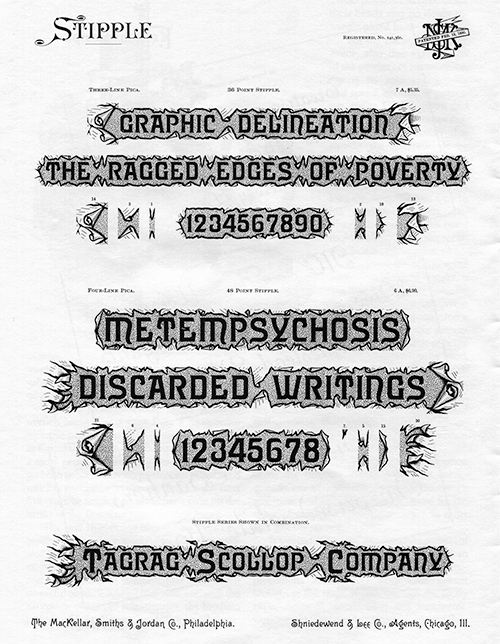
Pondering what I might want to do as a
keepsake for the 1990 American Typecasting
Fellowship Conference at Nevada City,
California, I asked myself whether anything
of great significance in our beloved "hot
metal domain" might have been going on
exactly 100 years ago. I went to bound
periodicals stored in my basement not too far
from my Monotypes and to my amazement, found
three different publications covering the year
in question.
Those volumes were The Inland Printer,
published in Chicago; The Superior Printer,
published in Cincinnati; and Paper and Press,
published in Philadelphia-all extremely
well-produced trade publications of that era.
Was anything happening in 1890? To my great
surprise, 1890 was 'THE year (if any year
could be signaled out at all) when man
finally got the upper hand in his quest to
automate the age-old manual process of
composing type.
Eighteen-Ninety was the turning point both for
Ottmar Mergenthaler and his Linotype, and for
Tolbert Lanston and his Monotype. John K.
Rogers also was very successful in that year
with his Typograph. Amidst such excitement, I
thought it would be most interesting to
reproduce contemporary articles with a bit of
my own commentary, so we-in 1990-might have a
better understanding and greater appreciation
for what was happening exactly 100 years ago.
One key reason for undertaking the project was
the chance to reproduce some of the fine wood
engravings I found in my research.
Unfortunately, reproduction hasn't always been
so good in texts and other publications
detailing printing history. I wanted to do a
publication which would show everyone that the
quality of work 100 years ago was every bit as
good as it is today, even with all the
over-rated technology we're always hearing
about.
For example, optical character recognition (OCR)
technology. Time wouldn't permit me doing the
work on my Monotype, so I decided it would be a
great opportunity for me to employ OCR software
with a flatbed scanner to convert the pages of
these fine publications right into keystrokes
which could be used in my digital typesetting
system. The software was "Image-In Read" and to
be blunt, it never got better than a 50 per cent
error rate. I soon realized I was wasting more
time with the software than fresh keyboarding
would take, so I bit the bullet and spent the
necessary time at my computer re-keying
everything.
Even still, it was fun to do and I hope this
special edition of the ATF Newsletter helps you
gain some appreciation for the many significant
events precisely 100 years ago.
The typeface used is Goudy' s University of
California Oldstyle, digital version inside,
hot-metal Monotype-cast version on the cover.
This is Qoudy' s Deepdene Italic.
3
The year was 1890. And the man who invented the
first successful machine of automating the
process of making foundry type was still alive
and active enough to tell his own story.
Let's get things in perspective. Somebody (who
knows for sure?) invented and perfected the
process of casting individual metal types
(through use of the hand mold) back about 1450.
And that invention remained virtually unchanged
for nearly 400 years-until a guy named David
Bruce, Jr., came along in 1834 with his pivotal
type caster. It's remarkable how rapidly his
invention swept the industry. David Bruce, Jr.,
was an amazing man in at least three fields: he
was an accomplished type designer and punch
cutter, he was a successful inventor, and he was
an historian of the typefounding industry as it
developed in the United States. His History of
Typefounding in the United States, printed by
the Typophiles in 1981, is evidence of that
fact. What's even more interesting is that
David Bruce, Jr., was alive and quite verbal in
1890 trying (through trade publications) to set
the record straight about what was done by whom
and when.
The son of a typefounder of the same name, David
Bruce, Jr., was born in 1802 and lived until the
age of 90 (1892). In 1890, the article below
first appeared in The Printers' Review, the
house organ of Golding & Company, and was
quickly picked up by The Inland Printer. It
gives some personal perspective on his
invention. The article: "History of Machine Type
Casting," by David Bruce, Jr., from The Inland
Printer, September, 1890, page 1129.
To get a full appreciation of the revolution
wrought by the invention of machine type
casting, it should ever be borne in mind that
all printing types, from Gutenberg in 1440
downward to the year 1827-nearly four hundred
years-were cast by the pouring process or hand
or spoon dipping, at the laborious rate of
twelve to fourteen per minute. This process was
followed by all the typefounders throughout
Europe and by Messrs. Binny & Ronaldson of
Philadelphia. It is true the ingenious Mr.
Binny had made several improvements, but these
related to the still-used hand molds.
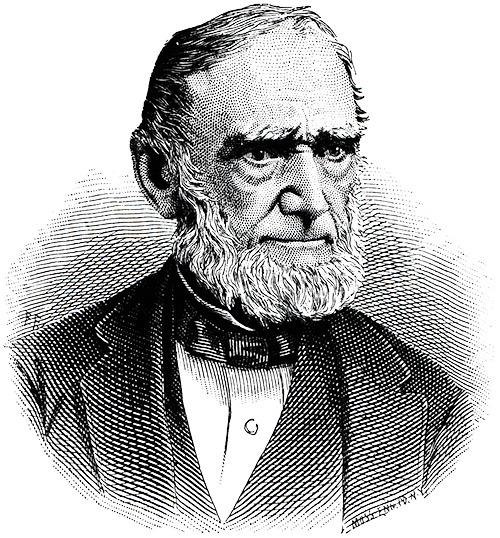
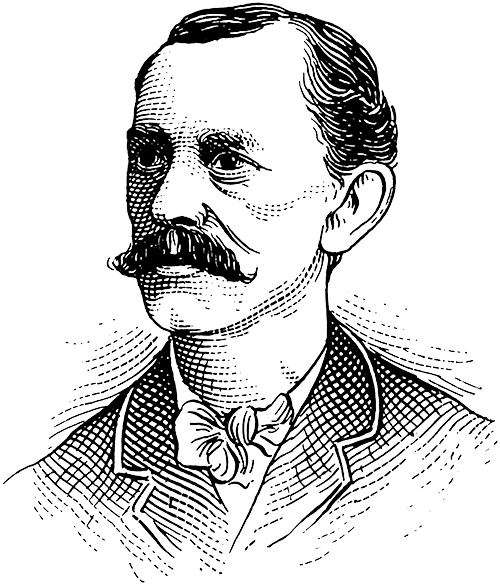
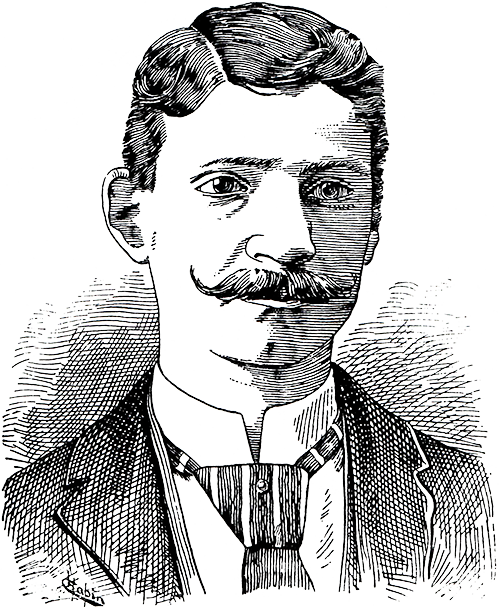
David Bruce, Jr.
From The Inland Printer, November, 1892
In the year 1804 Mr. Elihu White, of Hartford,
Connecticut, in conjunction with William Wing
and David Isham of that place (all only
theoretically conversant with the casting and
manufacture of printing type), conceived the
idea of a machine capable of casting whole
alphabets at a single dash. It was a plausible
conception. The result, however, too plainly
showed their ignorance. They had totally
overlooked the laws of unequal expansion of
metals. As it was, a patent was issued to
William Wing, of Hartford, Connecticut, August
28, 1805. Mr. White took the model to England
and in exchange received much practical
insight into the ordinary methods of type
casting, and brought back with him a few
punches and matrices, with which rude materials
he commenced type founding in Hartford in the
usual way, but removed to New York City in
1808. This feeling of improvement lay long
suppressed with Mr. White until it was revived
by Mr. William M. Johnson, a resident of Long
Island, in 1831. The outcome of all of Mr.
White's costly experiments amounting in the
aggregate to $50,000, was the complex machine
of Messrs. Mann and Sturdevant. This machine
was certainly encouraging in speed, accuracy,
and labor-saving; but alas! there was an odium
of porousness or instability which its uniform
sharpness of face, lighter weight and accuracy
could scarce overcome. True, this light weight
was urged upon printers as so much in its
favor—twenty-five per cent—vide Mr. White's
specimens of those days, 1832-1839. But it was
slow of sale. Whatever merit any machine may
have, Elihu White was the first to substitute
the force pump for the sluggish natural gravity
used by all the followers of Gutenberg.
It was a reckless resolve in the writer to
wrench himself as it were from a prospective
lucrative partnership with Messrs. George Bruce
& Co., in the year 1834, to construct, if
possible, a more perfect type casting machine
than hadyet been produced by his predecessors.
But such was his prevailing weakness, and for
the next five years he resided on his father's
farm on the banks of the Delaware River, in New
Jersey.
The year 1840 found him in New York City boldly
attempting to establish a foundry operated by
his machinery. But he found that however
superior his type might be, the fixed odium and
unreliability of machine-cast type was a
powerful obstacle against him also; and with
the exception of his old schoolmates, the
brothers James and John Harper, he almost stood
alone. Timid printers listened, shook their
heads and no doubt inwardly pitied him.
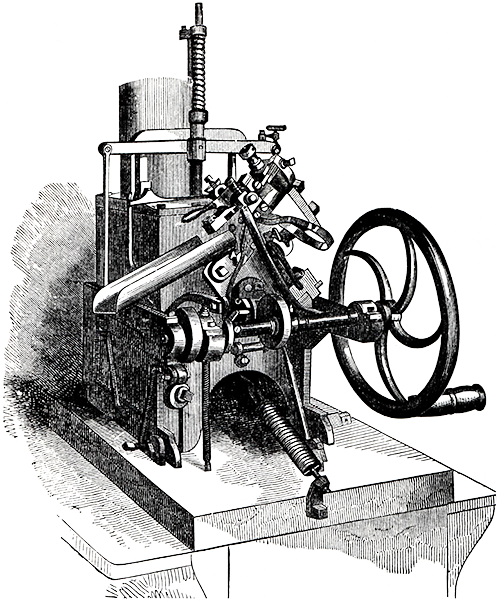
The Second Bruce Pivotal Caster
From Ringwalt's Encyclopedia of Printing, 1871
But his uncle, Mr. George Bruce, after due
examination of the product of his machine,
noting its accuracy, solidity and speed, became
its possessor, giving for the patent and
machines a liberal compensation, with the
proviso that should the inventor devise another
machine, to give him the first examination and
choice of purchase. It was not long ere
machine-cast type in his extensive foundry
displaced that made in his hand molds, without
any depreciation in the selling price.
Acting on his encouraging suggestion of
improvement, it was not long ere the inventor
invited Mr. Bruce to call over at his workshop
and examine a working model of the present
machine, one capable of being worked, as at
present, by wind, steam or water power.
Unfortunately for himself and the inventor, he
did not come personally, but sent instead his
machinist and his partner, Mr. P. C. Cortelyan,
to whom the capabilities of the invention were
explained, and its advantages over any other
preceding invention pointed out.
The indifference of Mr. Bruce to its adoption
when the inventor called upon him subsequently
was a perfect staggerer to the inventor's
ambition, and his working model stood for the
space of nearly two years in a comer, in quiet
and gloomy silence.
It was indeed a bold step for the managers of
the "Boston Type and Stereotype Foundry" to
enter again into the arena and struggle for
improvement, after having once been almost
brought to the verge of ruin through the
costly experiments of Messrs. Starr and
Sturdevant, workmen in their employ. But the
now popularization of the once-tabooed
machine-cast type, through the boldness of Mr.
George Bruce, was a strong financial argument.
Something must be done to hold their position
as manufacturers. Hence learning through my
friend Mr. Dalton of my rejected model, they
invited the inventor to give it a trial in
their own foundry in Boston, under written
stipulations defining weight, accuracy, speed
and continuity of action; and the writer must
be permitted to say that the written agreement
allowed him very little margin.
In due time the trial came off. The tests were
every way satisfactory and were what may be
called crucial. In fact the product, speed and
continuity of casting rather exceeded the
specified requirements, and both parties were
fully satisfied. The "Boston Type and
Stereotype Foundry" purchased an exclusive
right to manufacture in the six New England
states.
And the new invention fell into good hands, and
now from the once slow and laborious Gutenberg
process of spoon dipping and pouring, of
fourteen or fifteen per minute, type casting by
the power of steam has been increased to from
one hundred and fifty to two hundred types per
minute.
That the invention has not to the inventor been
a financial success he blames none but himself,
as he is not the first inventor who has failed
to profit from ideas which have enriched
others.
All inventors should be ever cognizant,
however, of the fact that most, if not all of
our prominent inventions are at best but the
outgrowth of some humble predecessor, as the
wheel-barrow was the forerunner of the
locomotive, or Franklin's electric kite was the
predecessor of the ocean telegraph or
telephone. Wonderful as are the developments
that daily occur, the world is still an
unexplored domain, but by the agency of the
press and machine-cast type the world is ever
ready for further unfoldment.
3
How was type set in 1890? Nearly all of it was
set by hand-a letter a time-by a legion of
workers who generally labored 12 hours a day
six days a week. They weren't paid by the hour
as nearly all employees today. Rather, they
were paid by the thousand ems of corrected
composition they produced. The pay? Around 38
cents per thousand, or a little more if one
worked the night shift.
Women had entered the composing room and in
great numbers. Their presence was still a topic
of heated discussion with general agreement
that women simply were not up to the task. But
in retrospect, there's question as to whether
men were either! The Inland Printer frequently
contained articles about drunken printers.
These gave a hint of working conditions. Two
articles are chosen to illustrate conditions
back in 1890 for the thousands of "comps"
necessary to get words into type.
(These help me better understand the lament of
my grandfather who asked me as a teenager-about
1955-what I wanted to do. "I want to be a
printer," was my reply. "Good Lord, Annie," he
said to my grandmother, "we're going to have
another drunk in the family." Working as a
"bouncer" in bar rooms before the turn of the
century, he had a first-hand experience with
some of the situations explained in the
following.)
Resorting to intoxicants to drive away despair,
the best of compositors are themselves driven
away to give place to men not unfitted for duty
at the case by intemperate habits.
Why despair? Wherefore intemperance? Let me
briefly sketch the checkered career of a typical
tramp printer. From the time, as a lad, he first
takes a stick into his hand, and carefully and
slowly adjusts the type, his story is an
interesting one.
He adopts the profession, perhaps, out of the
same reason that thousands of others do. Its
advantages are pointed out to him as a
profession that is not alone remunerative, but
educational; he admires the beauty of the
mechanism of printing; and office-life seems
highly desirable in contrast with outdoor labor,
where mud, rain, and snow are to be contended
with, and printing offices seem so nice and
cozy. Everyone in country towns, save alone the
printers themselves, are extolling the virtues
of the business and envying the compositors.
Under such favorable comment and observation our
tramp compositor starts upon his life work or
destruction, as it may be, as many young boys
do.
When once thoroughly imbued with the work, with
several years of experience behind him, of
course the confinement of the work marks him
with paleness. At this stage in his career, the
reverse side of the picture is shown him. His
friends begin to hint about the business being
unhealthy; and even go so far as to intimate
consumption as the inevitable result of
continuation at the case. His more learned
friends tell of the poisonous inks, type and
dust, and in some way or other give the young
compositor to understand that a moderate use of
alcohol would effectually counteract all evil
tendencies of the obnoxious scents from metal,
etc., found in the office. A longing, too, to be
out of doors in the fresh air of heaven, makes
office-life a prison.
After many years have passed, and confinement,
coupled with other effects of office-work, has
partially unfitted him for hard labor, a weak
despair fastens itself upon him. He had probably
reached his twenty-fifth year; and from his
standpoint he views life as a short stretch of
miserable existence. Nothing is visible to him
except a few more years at the case, then death.
It is then that he resorts to drink to drive
away despair.
What follows is natural; as natural as the law
of "the survival of the fittest." He is
discharged in a short time to give place to a
man of steady habits, one not incapacitated for
work by drink.
Thus, the incipiency of a dread life as a tramp
is thrust upon him by his own recklessness. No
person wants an incapable employee, and the
intemperate compositor will remain intemperate.
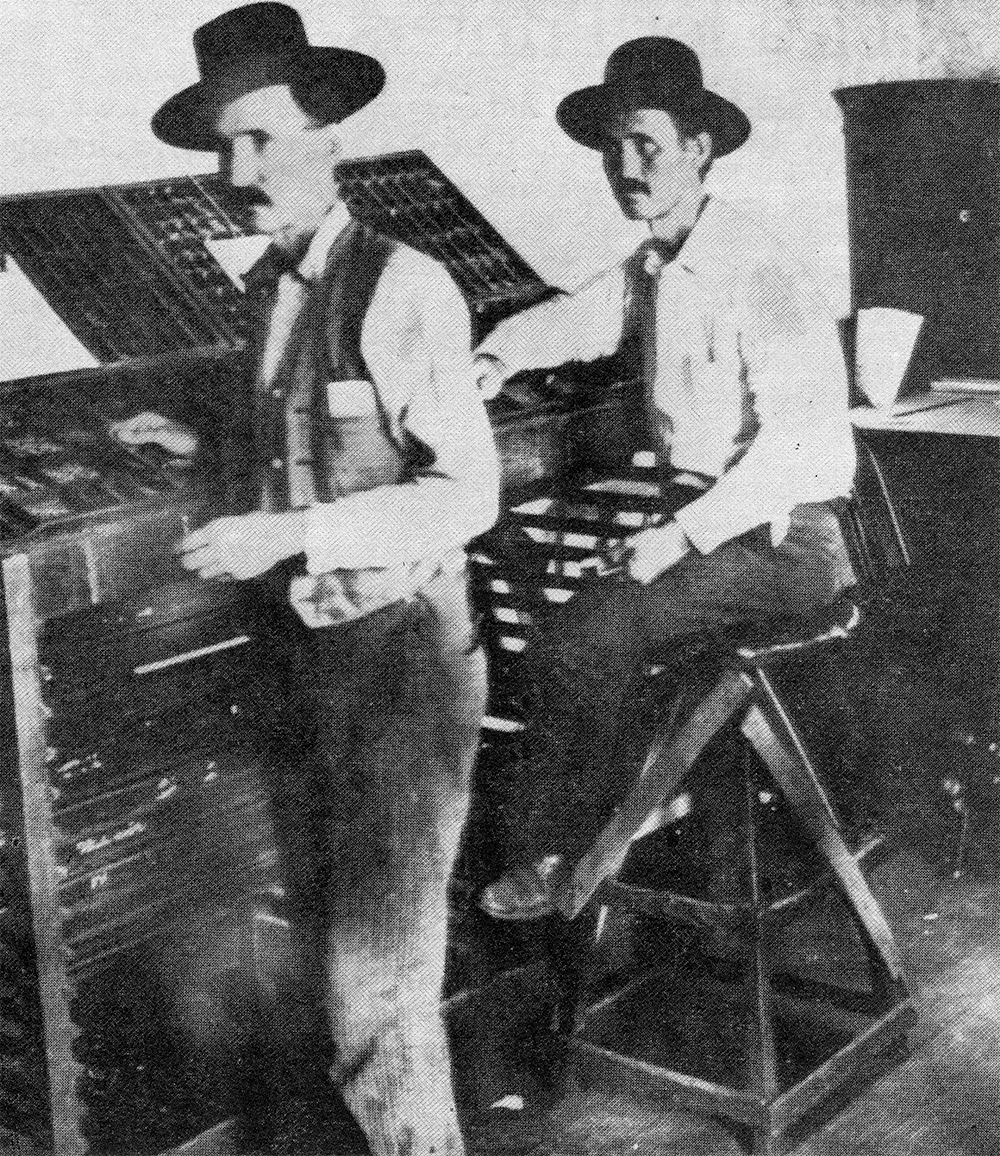
Finding representative illustrations of what the "comp" and his or her workplace looked
like is, indeed, difficult. This early photo is from Robert F. Karolevitz's Newspapering in
the Old West and depicts two comps for the Cherokee Advocate in the Indian Territory
which eventually became Oklahoma.
In his hours of soberness he is given work, but
on the recurrence of his "spree" he is
discharged; and on the downward road through
hunger, cold and gnawing thirst, the poor
wanderer goes, asking, forever asking, "How's
work?" "Can you give a fellow a show this
morning?"
Five, ten, twenty, perhaps thirty years see him
still on the road, old for his years, poor as of
yore, with dark lines of suffering and privation
deepening each furrow on his brow, living a life
of regret.
Not long will he remain with us, soon tottering
into his grave; but as sure as the sun rises and
sets, his place on earth will be filled by one
whom a little forethought or a little will-power
would save from a life of misery.
Brothers in the art preservative of arts, in any
dealing with an intemperate tramp printer, weigh
the probable inception of a terrible existence
and be charitable, at least, toward our erring
kinsmen-in-trade. Deal with him as a Christian,
humane conscience would dictate; and at last
when your form is locked in the chase of death
it will be by the quoins of love with an
assurance that all will lift.
3
So how would you react to being at the type case
all day sticking type? It would be downright
drudgery, right? But let's look at other aspects
of the workplace back in 1890. Folks often put
in unbelievably long stints at the case and
frequently seven days a week. There's no doubt
the International Typographical Union was at the
forefront of the movement to reduce the workday
to eight hours-and to restrict the work week to
six days. Much comment on these subjects filled
the pages of The Inland Printer. The article
below gives better insight into what conditions
really were like.
On every continent, in every clime, in every
section of country where civilized people reside
is to be found the ever-indulgent printer, and
in each place is cast upon him a reputation ever
the same. In success, in poverty, in weal or
woe, the poor printer is aspersed by the
untiring multitudes who rather condemn than
extend a helping hand to a suffering and
unfortunate fellow-mortal. On the beautiful
asphalted Avenue St. Charles, in New Orleans,
dotted here and there with a flower-be-decked
cottage or an imposing mansion, the cry is heard
as printers pass along: "Come in, children;
there are those drunken printers." And on the
cosmopolitan Street of Broadway, New York,
unnoticed in the motley crowd until arrested,
the remark is spontaneous: "It is only a drunken
printer." And, I may say, who among printers has
not heard someone outside the printing business
say: "Printers are a very dissipated class of
men, are they not?" Such, indeed, is the
reputation of printers-deserved or not is known
really by but few printers even.
Far away in the age of generations long gone
before us, printers were regarded with a marked
degree of respect, and that that respect to a
considerable extent has been lost to them is due
in no small part to printers themselves and in
part to the misfortune of the business acting
somewhat as a lodestone, thereby bringing into
the craft a surplus of motley characters.
There are men who love the taste of intoxicating
liquors and others who appreciate the effects
alone. These are to be found in every calling
and every sphere oflife. Very few physicians are
there who do not at times recommend or prescribe
liquors, and there are many men who find it very
essential to at times use liquor. This is
particularly so in the printing business. Very
few doubt the efficacy of the use of liquor. The
difficulty in its use as a medicine lies in the
ignorance of the quantity required at a time.
Printers, it is claimed, indulge more in strong
drink than any other class of men. This, no
doubt, is a fact, and there is every reason for
it. Let temperance advocates and ministers of
the gospel everywhere strike at the root of this
evil, if they will, and bring every effort and
influence to bear in correcting it. Let them
view the hungty man who imbibes voraciously and
the over-worked man who tipples persistently,
and they have discovered the cause which most
frequently leads to drink. Let them observe the
workings of an average newspaper office and they
will say: "Aye, go, thou, and drink, for thou
needest it."
Few readers of the many big dailies know through
what terrible ordeals printers have to go in
getting them out. As a general thing the work of
the first four days of the week is regular and
comparatively easy. During those days printers
are permitted to eat their breakfast at noon and
dinner at 5 in the evening. On Fridays and
Saturdays, however, they are obliged to rise at
10 or 11 a.m., as they have an unusual amount of
work to perform, and if they have an opportunity
to go home in the afternoon it is but to get a
bite. From the effects of these heavy days' work
they are unable to rise on Sundays until 12 or 1
o'clock in the day. The effect on one of this
disparity of rest and meals everyone knows.
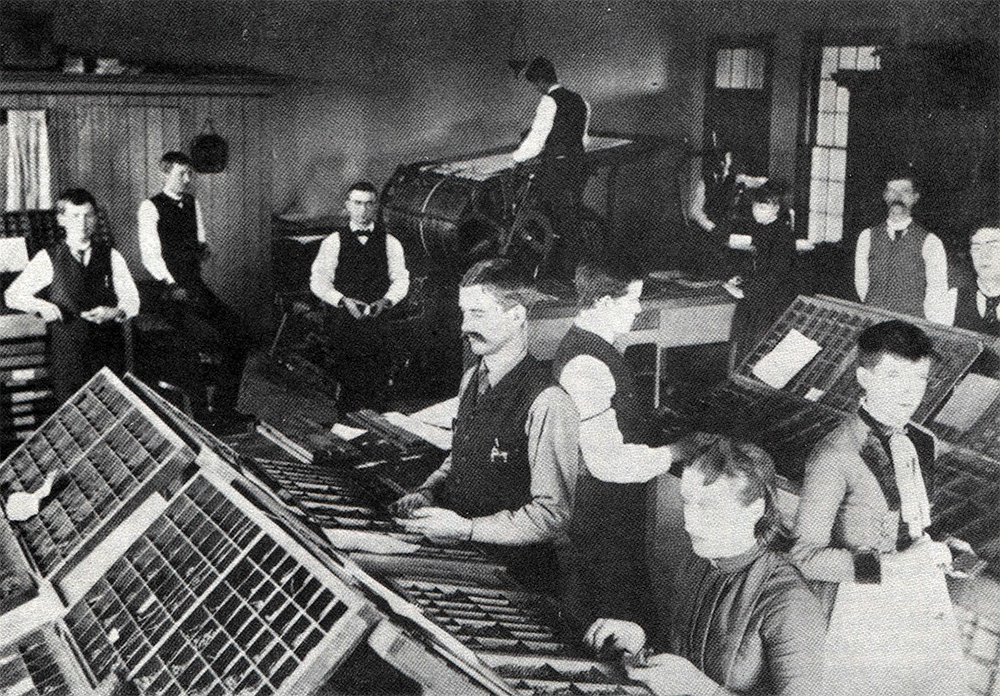
This crowded classroom situation at Kansas State University, where printing was taught as early as 1873, is a fair
representation of what conditions were like in the typical composing room before the tum of the century. Photo also
from Karolevitz's book.
It does not seem much to say that printers, as a
rule work some days ten hours and others fifteen
or sixteen, and in fact it could be easily
endured at laborious work; but when we consider
that mind, eyes and body are steadily at work
during those long hours, and at work which does
not develop and strengthen the body, but rather
nourishes from it, we can readily understand
that the body and mind crave for and require
artificial restoratives. More than this, type
dust is inhaled, and very few printing offices
are ventilated sufficiently for the number of
men who work in them, fifty to one hundred men
being sometimes obliged to work in a room less
than 100 by 200 feet square. Legislation in
this matter is seriously required-a sanitary
measure for our common good. Since such
legislation is lacking is it any wonder that
printers, after a siege of such work, should
require drink to excite the blood to exclude
these terrible inhalations? The point may be
made, do not work so steadily. In answer I would
say: One man does not know another's needs.
True, a man may work a week, following with a
three or four days' drunk. Evidently the strain
of work was too intense for him, but he was
probably forced to work that length of time to
meet a certain obligation. Did he receive a
regular salary, thus knowing the amount he could
depend on receiving at the end of the week, it
is more than likely that he would not work so
steadily. The amount of one big day's work,
especially when a "fat take" and several
"bonuses" are thrown in, is an inducement which
it is difficult for one to resist, be he ever so
fatigued.
If we would avoid this tendency toward
degeneration, all admirers of a sturdy and
robust nation must amalgamate in an effort to
regulate the hours of work on morning papers.
The extra amount of work is superinduced by a
determined competition on the part of
publishers-not by a legitimate demand of the
patrons, for who reads through the mammoth
Sunday paper? And all to the detriment and
injury of the printer, who makes a few dimes
for his extra work, and expends treble the
amount in obtaining recreation.
Some may say that the whole difficulty may be
averted by putting on extras on the big days,
but such has been tried and failed, as is shown
by statistics of the hours of work in all the
larger offices of the country: first, because
few men will hold two-day-a-week situations;
second, because the men are not always to be
obtained on those days.
When it is seen that this terrible evil exists
and that the only remedy lies in the reduction
and equalization of hours of work; that printers
are slowly but surely sliding into this
monstrous abyss in an avocation which enlightens
the world-is there the man who will stand by and
let them go as the ox led to the shambles? In
the name of civilization let the answer be No,
and action follow the word!
3
Let no one conclude that every "comp" was a
drunk and of inferior abilities. Indeed, some
were magnificent in their ability compose metal
type hour after hour. During this era contests
frequently were staged to help determine the
"fastest comp in the nation ." The report here
came from The Inland Printer, November, 1890
(page 174-175).
In case you're not familiar with the old sizing
terminology, nonpareil was the equivalent of
6-point type. The error which forced Monheimer
to concede the contest would not have resulted
had the contestants used composing sticks
calibrated to the point system, something
relatively new and advertised by the Golding
Company in The Inland Printer during that same
year. Sticks used in that contest had a sliding
knee, and were locked into place against the
prescribed number of ems set up. The comp set
the measure by assembling the prescribed number
of letter m's (28 in this case) turned sideways
in the stick. Apparently em quads were not
always perfectly square and therefore were not
to be trusted for measuring purposes, much to
Monheimer's dismay. Working to the "wrong
measure" was a devastating (yet easily made)
error, for it required that all work be
re-justified to the correct measure-a line at a
time!
To better judge their performances, consider the
average em of type contains somewhere between two
and three characters. Let's say 2½ characters.
Thienes' winning performance works out to equal
40 characters a minute of justified, corrected
composition. (Back then, poor spacing, poor
justification, improper word breaks, misspelled
words, etc., simply were not tolerated.) There
are many modem-day typists who will never do that
well!
It is explained that fairly "clean" copy
was provided to the two contestants and that
their speed was reduced by the amount of time
they took on correcting errors. This same
procedure was used in determining the pay a comp
was to receive for his work. He was paid by the
thousand ems of corrected composition he
produced. Though speed was not a direct requisite
to be a comp, rest assured if a man (or woman)
was unnecessarily slow, that person would be
removed and replaced by a faster comp.
One of the most remarkable typesetting contests
that ever occurred in this country was held in
the composing room of The Inland Printer on
Sunday, November 9. Peter Thienes, of the
Chicago Mail, and Leo Monheimer, of the Chicago
Herald, being the contestants. Great interest was
taken in the affair, as the men were so evenly
matched, each having a large number of friends
ready and willing to stake their "pile" on the
contestant they believed would surely win. The
ladies, too, took great interest in the affair
and were not afraid to back their choice.
The following are the terms under which the
match was contested:
Chicago, Ill., October 20, 1890
We hereby agree to set nonpareil type, beginning
at 12 o'clock,. November 9, 1890, unless sickness
prevents either contestant being able to work on
that day, in two stretches of two hours each, the
first to begin at 12 o'clock and continue until 2
o'clock, and after an hour's rest to resume work
at 3 o'clock and continue until 5 o'clock, for
$200 a side, a forfeit being deposited with the
sporting editor of the Inter Ocean, who is to be
the final stakeholder. Each contestant is to
appoint a manager, the two to appoint a third
party to act as referee. Each contestant has the
privilege of selecting spaces such as he wishes
to use. Should either contestant have an "out"
during composition it is not to be measured after
being corrected. The national typesetting rules
are to govern the contest in regard to spacing,
justification and correcting. The type to be used
is to be decided upon at least ten days before
the day of holding the contest. The final deposit
is to be made on the Tuesday preceding the day of
the contest.
Leo Monheimer, Chicago Herald
Peter Thienes, Chicago Mail
This is the second match the same men have been
engaged in during the last two years. Monheimer
winning on the former occasion. Thienes, however,
was not satisfied, and issued the challenge,
which Monheimer at once accepted, and chose
nonpareil as the type to be used.
Peter Thienes
William Lumsden looked after the interests of
Monheimer, while Gus Bilger anxiously waited upon
Thienes. 0. G. Wood, of The Inland Printer office
was chosen referee, and was called upon to give
some very close and exact decisions. Harry Flinn
and Adolph Scholl acted as proofreaders.
The copy given to each compositor was identical,
and was taken from The Inland Printer, the
subject being a lecture by A C. Cameron on the
labor problem, delivered in June, 1888.
Time was called at 12 o'clock, and both men
commenced steady and at a good gait and kept it
up for two hours, when they rested for one hour.
At the end of the first stretch Monheimer had set
3,666 ems and Thienes 3,598 ems gross. At 3
o'clock time was called again, and both
contestants started out to do better than they
had in the first half. The task was completed at
5 o'clock, with the following result Monheimer
had a string of 7,359 ems, Thienes having 7,305
ems, a difference of only 54 ems in four hours'
composition. Monheimer was 23 1/4 minutes in
correcting his two proofs. Thienes only taking
18¾ minutes to complete his task, 25 ems being
deducted for each minute occupied in correcting
proofs. This left the match in the following
close order: Monheimer, 6,783 ems; Thienes 6,837.
Both parties now commenced to look for the
slightest error or bad spacing, and the referee
was called upon to carefully examine the matter
set by the contestants. In going over the galleys
the referee discovered that Monheimer's stick has
been unfortunately set a three-em space too
narrow, "quads" being used instead of the letter
"m," which is correct when turned sideways;
Monheimer's stick, therefore, only contained
27 2/3 ems, instead of 28 ems of the type used.
Thereupon the referee awarded the match to
Thienes by 142 ems, his stick containing the
full 28 ems. It may be well to state that Mr.
Monheimer was not aware of the mistake and
accepted his defeat gracefully, the utmost good
feeling existing, and thus ended one of the most
remarkable typesetting.matches ever known.
The following is a short history of the two men
with some of their performances at the case:
Leo Monheimer
Peter Thienes was born in Edinburg, Indiana, and
is thirty-three years old, and is known
throughout the trade as an exceedingly fast and
accurate workman. The only public contest in
which he participated was that of Philadelphia,
when he set in thirty-three hours 60,323 ems, and
lost but thirty-two minutes in correcting the
entire amount. His best gross score was 2,912 ems
in one hour and a half; his best net score was
3,843 1/2 ems in one hour and a half. The most
remarkable run he has ever made was in this same
contest, when he set 2,734 ems in one hour and a
half, with only one turned letter. In this
tournament he won the local championship and an
elegant gold medal. He also was presented with an
engraved silver stick by the employees of the
Philadelphia Times in reward for his splendid
work in the Philadelphia tournament.
Leo Monheimer is a native of Lancaster, Missouri,
is twenty-four years old, and has been in Chicago
several years. He has never worked east of
Cincinnati. In private he has frequently set over
2,000 ems per hour. The only public record that
he holds was made in the Chicago tournament, when
in one hour and a half he set 2,600 ems gross and
2,522 ems net, and made a total set, in
twenty-one hours of 35,165 ems gross and
33,346 1/2 ems net. He is called one of the
fastest typos in the United States, and his
recent performance was one which justifies his
reputation.
3
The Inland Printer, November, 1890, pages 174-175
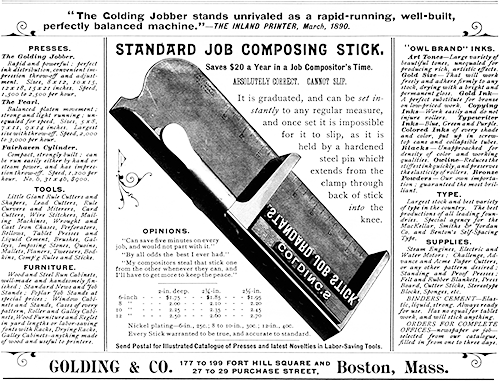
The age-old system of setting column measures by the "ems" of the type being used was slowly giving way to measures
expressed in picas because of the introduction of the American point system (discussed on page 30). This ad, from the
April, 1890, Inland Printer shows Golding's pica-calibrated stick. Too bad such sticks were not specified in the
typesetting contest lost by Monheimer because of an improper measure being used.
Now we could look back and say, "it's obvious the
Linotype was going to succeed." But it didn't
happen that easily. Printers were anxious about
what the future might bring. And editors of the
day were quick to discuss the systems being
perpetrated and, as below, project that they
might never succeed, especially in high-quality
book work. The author quickly mentions several
typesetting machines, so each is explained here
in abbreviated fashion, and two are illustrated
because such great original artwork has been
found.
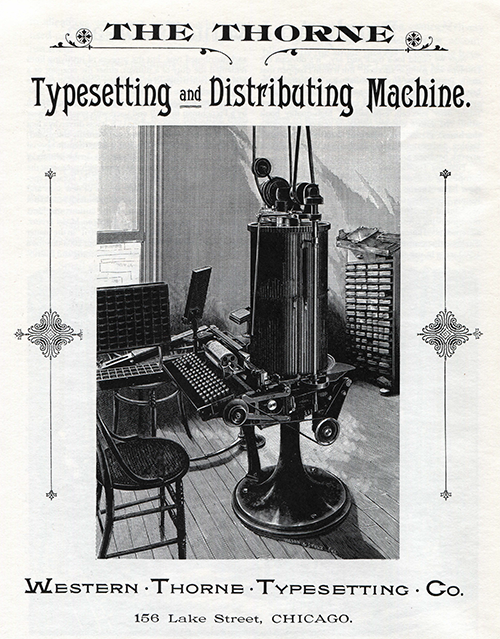
First, the Thorne, was a device invented in 1880
for composing and distributing specially nicked
foundry type. "The Thorne had a long, varied and
successful history," according to Dick Huss in
his The Development of Mechanical Typesetting
Methods. In 1890, it was the only machine being
advertised in The Inland Printer—the same ad
reproduced herein ran in several issues during
the year. The machine evolved into the Unitype
and by 1903 over 1,500 were in use throughout the
country. It assembled and distributed type, but
the process of justifying lines remained the duty
of a human, either the operator or a second
person assigned to get greater production out of
a single machine.
Next was the Kastenbein, invented (according to
Huss) by a Frenchman in 1869 and used with
greater or lesser success both in Europe and the
U.S. It was driven by a foot pedal. Distribution
was still by hand (partially automated) and
justification was by hand. It did not require
special nicking on type, and John Thompson, in
his History of Composing Machines, says it was
used with success at the London Times in
combination with a Wicks Rotary Typecaster which
provided a steady stream of new sorts and thus,
eliminated the need for type distribution. I
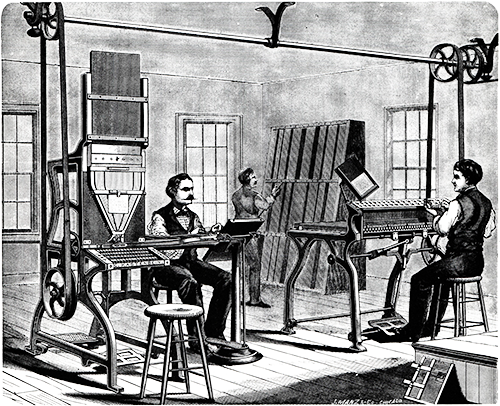
could not resist printing the illustration of
this curious machine, pulled direct from the
pages of American Model Printer, June, 1887,
page 233. Therein, it was stated "In the matter of
speed, when it is considered that about 200,000
ems a week is the output of one of these composing
and distributing machines, with at least three
operators, one to set, another to space out and
arrange the lines, and a third to keep up with the
distribution-then the actual result is not so
enormous. In other words, three operators and two
machines are required to do the aggregate of three
good hand-compositors, with about 56,000 ems gain
in favor of the machine compositors. This is not
deducting from the machines their cost, wear and
tear, interest on money invested, nor the damage
to type by contact and fall."
The Alden Typesetter alluded to had been in a
state of development since 1857. It was never
fully developed, yet patents were still being
taken out by its later developers as late as 1910.
It was a device for assembling and distributing
specially nicked foundry type. Justification was
by hand.
Another machine is mentioned as "Colt." The only
hint on this name is Legros and Grant's
Typographical Printing-Surfaces, which notes the
Paige Typesetter was built by The Farnham
Typesetter Company, which had works in the
building of the Colt's Firearms Company. Shall we
assume the editor was speaking of the Paige
machine? It was first proposed in 1873 and ' was
in a constant state of development/ abandonment,
helping Mark Twain waste a fortune in the process,
until its very successful unveiling and test in a
typesetting contest in 1894. It won against the
Linotype, but by that time the investors opted to
abandon the project after they determined they
could not price it in competition with the already
succeeding Linotype. Only two machines were built.
Interestingly, the March, 1890, edition of The
Inland Printer reported the following (page 560):
"The Page (sic.) typesetting machine is finally
done. The cost has been about $500,000, of which
Mark Twain has spent $100,000. He is now principal
owner. It is proposed to form a joint stock
company for the construction of the machines on an
economical scale. This plant and working capital
will cost about $1 ,000,000. When it is ready,
machines can be turned out in quantities at a cost
of a little less than $6,000 each, then selling
for $12,000..."
The Paige was a mechanical masterpiece and anyone
curious about its operation must read Legros and
Grant's detailed discussion of the machine. An
ankle also appeared in the ATF Newsletter, Number
8, January 1983, page 10.
The Mergenthaler machine with which the Paper and
Press editor was familiar was the "Blower" machine
(see next reprint); and the Rogers Typograph was
introduced in 1890 (article herein). But for now,
let's hear what the editor of Paper and Press
thought the future held for "mechanical
contrivances" designed to set type. The article
appeared in the February, 1890, edition on page
106.
A beautiful woodcut rendering of the Kastenbein typesetter, taken from The American Model Printer, January-March,
1881. With this machine, composition was controlled by a keyboard, but distribution and justification still were largely
manual operations.
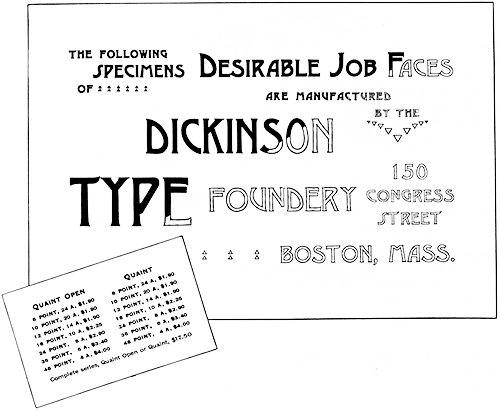
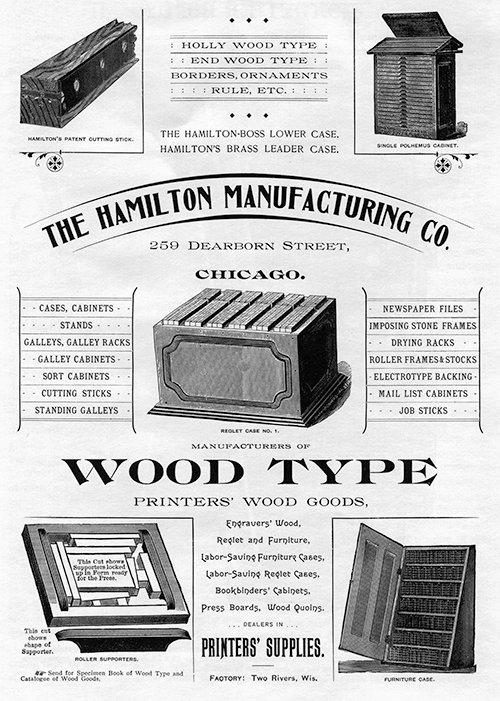
This is a slightly reduced version of the Thorne ad which ran in several editions of The Inland Printer during 1890.
Indeed, the Thorne was the only typesetting device advertised during the year. The Thorne typesetter was, perhaps, the
most successful device marketed which actually composed foundry type.
While we believe that labor is never injured by
mechanical invention, there are many of its
domains that the latter has attempted to occupy
with but little success. This is especially true
of the type-composing and distributing machines,
of which so large a number have been invented.
Each month, as the Patent Office Gazettes are
issued, improvements appear on minor details on
some one or other of these now well-known
machines. Either it is the Thome, the
Mergenthaler, the Alden, or others, in which some
minor part receives attention.
We have endeavored to present in past numbers a
record of inventive genius in this class of
mechanism, and in the present issue an
illustration and description are given of perhaps
the latest improvement on that ingenious assistant
to the compositor proposed by Alexander Lagerman,
of Sweden.
However near may be the day on which the last
compositor will lay his stick down for good we
cannot say, but thus far a careful examination of
the various systems already perfected and in
so-called practical operation discloses one and
the same obstacle to their introduction, and that
is the complexity of their construction which, in
spite of declarations to the contrary, renders
them extremely liable to derangement.
In connection with the working of the mechanical
contrivances here referred to, the central
difficulty in type-composing machines, and an
indisputable one, is the difficulty of human
ingenuity to devise a machine which will be able
to space a line as accurately as a skilled
compositor. Then the question of complicated parts
is a weighty one, the Alden machine for instance
consisting of no less than 14,625 parts, many of
them of very delicate construction, weighing in
all nearly 150 pounds.
It must be confessed that in plain work with one
kind of type, several of the extant machines give
satisfaction, but there is even a difficulty here
in the absolute necessity to furnish the operator
with perfectly clear and clean copy-a condition
which in many cases cannot be complied with.
Some of the machines call for special type or at
least modification of the existing styles,
together with other conditions quite outside of a
strictly practical application, so that the
machine in many instances is merely noteworthy as
a curiosity of mechanical construction.
It is unquestionable that the systems known as the
Kastenbein, Colt, Thome, Mergenthaler, etc., have
to a certain degree demonstrated their
possibilities of practical operation, but these
systems demand such skill and experience from
those in charge of them, and present so many
difficulties in the details of setting and
distributing, that there is no ground for
regarding them as yet perfect.
In the Mergenthaler system the disadvantage lies
in the necessary rejection of an entire line of
type when a single space or letter happens to be
omitted by the operator, who cannot correct the
slightest error made by him save by throwing out
the casting of the whole line and beginning over
again; what he would do with a piece of blind
copy is difficult to say. In order to achieve
the brilliant success which is claimed for the
system, every line of copy must be edited, every
paragraph marked, every difficult or unusual word
carefully spelled out in the plainest manner
possible; this, which is an expenditure of time
and labor, is a legitimate charge against the
system.
Of the late invention in type-setting machines the
majority have been improvements upon already
existing systems rather than original methods to
dispense with type-setting by hand. In this
category falls the Mergenthaler machine, which
applies the principle of the stereotype-plate to
the completed matrices of each line. To the
newspaper office its possibilities are doubtless
satisfactory, but for fine editions in competition
with first-class hand labor it is purely an
inventor's dream.
Another difficulty is that of cutting accurate and
artistic dies, striking the matrices and casting
perfect type. It would seem that a blind force, no
matter how skillfully controlled and guided, can
scarcely have intelligence enough to moderate its
blow according as the metal happens to present a
softer surface at one moment or another.
It is undoubtedly within the realm of possibility,
and indeed it is highly probable, that some one of
the systems of type-setting by machinery will in
the future play an important part in ordinary book
and newspaper printing, but the fine editions as
well as all manner of display work will hardly be
accomplished by this aid.
Another objection to the type-casting principle is
the difficulty of obtaining a deep and clean
stereotype-plate from such typefaces. It cannot be
done for the same price, as the extra dressing and
cutting away necessary to bring the plates up to
standard would add to the ordinary rates.
Taking as a specimen of the work the circular
issued by the Mergenthaler Machine Company, the
disadvantages are evident. Like the typewriter,
its prototype in one sense of the word, there is a
total inability to keep certain letters when they
fall together from having a crowded appearance.
Of the type-setting machines proper, the Thorne is
commanding the most attention at the present time
as coming nearer to the realization of the
inventor's claims. It is unquestionably a marvel
of mechanical ingenuity and has been greatly
improved since it was first exhibited. An
intelligent child, it is said, may work the
keyboard, but it may also be remarked that no one
but a skilled mechanic could readjust any of the
parts if thrown out of gear, or repair any portion
of the mechanism if broken or injured. For this
reason the machines are principally adapted as
residents of large cities near mechanical
workshops where aid may be quickly had, broken
bits of mechanism replaced, etc.
Women are slowly but steadily pressing into the
composing room, in England more than here; this
means a great reduction in the price of
composition and a consequent lessening of the
advantages achieved by the type-composing machine.
We hope at some time to see the objections we have
stated overcome and will receive with pleasure the
announcement of a perfectly practicable machine,
where simplicity is achieved and fewer working
parts embodied, and where the cost is not such as
to prevent any but the largest and richest offices
from possessing them.
3
Before 1890, Ottmar Mergenthaler was having
difficulty with the consortium of newspaper owners
which had taken control of his company. At first
they encouraged him but once most of them had
their machines in their plants, there was some
thought to restricting manufacture, discrediting
it, and thus hiding the obvious production
advantages they were enjoying so they alone could
reap all benefits. We ' re speaking of the "Blower"
machine, which was Mergenthaler's first production
model. The name stemmed from the machine's use of
compressed air to carry matrices from their
compartments into the assembler section. As
production on these machines ensued, Mergenthaler
was constantly finding better ways of doing things
and he wanted to incorporate improvements into
subsequent machines produced. Such changes were
hindering production and thus, he was given
specific orders to stop his innovation and
concentrate on production. Mergenthaler would not
do this so he was removed from production
activities. A complete account of these events is
provided in Carl Schlesinger's book, The Biography
of Ottmar Mergenthaler, Inventor of the Linotype.
An operational model of the "Blower" is on display
at the Smithsonian and a retrospective study of
the machine will reveal its many shortcomings.
Even still, it was successfully operated in many
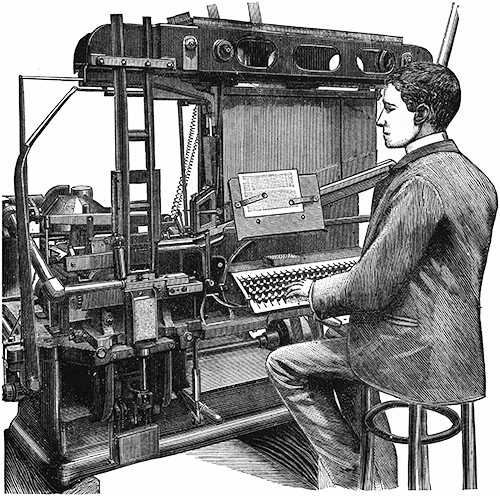
plants-about 200 were manufactured. The article on
the next page was printed just one month before
our magical year of 1890. It is reproduced both to
supply information on the machine actually in use
in 1890, and to display a very good wood engraving
of the machine itself. The article is from The
Inland Printer, December, 1889, page 272.
The Inland Printer herewith presents to its
readers a cut of this wonderful machine, which
will give a very correct idea of its appearance.
To describe its entire mechanism, so as to give
the reader an understanding of it, is almost, if
not quite impossible, but a short description, in
a general way, may not be devoid of interest. It
resembles a typesetting machine, in that it has a
lettered keyboard. These keys are connected with
a number of perpendicular tubes, shown in the cut,
directly in front of the operator. In these tubes
are placed the matrices, no type being used in
this machine, representing all the characters of
a book or newspaper font. When a key is touched
one of these matrices drops into an inclined
channel, along which it is carried by an
air-blast to its proper place in the line-gauge
where the line is formed. Spaces, or more
properly speaking, spacers are automatically
placed between the words simply by touching a key,
the same as for a matrix. When the linegauge is
full, or as nearly so as a line of type usually
comes to proper justification in an ordinary
composing stick, the operator touches a lever-key,
shown just to the left of the keyboard proper,
and the line of matrices is then carried off to
be properly justified and cast. The spacers being
wedge-shaped, perfectly even spacing and
justification is accomplished by these being
pushed up between the words until the line-gauge
is filled. The line of matrices is then carried
just a little forward to the metal pot when the
metal is forced in and the work of casting is
accomplished. Enough time is allowed for the
metal to cool, after which the line is trimmed
to thickness and height to paper, and when
completed resembles a line of solid type. In this
resemblance originated the name, i.e., Linotype,
or "line o' type." Herewith we show three lines
cast on one of these machines in the office of
the Providence, Rhode Island, Journal, in the
presence of our representative who was kindly
permitted to inspect their machines.
After the casting of each line has been
accomplished, the matrices are sent back
mechanically and distributed into their
respective tubes with unerring correctness. All
these operations are performed automatically,
without in any way detracting the attention of
the operator from his work at the keyboard, this
work consisting of manipulating the keys and
pressing down the lever, at the completion of
setting each line of matrices, to set the
various mechanisms into motion.
3
A critique of the "Blower" Linotype, in Ottmar
Mergenthaler's own words, was as follows: "The
1886 machine required an air blast for propelling
the matrices and for heating the gas, which was
found to be very noisy and objectionable in a
number of ways . The keyboard touch was hard and
not uniform, it took some practice to operate the
keyboard without causing matrices to fly out of
the channel, the locking up and alignment
features were rather unreliable, the distributor
was not as strong as it could be, and the machine
as a whole lacked that ease of accessibility
which is so necessary to keep machines in their
proper condition ." This is a quote from his
biography, included in Carl Schlesinger's book as
already noted.
Being removed from the manufacturing operation
and with nothing else on his mind (a status
Mergenthaler deplored and resented), he set out
to correct problems and come up with an even
better Linotype. The end result was a machine
which served as the basis for virtually all
future Linotype development.
The Linotype as we knew it for so many years was
introduced in-you guessed it-1890! Here's a
prelimary review of the machine. A more derailed
discuss illustrated with a superb wood engraving
of the sq'base machine, also follows. The article
below is from The Superior Printer, March-April,
1890, page 270. It had been lifted from American
Bookmaker, something frequently done by editors in
those days.
The Mergenthaler type bar casting machine has
recently been much altered, its construction
simplified and its working rendered noiseless.
So far in America, only four machines have been
put to extensive use to aid and supplement the
work of the compositor. The two earliest, the
Mitchel and the Burr, have run their course.
Their work was well done, but few employers saw
any advantage in them, and the first was
discarded, while the latter is now used in only
two places. The Thome, the third,is increasing
its sales day by day, while the Mergenthaler, the
fourth, after undergoing many changes, has been
altered so that many of its peculiar features
have been eliminated, and those who knew it
thoroughly once will be unable to recognize its
movements.
The machine is about 4 feet wide, 5 feet deep
and 7 feet high. In front is a keyboard,
somewhat like that of a type-writer, but longer
and larger. The lower case letters are at the
left, the figures in the center and the captials
at the right hand side. The impulse required to
move these keys is very slight. When they are
struck, a catch in the upper part of the machine
releases a brass die, in size similar to a bit
of long primer column rule two-thirds of an inch
long, but cut away in grooves at the sides and
ends. This has on its edge the character to be
cast, but hollow, and not in relief. When this
matrix is dislodged it falls down a groove till
it strikes against an incline which forces it
against the next preceding character. This was
formerly done by a blast of air. A sufficient
number having been brought together for a line,
the characters are placed on their feet; when
the blanks or thin wedges are introduced, which
spread apart the words as far as necessary to
justify the line; the characters are still
further straightened, so that each one is
exactly on a line with all others, and the slug
is then cast, a perfect reproduction of a
stereotype line with high spaces. Before casting
takes place the letters can be examined by the
compositor to see if any error has been
committed, as they are in a convenient position
for this to be done.
The cast is made as it is in a type foundry,
except that as the line has a great deal of
metal, more than even the largest letters cast
for a book office, it ought not to and does not
chill before every letter is perfectly formed.
An arm reaches down to this part of the machine
when this operation is completed, catches the
matrixes that have been used and lifts them up
to the top, there to be distributed. The casting
is extruded at the front and forms part of the
column which is being set. When the matrixes
arrive at the top they are moved along in a
channel and are distributed by the notches and
hollows on their edges. If these perfectly match
projections which they meet, as the key meets the
wards of a lock, they drop and are back again in
the places from which they originally came. The
operation is complete.
The alignment of the characters seems to be
perfect. There are not many imperfect letters,
and the slugs appear to be perfectly true and
square. It is claimed by the managers that there
is very little stoppage and that very few repairs
are needed. The blast of air and the electric
communicator are no longer required, and there is
no difficulty in seeing the progress of the work
at any time. It is asserted that 5,000 ems per
hour can be set by an expert and 4,000 by a slow
operator; that in a week or two a beginner can
become expert; that most literal errors can not
take place; that no separate justifier or
distributor is required, and that there is an
economy of from 60 to 80 per cent achieved by
using this apparatus. A statement has been made
by the Providence Journal to the effect that $250
a week is saved on its bills, the workmen making
as much as before and all of the expenses of
repairs, gas and power being included, which were
not included in the New York Tribune statement
previously circulated.
3
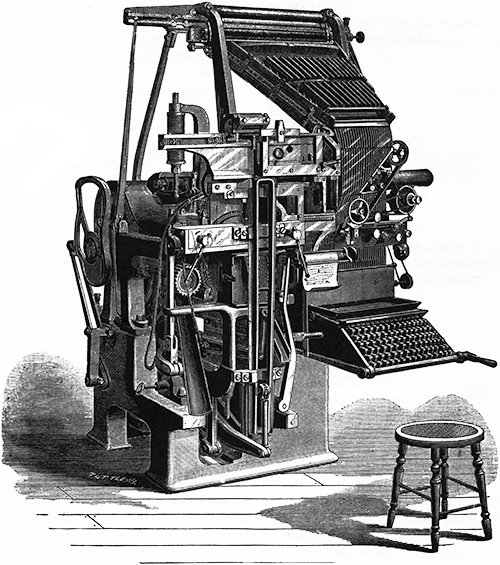
Here's a very detailed discussion of
Mergenthaler's new machine of 1889, accompanied by
one of the very best illustrations (a wood
engraving) of the Square Based machine already
mentioned. As the article indicates, the actual
copy was composed on the Linotype and the original
piece was printed direct from Lino slugs.
Curiously, the article would serve well to explain
the process to folks today who are not familiar
with how the machine worked.
A very cursory study of the typeset article
reveals the machine at this stage of development
did not yet have two-letter matrices and therefore,
italics were not available for the names of
publications and/ or emphasis, notwithstanding the
third claim listed in the article. Some of the
general rules relating to punctuation (quotes
within quotes) were not followed and I have chosen
not to attempt to correct these obvious problems.
The piece comes from Paper and Press for December,
1890, pages 357-359. Illustrated here is the
so-called "Square Based" Linotype, which actually
was introduced in 1889. The "Simplex" Linotype
followed in 1890 and Mergenthaler explained the
differences in his biography.
Having been removed from manufacturing activities
(and literally from the original company),
Mergenthaler found time on his hands so he went to
work improving the machine's defects. The result
was a radically changed device introduced in 1889,
called the "Square Based" machine. It was brought
to trial and proved to be an unqualified success.
However, "it was entirely too heavy, a fault
brought about by the draughtsman's general
inclination from which he could hardly ever free
himself entirely." It was decided to lighten the
patterns as much as possible and to build from
them a second machine which was to serve as the
pattern for large numbers to be built thereafter.
This "Improved Model l" ( or "Simplex") served as
the basis for virtually all future Linotype
machines until the Electrons of the 1960s.
When in July, 1886, the first Linotype machine was
placed in the composing-room of the "New York
Tribune," to be used in the regular daily work of
that paper, the first practical step was taken in
revolutionizing the art of printing by raising the
unit of composition from a single letter or
character to an entire line of type. The "Tribune"
was rapidly followed in this innovation by the
"Louisville Courier-Journal" and the "Chicago
News," and some time thereafter by the "Providence
Journal." Notwithstanding the predictions of
failure on all sides, the machines have never
failed to perform the task allotted to them and
the daily appearance of those journals before the
public has been entirely dependent upon the work
of this wonderful automation. To-day over 150 of
them are in regular operation in various offices
in the United States and Great Britain, doing
substantially all the work of composition which
had been previously done by hand, with great
economy of time, labor, and cost, as will appear
from the following:
The foreman of the "New York Tribune," in an
affidavit under date of November 14, 1890, states
that "during the past twelve months there have
been produced in the "Tribune" Office by the
Mergenthaler machines about 274,472,000 ems of
matter, which cost about $80,000 less than it
would have cost if set by hand in movable type in
the usual manner;" and in this he does not
include the savings effected by dispensing with
the purchase of type.
Walter N. Halderman, publisher of the "Louisville
Courier-Journal," in an affidavit under date of
November 17, 1890, states that "during the past
year the machines (Linotype) used by me have
produced about 184,102,800 ems of matter at a
cost of about $35,000 less than it would have cost
at the prevailing rates if composed in the
ordinary manner from movable type."
Victor F. Lawson, publisher of the "Chicago
News," in an affidavit under date of November 20,
1890, states that: "My long practical use of the
machines (Linotype) has demonstrated the fact that
they reduce the cost of composition in the "News"
office from fifty to sixty per cent, as compared
with the methods previously in use."
Similar testimony is furnished by the proprietors
of other establishments as to the value of the old
Linotype. It is claimed that the New Linotype,
which is now presented to the attention of the
trade, is more compact and simple in its
construction, more certain in its action, and less
liable to derangements in its working than its
predecessor.
The main changes in the new machine consist in the
substitution of a delivery belt for a blast of air
to transfer the matrices to the point of
assembling; in the more certain and simple
arrangement of the magazine for receiving, holding,
and delivering the matrices; and, especially, in
the simplification of the distributing mechanism.
The machine is styled the Linotype for the reason
that it casts solid lines or type-blocks to be
used in printing, instead of individual type "set
up" and "spaced" to make the required measure, the
object being to dispense with the employment of
movable type and the necessity for "distribution,"
which attends their use, and thus to reduce the
labor and expense of composition.
A series offinger-keys, similar to and as easy
of touch as those of a typewriter, control the
operation of the machine, each key representing
a letter or character to be printed. The
manipulation of the keys results in the
production and assembling of an indefinite number
of single-line type-blocks, each of which is cast
in metal by the automatic action of the machine,
and bears on its edge the letters and characters,
evenly spaced, to print a complete line. When
locked in the chase, these linotypes are ready
for the press without further preparation.
To form the linotypes, a collection of matrices
or female type is used, each matrix containing
the inverse representation of a letter or
character. These are arranged in the channels of
a magazine, provided with escapement devices so
connected with the finger-keys that the touch of
a key is followed by the discharge of a matrix
bearing the same character.
The "spaces," which are long, tapered wedges,
are arranged in a magazine, and are similarly
discharged.
As the matrices emerge from the magazine, they
are received on an inclined traveling belt, by
which they are delivered, one after another, into
a receiver, in which together with the "spaces"
they are composed or assembled in line; and the
mechanism is so arranged that the matrices
furthest off comes into position as quickly as
those which are nearest, and all danger of
transposition of the letters, even when the
machine is worked at its greatest speed, is
avoided.
When all the characters to appear in a line
are assembled, the operator depresses a key and
the assembled line of matrices and "spaces" is
transferred to the face of the mold. In this
position the "spaces" are automatically adjusted
to elongate the line to the required limit, or,
as it is technically termed, to 'Justify the
line."
A melting-pot, containing an abundant supply of
molten type-metal and provided with a force-pump,
is connected with the mold. As soon as the line
of matrices is presented to the front, the pump
causes the molten metal to flow into and fill
the mold, where it solidifies in the form of a
bar or linotype, bearing on its edge the impress
of the matrices, which are, for the time being,
assembled in the front.
The machine then automatically withdraws
the matrices, moves the mold, planes the cast
metal line, ejects it, and deposits it on a
galley in proper order with those which preceded
it. As soon as the line of matrices and "spaces"
is withdrawn from the mold, the machine
automatically picks out the "spaces" and returns
them to their appropriate magazine, while the
matrices are transferred to the distributing
mechanism, by which they are returned to the
respective magazine channels from which they
started.
If more than one cast of the same line is
required, as is frequently the case in newspaper
advertisements, the touching of a lever at the
operator's left will stop the distribution and
return the line intact, to be again cast; so that
the same line may be multiplied indefinitely
without being again "set up" or assembled.
The distribution mechanism consists essentially
of a single bar extending horizontally above the
upper ends of the magazine channels, having along
its sides a series of horizontal ribs, differing
in number and arrangement, over each matrix
channel. The V-shaped upper ends of the matrices
are provided with teeth by which they may be
suspended from this bar while being moved
lengthwise thereunder.
As each matrix is propelled along the bar, its
teeth may engage and disengage certain of the
ribs. When the matrix reaches the point directly
over its appropriate channel, all of its teeth
are, for the first time, disengaged from the
ribs of the bar, and being no longer supported,
it falls by gravity into the magazine, there to
remain until all of its predecessors in that
channel have been called into use.
The mechanism by which the matrices are
transferred to the distributing bar and then
carried along the bar in the manner above
described is simple and effective, and the
distribution is accomplished with great rapidity
and absolute accuracy.
The number and variety of the automatic
functions which the machine performs is most
astonishing, and they proceed in due order with
the precision and regularity of clock-work. The
only thing the operator is required to do is to
manipulate the finger-keys; the machine does the
rest.
Recognizing the fact that the machines are to be
used largely under the hurry and severe pressure
of getting out great newspapers, the inventor
has caused them to be constructed in the
strongest and most substantial manner. They are
operated by a small expenditure of power, and
are free from excessive strain and wear.
Errors can be corrected by the operator as he
proceeds with the assembling of the line. Each
matrix has stamped on the edge facing the
operator the character which it represents; so
that he has constantly in view the matrices "set
up," and any mistake can be rectified before
casting the line. The liability to make mistakes
is by this method reduced to the minimum; for,
in the first place, the operator has to touch a
key on which the character he desires to "set"
is plainly represented, and, in the next place,
the entire line of characters assembled is
before his eyes just as it would appear on the
printed page. Experience in the use of the
Linotype in various offices for the past three
or four years has demonstrated that proofs by
this process are much "cleaner" than by the hand
system, as none of the errors of careless
distribution or turned letters can occur.
Proof corrections and authors' changes are made
by recasting the lines, where necessary, and
require far less time to accomplish than when
made in a galley of type.
This statement is fully verified by the letter
of Mr. William H. Rand, of the printing house
of Rand, McNally & Co., of Chicago, under date
of May 3, 1890, in which he gives the results
of a series of experiments to determine the
relative length of time required in the
correction of a galley of the Linotype as
compared with hand work. In some 4,600 ems of
matter, taken from the daily press, there were
introduced numerous errors of all sorts,
including "outs" and "doublets." In this
condition the matter was given to an operator
on the Linotype as copy. After setting the
matter with all its errors, a proof was taken,
and the galley corrected by him. An accurate
record of the time occupied showed that the
composition took one hour and five minutes
and the corrections twenty-seven minutes. The
copy containing the same errors was then given
to a first-class hand compositor in the office
of Smith & Porter, of Boston, who occupied
five and one-half hours in the composition,
and one and one-half hours in correcting the
galley. In the latter case, the type yet
remained to be distributed, which would
certainly require an hour and a half's work,
while the Linotype distribution is automatic.
The capacity of the Linotype is the capacity
of the most expert operator who may be
employed upon it, for there is no touch,
however rapid, to which it will not instantly
and certainly respond.
A compositor will ordinarily "set up" about
one thousand ems an hour, and one-third of
his time, in addition thereto, is required to
"distribute" his type, or return them to the
case. The machine performs both these
operations simultaneously, and at a speed
equal to that of a typewriter. The ordinary
typewriter operator makes a speed of about
forty words per minute, which is equivalent
to 6,316 ems an hour; and this amount should
be set, after a few weeks' experience upon
the New Linotype, by any one competent to
operate it. There are no stops or waits and
the operator goes on continuously, for, when
once discharged from the magazine, by the
simple touch of a key, the matrices perform
the rest of their mission and the line is
justified, cast, and distributed, without
thought on the part of the operator.
The most intelligent and influential members
of the Typographical Union are now satisfied
that the Linotype is a success and that it
has come to stay. Whatever hostility was
manifested towards it originally has
disappeared or is fast disappearing. The
president of the Typographical Union No. 6,
New York City, thus writes: "After a careful
examination of the Linotype, and after
witnessing an exhibition of its capacity by a
skilled operator, I conclude that the acme of
perfection in a type-setting machine has been
reached. I was convinced that the amount of
matter which the machine was capable of
producing could be limited only by the speed,
accuracy, and endurance of the operator."
The International Union, at its meeting in
Kansas City, advised Union printers to learn
to operate the Linotype machine; and at the
convention in Denver a resolution was passed
that in all offices where type-setting
machines are used practical printers should be
employed to run them.
It is the universal testimony of the
publishers in this country and in Great Britain
who use the Linotype that the machines attract
and keep bright men, who make good wages, with
shorter hours, and that the work is less
tiresome than hand type-setting.
The following are among the advantages claimed
for the Linotype machine:
1. A saving of from fifty to seventy-five per
cent in the cost of composition, in addition
to the saving in the cost of replacing old and
worn out type.
2. Matrices representing fonts of type from
agate to pica can be used in the same machine;
which matrices are practically indestructible.
3. Small caps, italics, and arbitrary
characters of any font, may be cast in the same
line with ordinary matrices.
4. The appearance of fresh type with each issue
of a newspaper, pamphlet or book.
5. The ease and rapidity of handling matter
and making up forms, facility of distribution
by means of the melting-pot, and impossibility
of "pi-ing."
6. The facility of getting up at short notice a
large amount of extra matter.
7. The same line may be cast any number of
times where necessary, without "setting up" the
line more than once.
8. The length of line can be changed in about
ten minutes.
9. The justification is automatic and
perfect.
10 . The bars or slugs, which can be cast at
the rate of six per minute, are automatically
shaved and freed from burrs and ready to go
immediately into the form.
11. Matter can be kept standing at the cost
of old metal, and, when no longer desired,
remelted and used over and over again.
12. Rapidity with which corrections can be
made.
13. An editor or author can dictate to the
operator with as great comfort and ease and
with as much rapidity as to a typewriter.
14 . Assembling, justifying, casting,
delivery of slugs in galley, and
distribution accomplished by the single
process of touching keys.
The inventor of the Linotype is Mr. Ottmar
Mergenthaler, a native of Wurtemburg, Germany,
but for many years a citizen of Baltimore, Md.
Mr. Mergenthaler began his studies and labors
to improve upon the old system of manual
type-setting in the latter part of 1876, or
early 1877, his attention being directed
thereto by Mr. James 0 . Clephane and Mr.
Andrew Devine, two pioneers in this enterprise.
His researches led him to see the futility of
attempting to deal with single type, as in the
case of type-setting machines, and he boldly
launched out in an untried and novel field. He
has produced five different systems for
accomplishing the object which he sought, the
New Linotype being the last of these, which he
declares meets every requirement. It cannot be
denied that he was the first inventor to
produce a machine which could assemble matrices
and cast a perfectly "justified" line of type.
As a recognition of his labors in this line,
the Franklin Institute, of Philadelphia,
awarded to Mr. Mergenthaler the Elliott Cresson
Gold Medal, an honor only accorded for the most
meritorious invention.
(This article was first dictated to the
Phonograph from which it was immediately
reproduced in Linotype bars upon the
Mergenthaler Linotype Printing Machine at the
rate of over 7,200 ems per hour.)3
The Rogers Typograph cast lines of type very
similar in appearance to those from the
Linotype. It was a truly successful machine
everywhere except in the United States. It was
introduced in-you guessed it-1890!
John R. Rogers was the inventor and the machine
gained quick acceptance in the U.S. But there
were problems on the horizon, evidenced by the
ad reproduced herewith from the Mergenthaler
company, appearing in The Inland Printer,
September, 1890, page 114 3. They contended The
Typograph infringed upon many of their patents
and eventually won an injunction which
prevented manufacture and sale of the Typograph
in the United States.
That did not stop its manufacture in Canada,
England, and in Germany. Indeed, it flourished
in those countries and across Europe. The German
factory was bombed out during World War II, but
it came back in 1960. After certain Mergenthaler
patents expired in 1904, some Typographs again
were built in the United States, too.
Prior to 1890, a man named]. W. Schuckers had
invented a spacer device we all know today as
being the precursor of the spaceband used in the
Linotype machine. Schuckers didn't have a
machine to use it in, so he sold his patent to
the Rogers company. Ironically, Rogers did not
use it in his machine, but since the Schuckers
space-band patents preceded (by only a few
months) Mergenthaler's own patent application,
Rogers had infringement claims against
Mergenthaler too.
The entire matter was settled when the
Mergenthaler organization bought the Rogers
Typograph Company for $416,000. Mergenthaler
lament this deal greatly, for he had already
devised a new spacing apparatus which avoided
the infringement claims (and manufactured over
200 machines with these stepping bands).
Mergenthaler also noted the sum of money far
exceeded anything he had ever received from the
company himself.
As part of the deal,John R. Rogers joined the
Mergenthaler organization. Many patents for
improvement of the machine-primarily in the
area of matrix handling including the adding of
more magazines and "mixers"-were taken out in
his name. He remained with the company until his
death in 1934.
Paper and Press seemed to advocate use of the
Typograph and during 1890 carried several stories
relating to its successful use in various plants
across the country. It ended the year with a full
discussion of the machine, typeset on the
Typograph and accompanied by excellent line
drawings (wood engravings?) in the November,
1890, edition, pages 293-295.
For many years past inventors have been trying
to produce a machine to do the work of the
compositor. Their efforts have taken three
directions.
1. Machines which set and distribute the actual
type. These machines are by necessity complex
and delicate in their parts. The justification
of the lines and the distribution has to be done
by separate operators, and there is a very large
percentage of broken type. On account of these
difficulties, none of the many type-setting
machines invented have obtained more than a very
limited success.
2. Another set of inventors have endeavored to
make a simple machine by stamping a single die
or a line of dies into a papier-mache, or
similar matrix. The workers in this line have
met with apparently insuperable difficulties.
These are: The great difficulty of corrections,
the want of a dry matrix in which the impression
can be made, uniform depth, good alignment and
the necessity of two stereotyping operations
before the product can be used on a cylinder
press.
3. There is still another line upon which
inventors have worked. In this class of machines
the types are cast singly or in lines, as wanted
and are re-melted after each use. To this class
the Rogers Typograph belongs. The former machines
in this class, however, have been open to the
same objections-of great complexity, and
delicacy-making them unreliable, especially for
newspaper use. The Rogers Typograph seems to be
the only machine which combines great simplicity
in its construction, while avoiding or overcoming
the difficulties encountered in all other
machines.
The machine performs four operations. In the
first the type, or rather the matrices are
assembled. These type are long bars having a
matrix or female type impressed or stamped in a
small notch in one edge near its lower extremity.
The matrix is strung upon a rod by an eye at its
upper extremity. This wire is inclined at an
angle of about 30 degrees and is supported in a
frame. There are as many of these wires as there
are different characters to be used in the machine
and these wires diverge in their upper extremities
to an arch or bow; while at the lower extremities
they converge into a common vertical plane. The
matrices hang normally next to the arch at the
upper extremity of the wire and are released by a
simple key mechanism and slide down by their own
weight upon the wire, and are thus assembled at
the lower extremities of the wires.
The second operation is the spacing mechanism. At
the end of each word the compositor touches a key
which permits one of the spacers to come into
place between the matrices. This spacer is a
composite cam and is threaded upon a shaft a
little back of the line of matrices. When
revolved these spacers spread the line to a
predetermined limit, justifying the line
instantly, evenly and absolutely correct.
In the third place the mold moves up to the now
justified line of matrices, a spout connected
with a reservoir of molten metal comes into the
mold, and a force pump in the reservoir drives a
jet of the liquid type metal into the mold
filling it and the matrices. The liquid metal
cools instantly and becomes a solid slug or line
of type having the printed characters upon its
edge. The operations of justifying and casting
are performed in less than two seconds.
The frame supporting the wires is then tipped by
a motion similar to that of raising the carriage
of a Remington Typewriter. The types slide back
upon the same wires upon which they came down,
falling to their places instantly and without the
possibility of their getting wrong. These
operations setting the line, justifying, casting
and distributing are repeated until the form of
slugs or type bars is filled, when it is ready to
be printed from, or stereotyped, or electrotyped
just as any ordinary form of type.
The simplicity, accuracy and beautiful
working of this machine has held the admira-
tion of all who have seen it. Almost everyone of
the leading newspapers of New York and Phila-
delphia, together with many others throughout
the country, have given orders for this machine.
The inventor, Mr. John Raphael Rogers, was
born in Roseville, Illinois, thirty-four years
ago. He is the son of a clergyman, who was
during most of his life a college professor. The
boyhood of the inventor was spent partly in Ohio
and partly in Kentucky. Mr. Rogers graduated from
Oberlin College, Ohio, at the age of eighteen.
The plans of his parents and his whole training
naturally fitted him for a professional life, and
he spent thirteen years as a teacher, ten of that
time as superintendent of the public schools of
Lorain, Ohio.
But the inventive instinct was so strong in him
that he was continually turning his mind to
mechanics. During about twelve years of his
teaching, in the intervals of his professional
life, he was working upon a machine to take the
place of the slow method of composition now in
use. During this time he showed his plans to
Joshua Rose, the great English mechanical
engineer, and it was his encouragement and
approval which finally determined Mr. Rogers to
abandon teaching and give his entire attention
to the development of the machine. He found a
firm in Cleveland ready to undertake with him
the development of his plans, and in two years
from that time the machine as it stands, owned
and controlled by The Rogers Typograph Company,
has been produced.
As Mr. Rogers possessed no practical knowledge
of mechanics he early felt the necessity of
associating with him a mechanical engineer who
could give shape to his ideas. He was fortunate
in finding such a man in Mr. F. E. Bright of
Cleveland, who has given to the machine his
earnest thought and mechanical skill for the
period of two years past. Many details and the
general design of the working parts of the
machine have been suggested by him and are
covered by patents which are also owned by the
Rogers Typograph Company. He is now
superintendent of the company's factory, and is
devoting his energy to the rapid production of
the Typograph. Mr. Bright is a native of
Wisconsin, but has spent almost the whole of his
life in Ohio. He received his education at Mount
Union College, Ohio, but having a very dedicated
taste and genius for mechanics he determined to
give his life to that work. Beginning at the
bottom and learning his trade thoroughly, in a
few years by his own exertions alone he acquired
a machine shop of his own, where he manufactured
his own inventions and built and designed many
machines of various kinds for others, and
acquired an enviable reputation, which has gone
far beyond the limits of Cleveland. He sold his
business to The Rogers Typograph Company, and
became their superintendent about a year ago.
Mr. Bright, like Mr. Rogers, is a comparatively
young man being now in his thirty-fourth year.
He is a man of fine personal appearance and has
hosts of friends.
The general management of the Rogers Typograph
Company has been conducted by Mr. C.C. Ruthrauff
since the enterprise was first started. Mr.
Ruthrauffwas for many years a journalist, having
been connected with newspapers in all capacities
from reporter to owner. He was the first one to
foresee the magnitude of the invention and to
secure the cooperation of other capitalists in
its development. Under his management the policy
of the company has been very conservative, and
no statements have been allowed to go out
regarding the enterprise, that could not be
substantiated by the facts. The public was not
made acquainted with the invention until it was
about ready for the market. The business has
been conducted in a thoroughly business-like
manner by business men, who have laid broad
foundations for its future.
(Originally composed, justified, and cast upon a
"Typograph" in the offices of The Rogers
Typograph Company, Pulitzer Building, New York,
as a practical demonstration of quality of work,
etc.)3
Since this publication is written primarily for
members of the American Typecasting Fellowship
and since we have a strong inclination toward
the Monotype machine, it's only natural to ask
where this machine was in 1890. We know Tolbert
Lanston got his first patents in 1887, but his
"Embossing Type-Maker" was a far cry from what
eventually became the Monotype.
Dick Huss's book, The Development of Printers'
Mechanical Typesetting Methods, 1822-1925,
indicates nine different machines were
introduced during 1890.
We've already mentioned the Simplex (Model 1)
Linotype by Mergenthaler, and we've mentioned
the Rogers Typograph. A couple other inventions
pursued the concept of punching images into a
stereotype matrix for subsequent casting and
printing; also introduced was yet another
device for assembling foundry type.
Still another device was the St.John Typobar,
which stamped images into cold metal (very soft
metal) which was to be milled into slugs much
like Linotype slugs. The metal was too soft for
direct printing and thus, the slugs could be
used only to make stereotype printing plates.
This 1890 invention by St.John is mentioned
because it pursued the idea of cold metal
stamping. This was the process Lanston
incorporated into his first invention three
years earlier, in 1887. Lanston's machine
formed individual types (not lines) by
literally stamping cold metal into preformed
dies. The cold stamping process did work, but
was judged detrimental because it was too slow.
Two important aspects of this 1887 invention
were (1) Lanston's introduction of the concept
of line justification through mathematical
calculation, and (2) the idea of controlling
an apparatus through the use of tapes punched
separately.
Both these ideas were carried forward to
Lanston's next experimental machine, introduced
in-you guessed it-1890. This was when Lanston
introduced his "Triangle Monotype," his first
hot metal machine. Again, the machine was a
success-it did cast and justify type. Just as
his first device was controlled by two separate
ribbons punched on a separate keyboard, the
Triangle Monotype was controlled by two ribbons.
Lanston succeeded in creating a mold for casting
individual letters in rapid succession and again,
the justification process was controlled by
mathematical calculation.
There was no visible press coverage of this new
machine for it was still largely experimental.
Apparently, only one machine was made. But the
Triangle Monotype of 1890 provides clear evidence
that Lanston was on his way toward a viable
device for type composition. Virtually all the
principles incorporated into this machine were
carred through subsequent Monotype models,
including reverse delivery of composition (from
end to beginning) into the galley, the
up-and-down motion of the metal pot, the galley
mechanism, and much much more.
Ottmar Mergenthaler was himself responsible for
refinement of his invention into a
well-developed production machine. Tolbert
Lanston was not nearly as well equipped in
mechanics, and thus, the various machines he
developed tended to be ever larger, more bulky,
extremely complex and therefore, undesirable. He
even developed a machine (in 1893) which had
four paper towers and four molds, capable of
casting four different jobs at the same time, or
four copies of a single job. All of Lanston's
machines worked, but it took the creative genius
of J. Sellers Bancroft, an accomplished
mechanical engineer, to reduce Lanston's ideas
to a compact, smoothly running and commercially
successful machine. Bancroft, whose firm was
first employed to build machines for Lanston,
completely redesigned Lanston's models, coming
up with his version of the Monotype in 1897. He
eventually became general manager of Lanston
Monotype Company.
The illustration which accompanies this piece is
a true rarity. The halftone is direct from an
historic photograph, miraculously salvaged from
the residue of Lanston Monotype by Richard
Hartzell when the company was liquidated in 1969.
Photographs of eight experimental Monotype
machines were saved by Dick Hartzell, and all
will be reproduced in the future as the
opportunities present themselves.
3
Here's a clear depiction of Lanston's "Triangle Monotype." Although operation cannot be defined by looking at this photo,
the horizontal and vertical control devices for the differing rows (it looks like 15 x 15, doesn't it?), the two paper spools
(later merged into one by Bancroft) and the die case all can be identified.
There were many other forces in play during 1890
which we probably should touch upon. For example,
there was serious discussion relating to the
merits of various means of powering equipment,
lighting the shop, illustrating printed
material-and some familiar names were among the
advertising pages.
Lighting. No, electricity had not become
undeniably established as the way of lighting
the shop-or any other facilities-by 1890. There
were articles suggesting that electric lights
would cause health problems for people working
under them, and there was suggestion that electric
light would seriously damage books and
publications kept in libraries lit by
electricity. Alternatives? Gas lights, for one.
They were praised in some articles, and also
comments were put forth claiming gas fumes were
damaging to books and to humans.
Powering equipment. The individual electric
motor was not yet considered by most persons
seeking to power the heavier equipment as it
was being introduced. First we went through
a phase where a single "motor" was installed
in conjunction with overhead shafts and belts
extending down to drive individual machines.
It was earlier mentioned that one typesetting
machine was driven with a foot pedal. Several
presses were driven by foot treadles too. The
source of power was very much unsettled. Gas
engines, gasoline engines, steam engines, and
electric engines all were heavily advertised
and all were suggested for use in conjunction
with belt and pulley systems.
One interesting sidelight involved a press
which somehow became entangled in its own belt,
lifting it from the floor to the ceiling and
then crashing back to the floor in several
broken pieces. Rather than questioning the
validity of this preposterous claim, the
article speculated as to whether the "boy" went
up with the press, how many impressions he
pulled on the way up, and whether he spilled
the printed stock as all fell to the floor.
The point system. Everyone has read my book,
right? (Origin ofTheAmerican Point System for
Printers' Type Measurement, back in print and
available, if you want one.) So we all know
about the American point system and that it was
first introduced about 1877. But the issue
remained a topic for heated debate for many
years thereafter. It's significant to note that
a fairly comprehensive study of the issue was
conducted and published in the October, 1890,
Inland Printer (page 71), prepared for the
United Typothetae of America. This study
endorsed the system as it had evolved, and in
general closed all arguments to its further
modification.
Familiar names. The April, 1890,
issue of The Inland Printer contained this
business notice:
"We are pleased to note the rapid advancement
made during the past year by the Hamilton
Manufacturing Company in the wood type and
printers' furniture line. Although the youngest
house of the kind in the country, it has, by
its enterprise and careful attention to the
wants of the trade, taken the lead, and is
prepared to hold it. It claims that its end
wood type, made from thoroughly seasoned rock
maple, is unequaled, and always recommends its
customers to order it in the small sizes. Its
holly wood type, owing to its improved method
of manufacturing it, is undoubtedly preferable
for large size, for the reason that there is
absolutely no chance for it to warp or twist."
Another familiar name in use in 1890, Samuel
Bingham's Son, roller manufacturers. Their
revolutionary manufacturing process, "A
Gatling gun battery" for casting several
rollers at once, was highly touted in a
two-page ad in April, 1890, with this curious
footnote: "The accompanying illustrations of
the methods by which these results are secured,
are taken from photographs; and photographs
won't lie; if circulars or advertisements of
lying fakirs do. These machines are protected
by letters patent, consequently no one but the
Binghams' can use them."
One wonders whether the Rosback perforator
advertised frequently in 1890, was from the
company that now makes Rosback equipment
including automatic collator-stitcher-trimmers.
The name's right-F. P. Rosback.
Methods of illustration. Many of the articles
herein are illustrated with wood engravings, a
popular but threatened medium in 1890. Newer
process were being examined with virtually
every issue of the various trade publications.
There were zincotypes, various kinds of
halftone processes, and all sorts of other
ideas were proffered for engraving, such as on
plaster of paris and then electrotyping,
engraving on wood photographically, etc. Many
of the photos reproduced via these new processes
were exceptional. The June, 1890, Inland Printer
contained this brief article under the heading
"The Decay of An Industry."
"An illustration of the effect of improved
methods of production upon a particular industry
has been brought very forcibly to public
attention by the announcement that the trustees
of the Cooper Union, New York, will probably
discontinue the wood engraving classes in that
institution at the close of the present school
year. In explanation thereof the statement is
made that the mechanical processes of pictorial
reproduction have virtually destroyed the wood
engraving industry. This result has long been
recognized as inevitable by those most familiar
with the subject."
Typefounding. The variety of type styles
offered in 1890 would make the frenzy for added
type designs in desktop publishing today look
like child's play. Keep in mind, cut-throat
competition was underway. The big merger of
1892 (American Type Founders) was still in the
future. And where do you think "The Gay 90s"
typography came from? The Inland Printer's
business directory generally listed 18 different
founders (which was evidence these foundries
were advertising in the publication), and we all
know there were many more foundries in operation
at the time. Type designs ranged from the
absolutely elegant (I love the French Script
shown by MacKellar, Smiths & Jordan), to the
grossly bizarre (too many to mention). By far,
the bizarre were the most heavily advertised.
3
This illustration was intended to reveal a new gas engine, but also serves to illustrate overhead drive shafts in a plant.
Several machines were often driven by a single engine, be it gas-, electric-, gasoline-, or even steam-driven. (May, 1890,
Inland Printer)