My request in the last Newsletter for information
about the inventor of the Thompson typecaster has
brought promises of information but so far, the most
significant item to come to light is a copy of a
specimen book owned by Andy Dunker of Jackson, Michigan
John S. Thompson was inventor of the Thompson
typecaster, in addition to being inventor of several
other things and author of many articles in the
Inland Printer. Thompson authored two significant
volumes soon to be republished by Garland Publishing,
Inc., of New York. The books are: The Mechanism of the
Linotype, and a History of Composing Machines. The two
will be combined into one volume with a brief
biography of Thompson by Bruce Johnson, curator of
the Kemble Collections at the California Historical
Society in San Francisco.
Richard Huss' The Development of Printers' Mechanical
Typesetting Methods, 1822-1925, provides the following
details.
Thompson introduced the machine in 1908. Lanston
Monotype took over production of the machine in 1929,
and continued to make it until the early 1960's. The
Thompson was made in England until February, 1967.
First announcement of the Thompson typecaster appeared
in the May, 1907, issue of the Inland Printer, under
the title "Printers to Make Their Own Type." The
Thompson was described as a "model of compactness and
simplicity, and its mechanism can be readily mastered
by any printer."
Making the printer his own typefounder, the article
suggested, would enable him to eliminate the
electrotyping of forms, for he could print direct from
type and then dump the form after printing. Use of new
type always would ease press makeready too.
The article did not mention Thompson matrices, but it
did indicate Monotype and Compositype mats could be
used, as well as Linotype mats which cost but three
cents each at the time.
The firm strongly suggested Mergenthaler mats as an
inexpensive source of nearly 300 faces. Also, the
suggestion was made of casting assembled words to
create logotypes for easier hand composition. Probably
this is how, in later years, Empire and other founders
were able to offer any requested combination of
letters on one body with no "set-up" cost.
An article in the December, 1909, Inland Printer
indicates the Compositype, made in Baltimore, had
flaws which thwarted its success. "One great benefit
done by this company was the making and stocking of
thousands of fonts of electrotyped matrices... It
demonstrated to the satisfaction of printers of the
country that the matrix, at least, no longer was an
obstacle to their becoming their own typefounders."
The same article discusses the recent innovation of
casting larger sizes of types on the Monotype-up to
36 point-from electrotyped matrices made by Lanston.
(A sheet in a Lanston specimen book owned by Mac
McGrew indicates this innovation may have come as
early as 1903.)
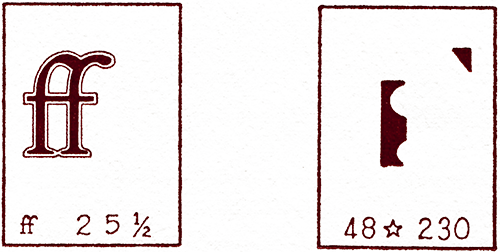
Front and back of the Thompson matrix. The front
carries the electrodeposited letter image.
That character is identified at the lower left
(important for such items as sans serif 1, l,
I, etc.). Set width in points is indicated at the
lower right. The reverse side carries the size
and face number separated by an open star.
This matrix reveals incomplete electrodeposit
on the rear of the matrix, leaving holes when
the matrix was milled. Drawing actual size.
An article in the JuJy, 1909, Inland Printer reports
the Thompson was introduced via 10 test machines, all
of which had been retained by their users and "not a
one but has made money for its user."
Assembly-line production of the Thompson was reported
in that article as "begun early in this year." Twenty
machines were nearing completion when the article was
written. At the same time, "a matrix department was
being organized and deliveries of a superior matrix
have already begun."
Cost, completely equipped: $1,500.
This all gives evidence to the fact that both Lanston
and Thompson were making electrotyped matrices by 1909.
It also puts us on the lookout for Compositype
matrices. Anyone know of a specimen from this firm?
Mac McGrew's research indicates Compositype's mat
inventory was bought out either by Thompson or by the
maker of the Universal typecaster.
Back to the Thompson specimen book:
Andy's copy of the specimen book reveals 144 different
series of matrices, with many ranging from 6 to 48
point. The Thompson Type Machine Company of Chicago
listed its faces by numbers, followed by "similar to
Caslon 471" or whatever the face. This suggests that
matrices were made entirely via the electrotyping
process. The specimen book reveals no faces which are
readily identified as original designs with Thompson.
Goudy Oldstyle, Garamond, Cloister Oldstyle,
Kennerly (sic.), Artcraft, Cooper, and a few other
faces were listed at a premium price, possibly
indicating a sweetheart deal existed with ATF or
Lanston. One face, Cooper Black, is listed as "sold
under license from Barnhardt (sic.) Brothers and
Spindler."
A matter of curiosity is the fact that the Thompson
specimen book repeatedly refers to the machine as a
type and rule maker. No accessories are implied, but
I wonder if anyone knows how rules were made and
whether anyone has ever seen the molds and
accessories necessary to do this.
Unfortunately, the specimen book carries no date. It
is unknown whether other faces were made into mats
later. A quick check of the faces shown, according to
Mac McGrew shows the latest design being Goudy
Handtooled, cut in 1923. And, of course, Thompson
sold out to Lanston in 1929.
Thanks to Paul Duensing and Mac McGrew for the
photocopied resources alluded to in this piece. The
matrix drawing was made from a matrix in my
collection.
My own quest for information was to positively
identify the few Thompson fonts in my collection,
which differ from Lanston display matrices as the
drawings here indicate. Since the faces are all
familiar ones, the numbers are most important.
Therefore, my report is organized in that fashion.
3
On the following two pages are separate references type
casters may need. The first is supplied by Hartzell
Machine Works. It correlates Thompson Machine Co. part
numbers with those used by Lanston. If you have an old
Thompson book, this list will help you, for some of the
parts still are available through Hartzell. Thanks, Jim
Fitzgerald, for the list.
Next is a list of "standard screw threads" used on the
Monotype. It is supplied by Hyden Sizemore of South
Bend, Ind., now retired, but a Monotyper for many, many
years. I have had need of such a list on a couple of
occasions.
Who Was John Thompson?
"What a question. John S. Thompson was born June 22,
1872, became expert in many phases of the printing
machinery industry, invented the Thompson Type Caster,
among many other inventions, became particularly
proficient at the mechanism and teaching of the
mechanism of the Linotype machine, and was editor of
the Inland Printer for many years.
"He died June 10, 1955, after writing an incredibly
interesting book on What Gutenberg Invented, which was
not single types but rather something far more similar
to linotype slugs by which he stated a 42-line Bible
was printed.
"I will be publishing this book soon. In answer to the
original question: he may have been the man who knew
most about the mechanics of every branch of letterpress
printing."
Harold Berliner, 224 Main Street
Nevada City, Calif. 96969
About the Thompson Gas Pot
"The gas burner for the Thompson was designed for
ma1factured gas long before the days of pipeline
natural gas. Manufactured gas had a higher BTU content
for the same volume than natural gas, so the jets and
pipes were smaller.
"I had trouble heating the metal in my machine with a
gas pot as it seemed to take forever to get up to
temperature. I cured it by doing two things. I opened
up the main jet to .110" (No. 35 drill), cleaned out
all the burner openings with a No. 32 drill and left
off the air adjustment val:ve on the burner so it
could get the maximum amount of air. Then I cleaned
out all the insulation and accumulated dross between
the pot and the outer sheet metal shell and now it
heats up fast and maintains temperature."
Phil Cade, 24 Ginn Road
Winchester, Mass. 01890
Still Committed to Hot Metal
"I am in charge of selling hot metal casters and
keyboards for the Monotype Corporation worldwide, so I
am pleased to inform you that my Company is still
extremely active in this very important division of our
business. I would be pleased to receive information of
your activities and to give you any assistance that I
can from the only company in the world that seriously
produces and promotes hot-metal type casting...
"It was most interesting to read in your Newsletter
that you operate a Thompson Type Caster. It does not
seem too many years ago that I helped to assemble the
last Thompson Type Casters built by the Monotype for
supply to India. I only hope you get less splashes than
I did..."
D. E. Belfort, Group Commercial Manager
The Monotype Corporation Ltd.
Salfords, Redhill RHl 5JP, England
Let's Share Thompson Molds
A quick study of the 1941 Parts Price List from which
the next page was photocopied, indicates that at one
time, matrix holders were made for the Thompson for
the following mats:
(1) Linotype and Intertype mats
(2) Monotype and Thompson display mats
(3) Foundry matrices
(4) American cellular Monotype matrices
(5) English cellular Monotype matrices
(6) Ludlow matrices
(7) English display matrices
(8) Giant Caster matrices
It is noted that every variation in depth of matrix
drive requires a mold to correspond, because the depth
of matrix drive governs the height of mold.
I am equipped with item 2 above. I would like to have
item 8 with the appropriate mold. What do you have and
would you be willing to lend it to another Thompson
owner?
3
Correspondence continues to come in from throughout the
U. S. and other countries too. Varied interests in type
casting are shown by excerpts of letters as follows:
Two Pivotal Casters on Hand
"Although I have not yet started casting as a hobby, it
is my long-term aim to do this and I have already
acquired two typecasting machines together with moulds,
matrices, etc. At the moment I am engaged in rebuilding
the machines but as my free time is somewhat limited, I
suspect this will take a considerable time.
"My two machines are both pivotal casters. The first
one was built for use in a proper typefoundry and the
pot was originally heated by an anthracite furnace but
was converted to gas firing about 1900. I estimate that
the machine was made in about 1870 and was used for
many years in the foundry of Stephenson Blake, the UK
typefounders. The second machine is a 'Nodis' and I
enclose some photocopy details of this which may be of
interest..."
Nodis literature indicates the machine was made by the
Williams Engineering Co., Ltd., in London. It claims a
"simplified mechanism, easily understood, 'fool proof
in a real and sober sense ... will cast type from 6 to
72 point, rules, borders and quotations ready for
instant use."
Chris Rule
Hitchin, Hertfordshire, UK
A Comp from Australia
From "down under," Charles Fitzharding-Bailey reports
from Bankstown, Australia: "I am a hand compositor by
training, of some 25 years experience, but of course,
in common with the printing industry everywhere, I am
now mainly concerned with photo-composition. I have a
private press at home, consisting of a large Arab
platen, and for types, I use British types, together
with Spanish and Dutch faces, all of which I import
myself. Hot metal equipment is still available in this
country, a Monotype machine costing about $5,000 (U.S.)
Linotypes and Intertypes range from $500 to $2,000,
depending on condition. Hot metal is still available
commercially, but it is only a matter of time before it
is phased out..."
He's Electrodepositing Matrices?
Roy Rice of Atlanta, Ga., reports progress in learning
the process of electrodepositing matrices. "It seems
that every time I turn around another mat has deposited
and is ready to be taken off. Now that might not seem a
problem, unless you consider the fact that I have yet
to devise a fool-proof method of milling to exact depth.
So spare moments are consumed with devising jigs and
holders for the dial indicator, measurements and trial
cuts on the lathe, and lots of head scratching between."
Museum Idea Gets Support
Bob Richter writes "I'm up to my elbows in alligators,"
alluding to the fact that he's making progress in his
bid to establish a newspaper printing museum in Lowell,
Mass. He has forwarded a newspaper clipping indicating
the Lieutenant Governor of Massachusetts has pledged
support of the state for the museum.
He Wants a Hand Mold
Ken Leenhouts, Waukesha, Wis. (an M.D. who has
handwriting which can be very easily read), writes
indicating great interest in obtaining and learning
how to use the hand mold. At the Conference, Stan
Nelson talked with Richard Hartzell about the
possibility of making a working replica of the
device. Perhaps if enough interest is expressed to
Stan regarding the project, we can get something
started. Do not fool yourself, though. There
definitely will be some cost involved. Contact Stan
at 10 Sugarloaf Court, Baltimore, Md. 21209.
Another Acquires 15x15 Caster
Lee Bullen of McFarland, Wis., writes "I have bought a
15xl5 Mono with 12 pt. mold and 12 pt. Caslon plus
keyboard. I don't care to tear it down to put it in the
basement, so I guess I'll have to use it in the garage
in mild weather, if there ever is any..."
An Address on Herb Czarnowsky
Someday we'll get it right, Herb: Yes, Herb Czamowsky
is involved in an effort to put to work some of the
equipment from his Baltotype firm. The new outfit is
called Volker Brothers. Address care of Herb Czamowsky,
9025 Stile Post Lane, Baltimore, Md. 21234. Phone (301)
668-7420.
On the Matter of Three-Phase
Harry Wiedemann of Nyssa, Oregon, who has been in the
maintenance and design and installation of drive
systems for many years, reports the phase converter
mentioned in the last Newsletter actually converts the
motor to single phase and therefore, has limitations.
"The very best genuine phase converter," Harry writes,
"is an old three-phase motor. In case you are not
thoroughly familiar with the circuits, do this:
connect the three wires of the motor on your equipment
to the three wires of the junk motor, both motors
connected for the same voltage. Have the machine switch
between the two motors to start and stop the machine.
Connect the single-phase line to any two terminals
through a switch control to the junk motor. To start
the junker, give it a spin with a belt or rope wound
around the shaft, then tum on its switch. Some motors
will start by connecting a starting capacitor from a
small single-phase motor from one line wire to the
third wire of the motor. Another way is to connect a
small single-phase motor to the three-phase motor shaft
with a belt or flyball clutch and start it with the
single-phase motor and then dis-connect the single...
"The above three-phase drive is a genuine induction
generator and produces true three-phase current. These
were used in the 200-horse size to drive streetcars in
the early days. The converter motor need be the same
horsepower of your machine motor or it can be larger.
In fact, you can use one big one and drive several
small ones from it..."
Can't Cast Type Under Water
Jonathan Greene of Fankfort, Ky., writes: "We had a
flood last December causing a great deal of havoc. Both
Monotype equipment plus presses, plus mats, etc., were
under water. Plus stock of close to 7,000 books, most
of which had to be thrown away. We went right to work
cleaning motors of presses, getting rust off of mats
with kerosene, etc., but I'm not sure of the future of
the Larkspur-Gnomon Printing Works. We have been
encouraged to apply to the National Endowment for the
Arts for an emergency grant to get things going
again..."
When You 're Through Casting
Hyden Sizemore of South Bend, Ind., hasnforwarded a
pamphlet about better casting procedures on the
Monotype. The section about shutdown is an eye opener:
"When job is finished, make sure that the line hook,
mat and pin jaws and spring box are all back in their
normal, neutral, at-ease position. This will prevent
stress, strain and wear on the springs and parts.
Take matrix case out, clean it and top of mold with a
rag and take the metal off the mats with a piece of 6
pt. slug.
"Leave mat case on sort tray as this allows
mat case to cool off and dirty oil cannot drop into
the back of the mat case from the bridge. This also
prevents the air blast from blackening the mats. All
this prolongs the life of the mats and helps in the
production of cleaner and sharper type."
History of Los Angeles Foundry
Nancy Sue Skipper of Santa Monica, Calif., writes:
"Working for the oral history program at the University
of California, Los Angeles, I have completed a series
of taped interviews with Don Winter, the long-standing
employee and current manager of the Los Angeles Type
Founders, Inc., which are being transcribed into bound
volumes. If these activities would be of interest to
the Fellowship's constituency, I would be glad to
contribute a brief article about the foundry."
(Needless to say, she has been encouraged to do the
article for a future issue.)
Poor Little Mice Evicted
"Vance Gerry's (of Fallbrook, Calif.) 'most neglected
private typecasting machine in the U.S.' has been made
to work. Paul Duensing himself has viewed the
porous-bodied, hairy-footed type which was cast from
Linotype mats on above said machine. The mouse that had
made her home in the pot has been evicted as well as
those who had made an apartment house in the gears."
(From Vance himself.)
Let's have your report of typecasting and related
activity for the next issue of this ATF Newsletter.
Everyone wants to hear from you.
On Making Matrice·s, Etc.
On the matter -of matrix making, Harry Wiedeman of
Nyssa, Oregon, writes, "If you want to run a
typefoundry, first buy a planer and a lathe. This is
all you need. You can build a surface grinder and all
the other tools and machines..." In a later Newsletter,
we hope to print photos of the grinder and planer he
has built himself.
Duensing Visits Hill & Dale Shop
The Hill & Dale foundry was honored with a visit from
Paul Duensing May 13. It was all too brief, but topped
off with a couple of hours of casting on the Thompson
of newly cut mats by PHD. Reproduced here are a couple
of the mats-part of a series PHD intends to complete
someday, representing all the various tools found in
the old letterpress shop. He's already done a composing
stick, which he has decided to re-design.
Casting was accented by my trying to cast with the
nozzle plate not in place (nice squirt, boy!) and by
another squirt caused by Paul's matrix being too wide
and hitting an abutment on the way to lockup. An
afternoon's work: six different characters cast!
Flea Market Pattern Letter
Steve Saxe, of New York City, reports having found a
4-inch pattern letter for matrix engraving at a flea
market sale recently. It's remarkable how things get
out of their proper environment, isn't it?
Visiting the Matrix Collection
From a letter of May 20: "I met with Stan (Nelson) and
Elizabeth (Harris) in Washington and we had a nice
lunch, punctuated by much type talk. Stan and I went
to Suitland (this is where the Smithsonian has the ATF
mat collection stored) and visited the mat collection.
"I would love to take about two weeks off and spend
them working with those mats, cataloging, making trial
casts, etc. We also looked through the drawings, which
are now nicely contained in four cabinets, sealed away
from dust and moisture.
"There are some fascinating stories to be learned about
how they changed descenders for small sizes, and how
the names went through several modifications, and how
even ATF designed some characters which-upon more sober
thought-they decided not to produce. (If I were sober
more often, I probably would not have produced several
of the gaucheries for which I have been responsible.)
"There are just a zillion nifty mats crying to be cast.
I even found a font of 10 point Burmese and there are
doubtless other esoteric goodies lurking in the dark
depths."
Printers Trouble Shooter, published by I. H. Alderman,
P. 0. Box 1737, New Haven, CT. 06507 lists a Monotype
strip caster at $250, several fonts of Ludlow mats and
casters.
Giant Fonts-A. J. Horowitz, who has been a Monotyper
for over 50 years, has a few remaining Giant Caster
fonts and miscellaneous items for sale. Contact him at
2850 Ocean Ave., Brooklyn, N.Y. 11235.
Hand Mold Sought-Benton Marder, Jr.; 696 Congress St.,
Portland, Maine 04102, seeks to buy an 18-point hand
mold. He also seeks a large (40~piece) set of composers
rules. For trade or sale he has a Linotype matrix
reshaper, patented June 1, 1909.
Matrix Holder-Herb Harnish, 4716 Ottawa Drive, Ft.
Wayne, Ind. 46815, seeks a Linotype matrix holder for
use with the Thompson type caster. "I might even try
swapping a font or two of Thompson (Mono) mats for some
Ludlow mats since at present I can cast only Ludlow
mats and have none." He also has some partial fonts of
mats which he would be interested in trading with
someone who could use them to fill out his own fonts.
Linotype Mats are sought for use on a Lino by Bert F.
Williams, 24667 Heather Courte, Hayward, Calif. 94545.
Long S Shorts. Help me pay for my matrices. Am willing
to cast sorts fonts of special longs characters for
either 8 or 11 pt. Caslon 337. Just bought all the
italics and now have them all. Contact Rich Hopkins,
Box 263, Terra Alta, WV. 26764.
Barney Rabin (reported in the last Newsletter as making
his own Linotype matrices) paid a visit to the Hill &
Dale in early April. Introductions out of the way, we
quickly got down to discussing type-making and matrix
engraving, losing track of time and the world around
us.
Barney is among those who have a very real need to
maintain matrices-his firm still runs five Intertypes
continuously and because of the nature of his business
(imprinting diplomas), he must stick with letterpress.
"They say they still make and sell matrices, but just
try to get delivery from Mergenthaler or Intertype on
an order," Barney complains.
"I just resolved that, when I retired, I would take a
crack at making my own mats." And that is what he has
done. He works with a pantographic engraver at his
winter home in Florida.
He has a unique way of obtaining patterns for use with
the pantograph. He has a 400% enlargement made of a
repro proof of a font or a specimen sheet from the
Mergenthaler book. He has a zinc line engraving made
from the enlargement and the zinc plate then is
pressed into Bakelite by his photoengraver. Bakelite
is the material used to make plastic letterpress
printing plates.
With that intaglio image, he is able to recreate the
design onto blank matrices bought from Intertype or
Linotype.
Obtaining blanks of the proper set width—or at all!-is
becoming increasingly difficult. He hopes to find a
source for such blanks in the United States, since
both firms now have the work done in British factories
only, and orders are exceedingly slow in being filled.
Barney admits he hasn't been able to stick with
original designs on some characters. Making his own
mats has provided him the opportunity to "correct"
what he considers flaws in original designs.
He began business in 1933, hand lettering diplomas.
With some letterpress background, he wondered how the
process could be hurried. First he went to hand type
and then bought a used Intertype. Now he has five
tape-driven machines in use two shifts daily, casting
only names for diplomas. "I use the quadders-we don't
have a spaceband in the shop," he notes.
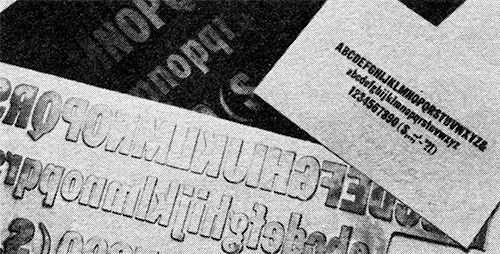
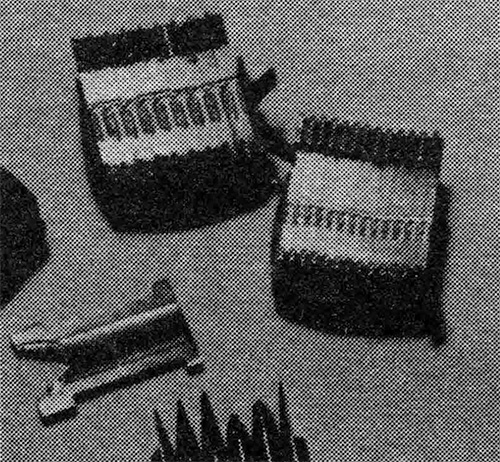
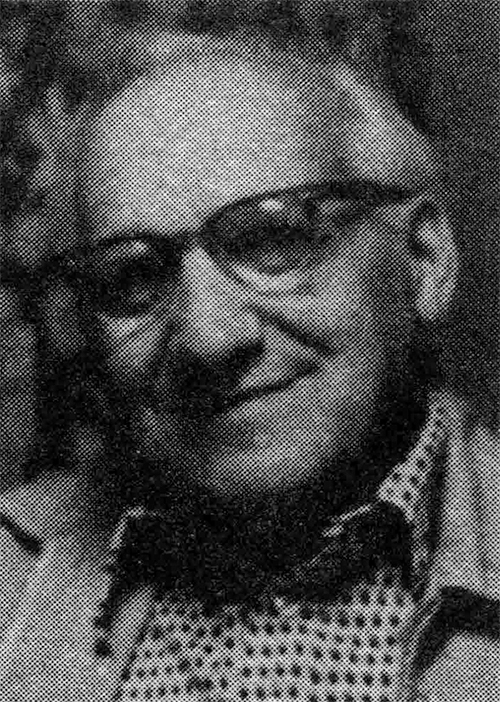
The original proof, a 400 per cent zinc
engraving and Bakelite imprint used as a
pattern to cut individual Lino matrices
(below) by Barney Rabin (below).
He has devised a process of automatically changing the
slug in a modified platen press to expedite printing
the diplomas. But he's not free with details fearing
someone will pirate the process.
As far as matrix engraving is concerned, he indicates
his greatest problem is that of sidewalls breaking down.
If anyone else has done similar work, he'd like to hear
from him.