Very preliminary plans are afoot for the second
conference of our fledgling organization,
hopefully coordinated by Terry Belanger and Pat
Taylor in the New York City area, with,
hopefully, a visit to American Type Founders
included in the itinerary.
By the way, for those who wonder, there is no
relationship between our fellowship and the
above-named company. The ATF letters have
symbolized typecasting in the United States for
so long, our “fathers” felt it only proper to
play on the initials when setting up this loose
organization.
Production work finally has begun on the
Proceedings of our first conference, held at
Terra Alta, W. Va., in 1978. The delay followed
the limited time available for keyboarding and
casting this volume, which is heralded as the
last comprehensive manual on the processes of
typefounding ever to be printed—especially by
letterpress.
Hopefully it will be done before the end of the
year, but don’t hold me to it. See related
information inside. Since the last Newsletter,
the biggest news is the “discovery” of several
additional persons with lots of type making
equipment. We will hear from several of these
persons on other pages.
Since the last Newsletter, the biggest news is
the "discovery" of several additional persons
with lots of type making equipment. We will
hear from several of these persons on other
pages.
Rather than ramble further, we’ll let the “new”
discoveries tell their own stories. So read on,
fellow typecasters (and interested observers
too!).
3
There was great interest in the Thompson
article in Newsletter 3. Questions in that
article have been answered and thus, this piece
should be considered a continuation of the
first article.
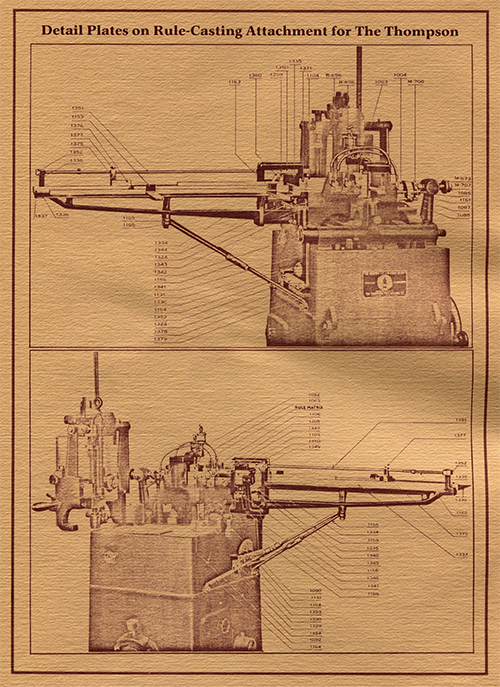
For example, prints from the 1925 manual,
explaining the rule-making device, were
forwarded by both Phil Cade of Winchester,
Mass., and Vance Gerry of Fallbrook, Calif.
Harry Wiedemann of Nyssa, Ore., reports having
such an attachment, although he admits he has
not used it for years and can’t put his fingers
on it right now.
The device definitely was an attachment,
installed after removal of the mold, vertical
mold blade, type-receiving shoe and other
items. It cast rules and spacing material from
2- to 18-point, much in the fashion of the
Elrod machine. An automatic cutting device
would cut any pre-set measure from 4 to 106
picas.
Another device, for trimming type on the right
and sides (“dressing” is a more precise word),
also was detailed in the 1925 owner’s manual,
from which the rule-making information came.
I also had posed the question about what was
necessary to cast Mono Giant matrices on the
Thompson. Indeed, the manual said such an
adapter was made, but no one knew much about it
until Pat Taylor came up with one. Obviously it
involves a special mat holder, but since the
“set” on Giant mats is variable on the left
side of the mat, the special mold is made with
the nick on the bottom. In a sense, you cast
the Giant mats upside down in relation to
standard flat mat casting. Only the 42-point
and 48-point sizes of Giant mats can be used,
since 48 is the maximum size for the Thompson.
Regarding Thompson himself, Fred Williams of
Hayward, Calif., notes:
“About 1938 or ’39, I visited the Pacific Coast
agency of the Linograph Company to see the
little linecasters. A gentleman demonstrated
the machine and other printing equipment. The
agency was in San Francisco. The gentleman who
showed me around could have been Mr. Thompson
as he was the representative of the Linograph
Company. I was only an apprentice at the time
and didn’t “know” of Mr. Thompson.”
Thompson’s role with the Linograph firm is
documented in an article concerning Thompson by
J. L. Frazier, long-time editor of the Inland
Printer. The article appeared in January, 1954,
on page 47. Thompson was 81 at the time, but
still actively writing for trade magazines and
doing research alluded to by Harold Berliner at
the typecasting conference, “What did Gutenberg
Invent?”
Thompson’s “personal” machine now is in the
hands of an ATF associate, Alan Ligda, of
Issaquah, Wash., according to Frederica and
Monroe Postman, owners of The Printers’ Shop at
Palo Alto, Calif., who recently sold the
machine to Ligda. “We bought it from Andy Soule
about five years ago. Andy got it from Dan
Solo, who told us that it had been Mr.
Thompson’s caster when he lived here on the
Peninsula.”
Regarding the list of Thompson matrices printed
in Newsletter 3, Andy Dunker of Jackson, Mich.,
comments:
“That little booklet on Thompson typefaces that
I have is in a tattered condition, and since it
carries no date, it is hard to tell just how
old it is. From what little study I have done,
it appears that there were at least two other
firms who made Thompson mats, and may possibly
have used numbers of their own. In going
through some of my own fonts, I have found
additional numbers for your listing. These may
be a useful addition.”
The fonts listed by Dunker are:
59
Unnamed Condensed Gothic
112
Narciss
228
Goudy Handtooled Italic
238
Garamond Bold
239
Garamond Bold Italic
552
Victoria Italic 12 pt.
553
Victoria Italic 12 pt.
554
Victoria Italic 12 pt.
650
Penn Initials (Ben Franklin)
1079
Modern Title
1082
Cheltenham Bold Condensed Italic
1084
Cheltenham Bold
1116
Contour No. 4 (Open-face letter)
2039
Elzevir
2504
Modern
Phil Cade opens another matter for question
with the comment that he has an old specimen
book of Universal Type Caster and the numbers
therein agree with the Thompson numbers listed
in Newsletter 3. The book has a Chicago address
shown, and a New York address pasted over.
Two references indicate that the Thompson
Machine Company was bought out first by the
Universal machine’s manufacturer, rather than
going direct to Lanston Monotype ownership. The
most credible is J. L. Frazier in the article
already mentioned. He says, “In 1918 the
company was sold to the manufacturers of the
Universal typecaster. Called the
Monotype-Thompson typecaster, it is still made
by the Lanston Monotype Machine Company in
Philadelphia.” (Remember, this was written in
1954.)
Frazier may have had first-hand knowledge, for
he obviously knew Thompson, and perhaps many
other principals in the Thompson Company. He
reports: “The Inland Printer was associated
with the development of the typecaster,
officials of the publication joining him
(Thompson) in forming the Thompson Type
Machine Company in 1907.”
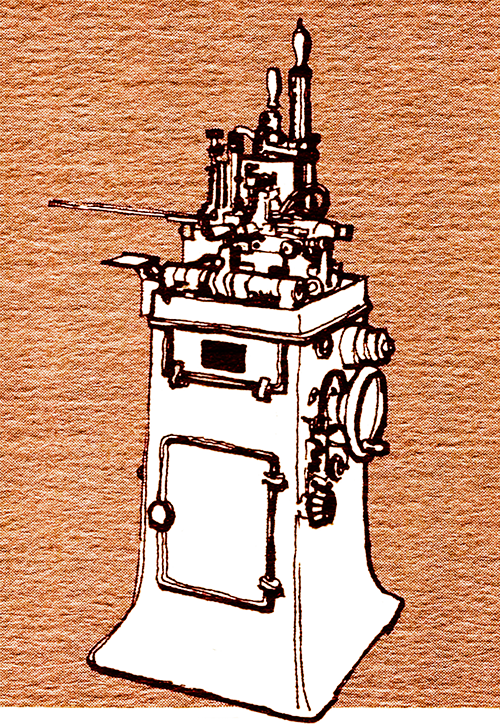
The line drawing of the Thompson caster on
page one comes courtesy of Paul Duensing of
Kalamazoo, Mich.
3
Engraved matrices still are commercially
available from at least one source: Design
Trends, Inc. 307 Oak Street, Grantsburg, Wis.
54840.
Their letterhead indicates they do matrices for
Giant, Mono cellular, Mono or Thompson flat
mats, Ludlow or Linotype mats.
Carl A. Solomonson, representing the firm,
provides the following information:
“In reply to your letter, it is hard to quote a
price on a matrix engraving without seeing the
copy. A single mat can cost from $15.00 to more
than $65.00. We have done Monotype or Thompson
fonts for $7.50 to $10.00 per mat.
Some mats involving a lot of detail, such as 12
pt. trademarks and other logos, cost in the
area of $25.00 to $65.00. For the average
typeface duplication, assuming one mat, the
minimum cost would be $15.00.”
As a postscript, it should be added that type
cast from engraved matrices often must be
dressed by hand after casting to eliminate the
bevels leading to the relief images; bevels are
necessarily created by the engraving tools. But
this should not be an insurmountable obstacle,
especially for a hobby caster.
3
These comments about pot, nozzle and mold
lubrication came from Hyden Sizemore, a retired
Monomachinist now living at Kalamazoo, Mich.:
“Each morning I took out each piston and
brushed it off and put pure Ivory soap on it. I
used the large cakes of the Ivory soap. Also, I
always used Dixon Micro-Fyne flake graphite,
which I mixed around half and half with a heavy
black oil into a paste, and I used this on all
nozzle threads. In fact, I used it on all of
the threads on the pump bodies and on all
threads around the metal pot where there was a
lot of heat. This prevented the threads from
rusting and burning in from the heat. Years
later, if you want to take out a screw it comes
out easily.
“Now about mold oil: Two of my greatest
teachers in New York City were Ralph Hall and
Bill Hyslop. Both spent many years as service
men on the road for Lanston Monotype Company.
Both would not have any part of the Monotype
Company’s mold oil. They both said it was just
like water, and they had seen many molds cut
up, damaged and ruined from the thin oil. Both
used a No. 60- or 70-weight body lubricating
oil.
“I too used the very heavy No. 60 or 70 oil for
my molds all of the time, with wonderful
results. It stayed with the cross block and
lubricated moving parts of the mold, and did
not work up on top of the mold and into the
mats, making a dirty face on the type. The oil
I used was Shell Oil No. 140 Dentax.”
Because I Am Stupid
I operated my composition caster for two years
before I felt compelled to buy a micrometer.
Indeed, the little device helps a lot in
setting up the machine, but a trick I learned
before I got the “mike” still turns out to be
quite useful—simply because I never seem to be
able to convince myself that I am reading the
“mike” correctly, or that I have tightened it
enough or too much.
The trick? Simply check out the table which you
use at the keyboard to establish how many
keyboard EMs are in the measure you want. Scan
down this list until you see where the EM unit
measure is even (with no extra units or ENs)
with the pica measure, such as 24 EMs make 23
picas in 11 set. Now simply cast up 24 EM quads
and throw them into a composing stick which is
accurate. They should fit snugly. If they
don’t, then the set of the EM is not yet
precise.
Monotype Equipment Supplier
A note this summer from Hartzell Machine Works
indicated several items of typecasting
equipment were on hand, some with special
“sale” prices. Hartzell carries a full
complement of spare parts, molds, manuals and
technical literature for the machinery listed,
and manufactures matrices in composition sizes
for nearly all American Monotype faces. Repairs
and overhauls also are carried out by
experienced personnel. Write Richard Hartzell,
Hartzell Machine Works, Market Street and
Bethel Road, Twin Oaks, Pa. 19014.
3
The best way to move type casters is to do the
work yourself. That way, you’re present and can
supervise. It’s virtually impossible to
convince others that machines are (1) fragile
even though heavy, (2) very adversely affected
by water, and (3) all the crating in the world
won’t save a machine from abusive handling.
Bob Halbert of Tyler, Tex., reports "the last
caster I had sent by motor freight was a pile
of junk when I got it. They turned it over and
mashed it, lost all the molds."
Roy Rice of Atlanta, Ga., just got a Mono
shipped to him only to discover it had been
rammed by a forklift, and turned over on two
sides.
I now have moved five machines with no damage
at all. That’s because I did the moving myself.
Care and patience are all that’s needed.
3
Here is an overview of correspondence received
since the last Newsletter, giving an indication
that there are far more typecasting enthusiasts
than anyone first realized.
Thompsons in Washington State
The writer below sent this follow-up to a
letter claiming he was the only owner of a
Thompson in Washington:
“My claim to having the only Thompson caster in
the state of Washington was, to say the least,
premature. There are two guys in this little
one-horse town, one within three miles, who are
so equipped. I bought this one from Freddie
Postman at the Printers’ Shop in Palo Alto,
Calif. She got it from Andy Soule, and he got
it from Thompson himself, or so the story goes.
My dad is an old Linotype operator and this
machine has a Linotype mat holder, so I’m in
good shape for scrounging mats for casting. I
bought the machine just before we moved up here
from Northern California...
“My main line is hand composition and I’m
always looking for good foundry type,
especially large quantities of book faces like
Lutetia, Weiss, Elzevir, etc.”
Alan Ligda
2101 192nd Avenue, S. E.
Issaquah, Wash. 98027
Beside His Handpress
“Your typecasters’ newsletter is very
informative; even though I don’t have any
casting equipment yet, I do have some Lino mats
and maybe I’ll get a machine to go with them
yet. I plan on enclosing one of my three
carports to house my Washington Handpress and
maybe there’ll be enough room for a type or
line caster when the room is finished...
“I bought a small photoengraving shop and gave
up land surveying. I do a lot of work for
offset printers. Eventually I plan to produce a
flyer showing many of the cuts I produce on a
stock basis—mostly cuts from the wood
engravings of Thomas Bewick.”
Paul W. Bohne
7718 Fern Avenue
Rosemead, Calif. 91770
Tinkering with a Keyboard
“I have a Monotype keyboard and am tinkering
with it and hoping to get to the tape-punching
point with a little luck... But actually, I’d
also like to know if your members offer cast
type for sale, and styles and terms of sale.
Typecasters are a scarce breed, and I’ve been
inquiring here and there with mostly
‘address-unknown’ returns.”
Bruce Northrup
29 Henrietta Boulevard
Amsterdam, N. Y. 12010
Has Several Casting Machines
“I am a retired printer, especially interested
in typecasting and typefounding. I retained
some equipment from my own shop when I retired,
including several Monotypes, the keyboard,
mats, molds, keybanks, bars, scales, etc. I
have some 300 faces of cellular mats and
several display Monotype flat mats, as well as
a considerable number of Thompson .043 drive
mats. I also have an old Nurenberg-Rhettig
(commonly known as a ‘Universal’) caster with
some 25–30 molds. I make type when I feel like
doing so, mostly for my printer-hobby friends.
I do not advertise as a business, but do carry
a small stock of type in fonts and sorts cases.
“Where can I get Monotype flat mats
electroplated? Or where can I find the base
angle quads for making up my own forms for
electroplating? Does anyone happen to have an
old matrix engraving machine (such as mentioned
in Legros and Grant’s Typographical Printing
Surfaces)?”
Owen Stout
Route 3, Box 108
Paoli, Indiana 47454
Need Some Typecast Logos?
If you haven’t heard of the Sterling Type
Foundry, P.O. Box 94, Charlotte, Mich. 48813,
then you’d better send a buck for Frank
Sassaman’s most extensive catalog of logos,
dingbats and other miscellaneous cuts, all
foundry-cast. In a recent note, Frank detailed
his equipment:
“I have two Thompsons (one with a .050 and one
.043 drive) and of course the .043 will cast
Lino mats. They both work fine. Also have two
Universal type makers in 18 to 72 points (one
with .050 and .076 break-out molds).” Probably
a majority of his matrices have been made
expressly for him to provide up-to-date (as
well as old-time) commercial logos.
3
I had inquired about documenting in a future
Typographic Curiosities (my own publication)
the curious, long-used “private” typeface used
by The New Yorker magazine. It was designed in
1925 by a New Yorker artist, Rea Irvin, and cut
into matrices by Mergenthaler. That much
information was volunteered. But the letter
went on:
“Since we’re in the process of converting from
metal to computerized typesetting, we’d prefer
not to collaborate on the sort of booklet you
have in mind.”
Down goes one of the last remaining bastions of
letterpress printing. But no documentation of
yesteryear, please. (!)
3
For the uninitiated, it may come as a surprise
that characters are not stamped or engraved
into matrices to any single “standard” depth.
Rather, the depth varies and makes casting from
differing matrices somewhat complicated. For
example, although the Thompson caster is
capable of using Thompson, Monotype flat,
Monotype Giant, Monotype cellular, Linotype,
Intertype or even foundry mats, to use them all
would require at least five separate molds,
varying mat holders, and probably some other
paraphernalia. Below are listed the most common
“drives”:
Be alerted to the fact that the hodgepodge of
old foundry matrices roaming the countryside
varies considerably regarding drive. No one
drive is dominant.
Monotype cellular matrices
.030 inch
English cellular matrices
.050 inch
English display matrices
.050 inch
Monotype “flat mats”
.050 inch
Linotype/Intertype mats
.043 inch
Older Thompson “flat mats”
.043 inch
Newer Thompson “flat mats”
.050 inch
Monotype Giant matrices
.065 inch
Measuring mats requires a depth gauge. In the
absence of such an instrument, measure to the
shoulder of the sample letter—generally left
with the matrices by the caster operator using
them before you got them. Subtract this from
.918 to determine the drive. (Anyone who casts
type knows this .918 standard rarely is
accomplished because of varying molds, and so
on.)
3
More Interesting Correspondence from Caster Owners
Plan to Sell Type
“We have two Thompson casters. One is quite new
and made in England. We also have a Monotype
caster and keyboard and hope to put all of
these machines to work casting type for sale.
We have a large number of mats, though we are
always looking for more.”
Frederica and Monroe Postman
The Printers’ Shop
4047 Transport
Palo Alto, Calif. 94303
Has Super Caster and More
“I have set up a Monotype material maker, a
Monotype keyboard and composition caster, and
a Super Caster. Pat Taylor is sending me a
Thompson. I have some mats—but am looking for
others. Of course, it is all just a hobby that
I enjoy. I hope someone comes along that will
be interested in casting someday. So far,
everyone around this part of the country thinks
I’m a little ‘off’ hauling these old obsolete
machines in.”
Bob Halbert
Route 1, Box 344
Tyler, Tex. 75709
Around Shops Since He Was 7
“Set up and operating (or almost) are three
composition casters, one material maker, one
Thompson and two Monotype type-and-rule
casters. I am 66 years old and have been around
a print shop since I was seven. Bought my first
Monotype in 1946 and have continued to add to
the outfit until now.”
W. R. Newberry Jr.
2979 Old Highway 5
Cathey’s Valley, Calif. 95306
Two Intertypes, Thompson
Producing sod-cover sewn books printed by
letterpress is the principal activity reported
by this correspondent. "We have a C-3 Intertype
and a good selection of Linotype mats that we
sue for books nd job composition. We also have
an F-2 Intertype that is functional but has not
been used for several years. We also have a
Thompson caster for which we need matrices.
Dan Keleher
P.O. Box 162
Whately, Mass. 01093
'I Came to Love Monotypes'
“Years ago I worked as a compositor and
casterman in the trade, and came to love the
Monotypes in our office. Since the decline of
letterpress in our area, I have been able to
pick up my machines very reasonably. So far I
have a Monotype comp caster, keyboard, and
material maker. Last summer I found a Thompson
on the prairie and brought it back here. At
present I am searching for some sort of matrix
cutting machine. Paul Duensing has been most
helpful in getting me started in electroforming
mats.”
Jim Rimmer
411 West Cordova Street
Vancouver, B.C. V6B 1E5
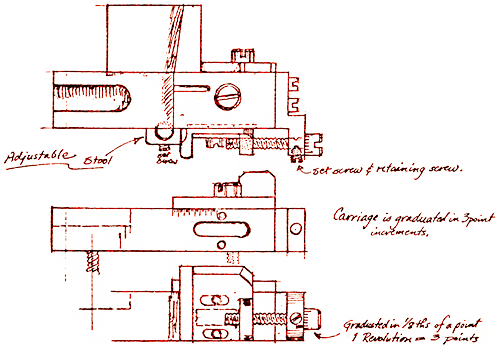
Stan Nelson continues his spare-time project of
developing a modern-day hand-mold. He forwarded
the accompanying drawings, with this note:
"I am writing instructions on how to make a
type mold—these are in the rough draft
stage—and also I have been doodling with
drawings for a hand mold that will cast from
say 10 to 18 points, and, with the proper
holder, from foundry, display and Linotype
mats. The body pieces are interchangeable, the
mouth piece adjusts to each size, and the
registers are calibrated to follow the sets
marked on display mats. I am ready for
suggestions about the drawings."
3
Yes, Virginia, Once There Was Hand-Set Type for Doing Music
Richard L. Hopkins
The depth of specialization within the confines
of metal typography is yet to be measured. Owen
Stout of Paoli, Ind., indicates having had some
music matrices made several years ago, and
Richard Harrington of Winona, Minn., writes:
"My latest project is sorting a music font that
a good friend found for me. It has
approximately 250 characters and the more I
work with it, the more I realize why hand
setting music was never really practical."
Stout adds these details:
"Modern music type for printing 'round notes'
has 546 different characters in the font, and
three type cases are required to hold it.
Contrast this with the 26 letters in a font of
'Roman' type!"
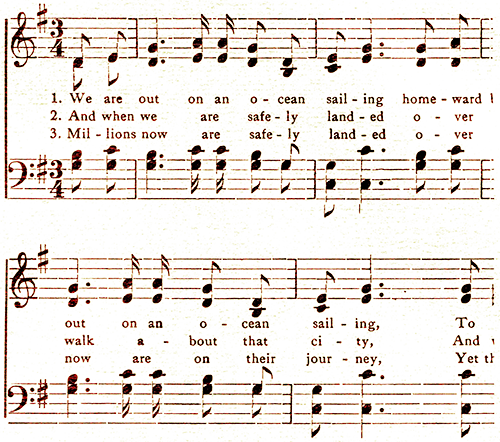
Stout sent along this sample of some sheet
music which he printed several years ago-the
Entire job done from hand-set metal types.
3
Annenberg, Turner, pass to Eternal Monotype Kingdom in Sky
Richard L. Hopkins
Maurice Annenberg
I cannot let the passing of Maurice Annenberg
go without mention. He died April 20, 1979, and
was one of the earliest “supporters” of the
Typecasting Fellowship. His Maran Printing
Company was Monotype for years, and he
commented in a letter regarding his monumental
book, Type Foundries of America and Their
Catalogs, that it could have been done Monotype
in half the time it took to do it on the firm’s
then-new Mergenthaler VIP photocomp machines.
The bulk of his Mono equipment was obtained by
Alan Teas, who’s a current ATF associate.
We who have such great affection for the
heritage of our craft all know we have lost a
staunch friend. Fortunately, Maurice has left
behind two excellent books of very recent
vintage, both of which will help preserve this
heritage for many others in years to come.
Bill Turner
Paul Duensing has received word that Bill
Turner, longtime customer service manager for
Monotype Corporation, Ltd., passed away in
December. Bill Turner retired five years ago,
but until that time was quite visible wherever
Monotype equipment was demonstrated, and
frequently was the “contact man” for anyone
buying Mono matrices, etc., from England. Paul
adds that Bill Turner could have filled a large
book with stories of unusual requests and
special applications of Monotype equipment he
was involved with over his many years with the
company.
3
Harold Berliner, a participant at the
Typecasting Conference, sent along this note
for everyone to drool over:
“Since last we talked I have made yet another
buy. The only useful matrix items obtained were
a full set of Walbaum as well as Helvetica and
70 sizes and kinds of Univers. The real virtue
of my last purchase was machinery: I was able
to pick up four perfection casters in mint
condition. One of them is a 16x17 which has air
spacing (they all have air spacing) and a sorts
caster which is the finest machine I have ever
seen along these lines. It makes less noise
than a sewing machine in operation; you can’t
even hear the pump. Of course, beautiful type.”
3
HAROLD BERLINER
224 Main Street
Nevada City, Calif. 94949
For Sale. Over 200 cases of type, one D
keyboard, one DD keyboard, two composition
casters and one material maker and about 125
fonts of display matrices. A C&P 12x18, small
offset, 24-inch cutter, and all the necessary
equipment for a printing and rubber stamp
plant. Also type and rule caster. Wayne Holmes,
294 South Street, Eaton Rapids, Mich. 48827.
(Info provided by Frank Sassaman, Sterling Type
Foundry.)
Wanterd: Monotype display matrices, borders,
ornaments, signs, dingbats, or others. Robert
Halbert, Route 20, Box 76, Tyler, Tex. 75708.
Totally English Shop For Sale. Many items
already sold, but inquire about what is left.
Purchased while studying casting at the
Monotype Corporation in England in 1976.
Relatively new. Write James Houle, 34 Union
Street, Biddeford, Maine 04005 for details.
For Sale. Several duplicate fonts of flat mats
for Monotype casting. Also some fonts to 48 pt.
of old Thompson mats. In current inventory of
Detroit Type Foundry, Bob Hansen took the
trouble of typing out the list. Write me and I
will forward it to you so you won’t have to
bother him. Rich Hopkins, Box 263, Terra Alta,
W. Va. 26764.
Wanted: An .043-drive mold for my Thompson.
Have several fonts of Thompson mats, Intertype
mats, etc., and wish to cast them. Owen Stout,
Route 3, Box 108, Paoli, Ind. 47454.
Giant Matrices For Sale. About 100 fonts of
Giant matrices are offered for sale at $10.00
per font postpaid by Ray Adkins, 306 Cascade
Drive, Belleville, Ill. 62223. Most are the
standard newspaper faces, but there are
exceptions. Write for list.
Wanted: Would appreciate any ideas you might
have as to where I could possibly obtain
Linotype mats of either Eldorado or Falcon,
both faces designed by Wiggins. Most dealers
seem to never have heard of either. Glen
Goluska, 81 Elfreath Huron Street, Toronto,
Ontario, Canada M5S 2G5.
3
Letterpress Production of First Conference Proceedings Finally Getting Underway
Richard L. Hopkins
The Proceedings book finally is taking shape.
The format is established at 4¼ x 7 inches
with the text being composed in 9- and
11-point Baskerville with subheads in 14-point
Bulmer Italic and main chapter headings in
24-point Bulmer.
The size is almost the same as that most
popular handbook carried by printers for so
many years, MacKellar’s The American Printer: A
Manual of Typography, last printed in 1886.
There will be about 112 pages, incorporating
numerous illustrations.
Pat Taylor has supplied ranging figures to
round out my 11-point Baskerville font. I seek
two items to complete the design: mats or font
of 14- or 18-point Baskerville Roman ranging
figures for type page folios and I also need
several accented characters in 9- and 11-point
Baskerville and Italic. If you can loan me any
of these items, your help will be appreciated.
3