The Second National Conference
on Metal Typecasting & Design exceeded fondest
expectations for fellowship, learning, and plenty of
type talk. It is most difficult to write objectively
on such a subjective experience, so why bother.
Arrival. I knew I was in for
a one-of-a kind experience immediately upon arrival at
the Sheraton Inn at New Rochelle, N.Y., Sunday afternoon,
June 28. Guy Botterill of Baltimore was just
arriving by taxi, and we were deep into type talk
even before getting into the lobby.
In the lobby, we were joined by Benton Marder, Mark
Matteau, Barney Rabin and many others. Three- and
fourway conversations ensued and I mechanically went
through the processes of checking in. I was quite
unaware of check in; Lynda and the girls took the
key and went to the room while type talk continued
in the lobby. Later, I had to ask at the desk to find
what room I was in.
Friendly chatter continued throughout the early
afternoon as others checked in and Pat Taylor arrived
on the scene to set up his registration table. As
several of us pulled up to the bar, we quickly
learned that David Belfort of Monotype International
shared our fanatical interest in the whole area of
typecasting, though he was a bit chagrined not to
know the name of the typeface on his business card,
upon being queried by our friend Botterill.
Out of Sorts Visit. Pat and
T Taylor had a marvelous array of good food laid out for
the Sunday-evening buffet at their home in Larchmont,
but I fear few of us took the timeto offer our
appreciation, for we all were engulfed by the fantastic
collection of paraphernalia in Pat's basement and garage.
He had one caster set up for large comp (18 point) and
demonstrated it several times by casting a list of
those present-but we never got around to seeing a
proof to check Harold Berliner's keyboarding ability.
All were quite oblivious to a heavy downpour outside.
Conversations led in all directions, and many took
the opportunity to "skip out" for an impromptu visit
to Ben and Elizabeth Lieberman's shop nearby.
Nightowls returning to the hotel refused the noise
of disco, in favor of a downstairs meeting room where
type talk continued into the wee early hours.
A Very Busy Schedule. Pity
that time was so short, for we all wanted to get in so
much, yet had so little time. That quickly became
evident Monday morning. We were forced to a rigid
schedule because of bus travel, etc., and were not fully
able to take advantage of our speakers in
question-and-answer sessions.
Mike Parker of Mergenthaler Linotype came prepared
with two splendid multi-media presentations on the
development of the various letterforms and the
roots of various modern-day alphabets. Then we
rushed into Steve Saxe's presentation of the "roots"
of American Type Founders-wherein Steve traced the
history of many foundries which went together to
form ATF in 1892. He accompanied his talk with a
drawing of the ATF tree-a tree with plenty of roots
underground, but not much of a tree above ground.
This, of course, was in preparation for the bus trip
to Elizabeth, N.J., and what proved to be the first
viewing of American Type Founders by anyone in the
group-except Benton Marder, Jr., whose great
grandfather, John Marder, happened to be one of the
ringleaders in initiating the establishment of the
typecasting consolidation.
I got my first ATF catalog in 1953 and literally
wore the catalog out studying it, dreaming of
buying fonts, and then studying it further. The
fact that I still have the first fonts I bought
attests to the quality of the product the company
manufactures.
ATF Comes to Life. "Just
being here in this room is worth the trip from
California," Andy Soule bubbled enthusiastically. The
feeling was representative of everyone. Although we all
had preconceived notions of what we would see, none of
us was able to reconcile those notions with reality,
once we were in the foundry.
Evidence of what once was was first to hit us-large
areas which had been occupied by clerical help stood
virtually abandoned. The huge three-story building at
200 Elmora Avenue once was completely occupied by ATF.
Other tenants, and, indeed, the building's present
owner, occupy everything except the top floor where
ATF now is confined.
First we entered the pattern room and matrix
department. And quickly my notions of a cluttered
building piled high with relics disappeared. Things
were remarkably neat, and everything seemed to be in
place and easily located. We spent precious little
time with the Benton pantographs, although we surely
would have spent all afternoon in total fascination
studying the device's unique workings and the many
pattern letters stored all around.
Then it was out into the machine area, where lathes,
grinders, milling machines and other devices stood
idle, waiting for work to be done. There was evidence
of work being done, such as new choker valves and
nozzles for the typecasters in the next room.
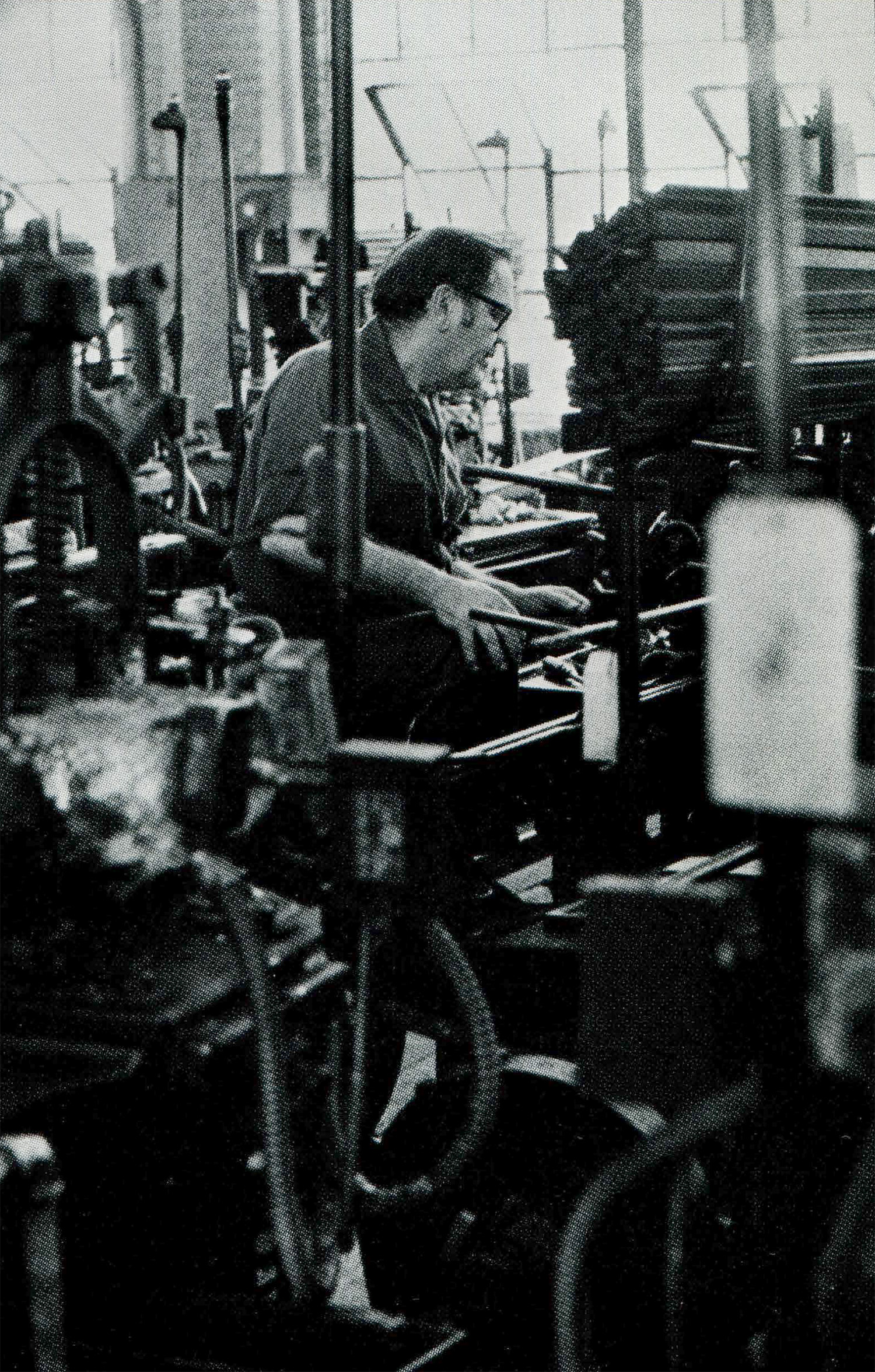
The next sight stunned me. There, amidst a whole row
of Bruce casters stood a man actually hand-cranking
a Bruce, turning out ornamental dingbats which bore
the Bruce typefoundry name on their matrices.
Somehow, it never dawned on me that this ancient
device still was being used. After all, it was the
machine which revolutionized the typecasting
industry back in the 1840's. But still being used? I
would never have dreamed.
David Belfort echoed these thoughts. "Imagine. Here
in the United States in 1980. An operation like this
still going on. It's absolutely amazing."
"We were told the foundry still employs about 50
persons."
Our guides realized very early most of us had some
acquaintance with the process, for they were fielding
questions which referred to such specialized areas
as "How are proportions changed on the pantograph,"
"Do you grind your own choker valves," "Where are
the Oxford matrices?" Considering the rather
restricted nature of ATF's modern catalog, my next
surprise was that so many of yesterday's goodies
were still being made by the company-in foundry sorts
lines instead of fonts, however.
We watched a Barth caster turning out 4-point type.
Then we discovered one set up for 120-point type.
Machines stood like soldiers in neat rows, each set
up for a specific casting requirement and used only
when such jobs were ordered.
Across the aisle stood idle equipment which once was
used for making brass rule, and famous "Duritan"
leads, slugs and strip material. All seemed to be in
perfect order, ready for use again, if the need ever
returned.
Several typecasting machines were actually in use
and we were told the foundry still employed about 50
persons.
On several occasions I have watched Stan Nelson
plough the groove on his hand-cast type. Still, I
was surprised to discover a man doing the very same
procedure at ATF-dressing types cast on the Bruce.
Then there was the woman using a sawing device to
finish the sides of heavily kerning types. Surely
these manual operations contribute greatly to the
expense of the foundry's superior product.
Most of us were aware of the Barth casters and
wanted to see them up close, since ATF had never
allowed any to leave the foundry. We weren't
disappointed, yet I somehow did not expect the
answer I got when I asked where the actual machines
on the floor had come from. "I think they all came
from Cincinnati," my guide replied. That would
suggest that all had been manufactured in Barth's
own foundry, the Cincinnati Type Foundry, and that
all were rapidly approaching their 100th birthday.
Yet they seemed to be in excellent operating
condition. Only the massive type metal droppings on
and around the pot insulation would suggest lengthy
service.
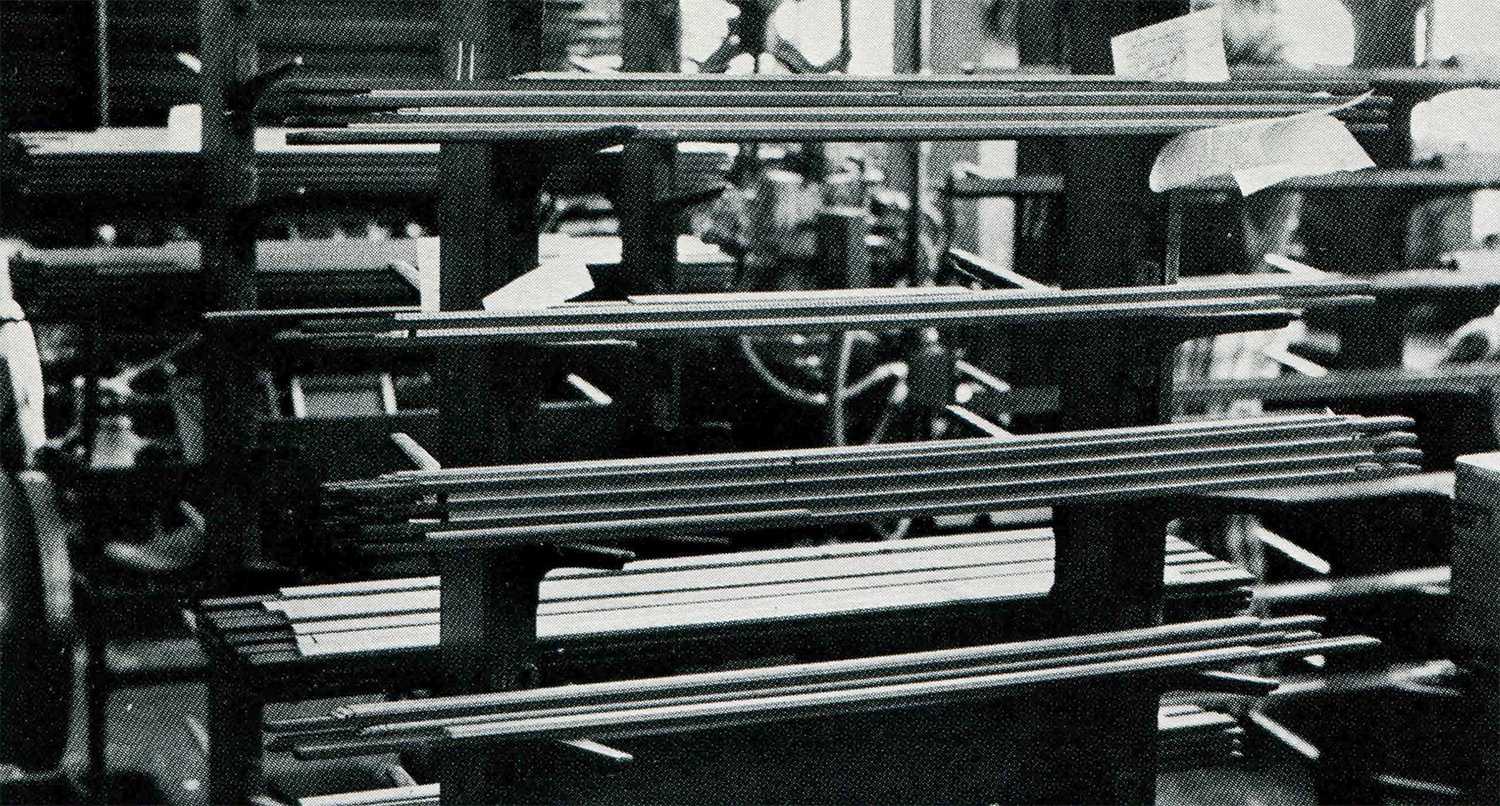
Piled in and around all the Barth casters were
wooden sticks about a yard long, which were used to
receive long rows of types from the casters. Shaped
with a small lip on the back edge, these sticks were
the medium used to transport type from the casters to
the fonting room.
One area was isolated from others in the typecasting
department, and we learned this was the room where
types were cast in zinc, a far more difficult metal
to cast, but necessary for making materials to be
used with various hot-stamping devices.
Casual observation would indicate that much of the
foundry's modern-day product was in 6-inch foundry
lines. Yet surely a great deal of fonting still is
being done. The large size of the fonting area
dwarfed the few people working there.
Matrix Files. The matrix
storage area was, perhaps my biggest surprise. Somehow
I expected it to be in disarray. Yet an inconspicuous
box atop one table contained index cards which totally
documented the very extensive collection still retained
by ATP.
Mike Kipps and I were anxious to see the matrices for
Caslon 471, now available only in 8- through 24-point
and without all the nice quaints. Quickly we had
before us the mats for 72-point, not offered in fonts
for many, many years. Then 9 and 14 in a single
drawer, complete with all the nice quaints, long s
characters, accents, and even a few alternate
characters-all handsomely arranged in their shallow
metal drawer, ready for use.
Stan Nelson was interested in the historic Oxford
matrices, which supposedly originated with Binny and
Ronaldson. Those matrices also were brought out
quickly, though the reference card indicated they
had come from Boston Type Foundry. Stan studied the
mats, which revealed electrodepositing and other
alteration for adaptation to the Barth caster-but all
the mats were present, again ready for use should the
need arise.
What started out to be a rather formal, hands-off
tour turned into a definite hands-on exchange between
ATF employees and various members of our group. A more
cordial, open tour could not have been conducted, and
we all expressed our sincere thanks to manager George
Gasperik and his fellow workers.
On To Manhattan. Our bus next
brought us to Manhattan via the Verrazano Narrows Bridge
and a rare, spectacular sunny blue-sky view of the city.
We ended up at Columbia University and the Butler Library,
where a brief talk was given about the Bullen
collection and several ephemeral pieces were laid out
for us to view-specifically relating to Linotype,
Intertype and Monotype. After buffet dinner at the
library, we were treated to an unexpectedly complete,
thorough discussion by David Mallison on Henry Lewis
Bullen, his life, and his lifetime efforts at
gathering and cataloging the ATF museum and library
(now at Columbia University). The discussion revealed
exhaustive research, done for a doctoral dissertation
on the subject under the tutelage of Terry Belanger,
our gracious host.
Although nothing was planned for the evening, groups
of conference attendees gathered at various places
for continuing conversations long into the night.
Practical Sessions. Tuesday
morning we were up early with a session by Harold Berliner
on the books and documents you should seek if you're
serious about Monotype. Then Pat Taylor, Richard Shaw,
Richard Hartzell and I had a panel discussion on the
practical aspects of being a typecaster.
A poll of participants revealed about 30 percent of
the attendees actually were casting type, with others
having machines not in operation at the time of the
conference.
Quick lunch and then we were off to the A. Colish
Press, where we quickly discovered a place truly
"after our hearts."
Richard Shaw had his Monotype department ready for a
most thorough demonstration. Large comp, a Thompson,
many regular comp machines with ledding attachments,
a Super Caster making strip material-all were not
only present but running while we visited.
Dick Shaw and his crew nimbly hopped from machine to
machine answering questions and willfully jumping
into even complicated maintenance and repair
demonstrations when questions were asked. He ripped
out molds, type carriers, pump bodies and the like,
rapidly going through the "steps" as we crowded
around.
Pat Taylor managed to inject embarrassment when he
offered a worn type carrier for a demonstration. Wear
does funny things-like making it virtually impossible
to reassemble spring-loaded parts. Being hurried,
Dick was unable to reassemble the piece. David
Belfort offered to help, but fell victim to the
spring too. Whether it ever was put back together, we
will never know.
"Most of us only dabble with making type, yet to some,
it's routine, serious business. Dale Dippre of
Colonial Williamsburg casually injected that anyone
who has run a Thompson for any length of time would
know there were 192 e's to the foot in 1O-point
Caslon 337."
"Pride in work." That was most obvious at
A. Colish, and the firm had printed up a very
handsome keepsake for us to commemorate our visit.
The craftsmen there obviously were "our types" as
evidenced by this quote from their directory of type
faces: "And lest anyone forget, we find special joy
in printing books or ephemera by letterpress,
directly from our beautiful types on good paper."
Truly, A. Colish continues the letterpress tradition
in its highest form-and coupled with outstanding
process color off set production-turns out work which
is the envy of all.
Goudy at Deepdene. After
such exciting events, it was difficult to anticipate
still more, but it was on its way that evening when Herb
Johnson, now of Rochester Institute of Technology, gave
a splendid talk on Frederic W. Goudy, complete with
slides of his work and followed by a rare film showing
Goudy going through all the steps in type design and
manufacture, filmed at Deepdene in the 1930's.
The keepsake exchange surprised everyone. Many persons
brought several contributions, and several pieces
demonstrated very extensive effort being put forth.
With overloaded arms, we all hurried back to our rooms
where things could be kept until they could be
studied. Things continued in the hospitality room as
Dave Churchman of Indianapolis, Indiana, took center
stage and proceeded to auction off (and amuse
everyone) many of the choice "goodies" brought to the
conference by Dick Hartzell. Happiness extended far
into the early hours of Wednesday.
Wednesday Morning again was
filled to the brim with presentations, yet was also
pressured by early departures, flight schedules and
other interruptions. All presentations made that
morning were excellent and could have easily filled an
entire three-day conference.
Stan Nelson gave a thorough discussion on the making
of the hand mold, accompanied by well-prepared slides
of the process. Paul Duensing discussed the process of
engraving matrices and quickly demonstrated with the
pantograph he lugged all the way from Michigan. Will
Reuter gave a discussion on procedures he follows in
designing a typeface for subsequent engraving, and
Andy Soule gave an all-too-hurried presentation on how
he electrodeposits matrices, accompanied with a
printed procedure with all the incidental, yet
essential, information.
Six persons returned that afternoon to Pat Taylor's
typefoundry for a hands-on demonstration of the
composition caster presented by Abe Horowitz of
Brooklyn, who has over 40 years of solid professional
experience with all aspects of the machine.
We went away stunned that so much could happen in so
little time-stunned that it was over so soon, but
exceedingly happy to have had the experience.
I personally congratulate Pat Taylor on putting
together a very economical conference, since the $100
fee included so many meals, the bus, etc. Lynda says
she never thought she could be away on a trip with me
for four days and never see me, even at night.
Indeed, this sixth
Newsletter is far past due, but especially
because of a superbly printed eight-page insert, I hope
you find the edition worth waiting for.
The pressures of a work-a-day world have a funny way
of suppressing hobby activities, and thus, the
building of a new home for my commercial offset plant
halted my hobby activity completely during the months
since our conference.
Rodger Glessner, as much as anyone, was responsible
for prodding me back to activity. At the 1980
conference, he volunteered to print a supplement to
the Newsletter showing photos of our visit to
the ATF plant at Elizabeth, New Jersey. His phone calls
asking about progress on that project finally got me
into gear. Had I, beforehand, known such a project
was in the offing, I would have shot more film, made
more effort at framing my shots, etc. But hindsight
won't make anything better. Please thank Rodger for
volunteering to print-in duotone, no less!-this
excellent work. His address: 136 Springdale Road,
York, Pennsylvania 17403.
Also a word of thanks should be extended to Mac
McGrew, 181 Mt. Lebanon Blvd., Pittsburgh,
Pennsylvania 15228, for his excellent American Type
Founders article.
3
Next Newsletter to Feature Typecasting from Your Shop
Richard L. Hopkins
Various persons have asked who the members of ATF are,
and what aspect of typecasting they are most involved
in. I feel we should answer them and at the same time,
give each other a good viewing of our typecasting,
layout and makeup abilities.
Therefore, in the next Newsletter, I hope you will
cooperate by sending me a made-up form to be printed
here, with the remainder of the Newsletter, wherein
you will outline the equipment and faces you have, and
your primary typecasting interest (small books,
casting for others, etc.).
Make your form attractive. By all means include a
border around the form. Its outside dimensions should
be 35 picas wide by 24 picas deep. That's half a page.
Those with Linotypes are encouraged to participate
also. Send your form (it'd better lift, bygosh) well
tied up and cushioned, preferably by UPS to Rich
Hopkins, 330 Fourth Street, Terra Alta, W. Va. 26764.
3
I had the pleasure of
being asked last summer to demonstrate the
letterpress, hot metal process with emphasis on
historic aspects at the Baltimore Graphic Arts
Exposition.
While there, being adjacent to the Mergenthaler
display of photocomp and laser equipment, I was
able to chat at length with several of their
representatives.
A veteran volunteered the opinion that "anyone can
use our equipment, but invariably the person with
hot metal experience gets far better results and
uses more of the machine's capabilities."
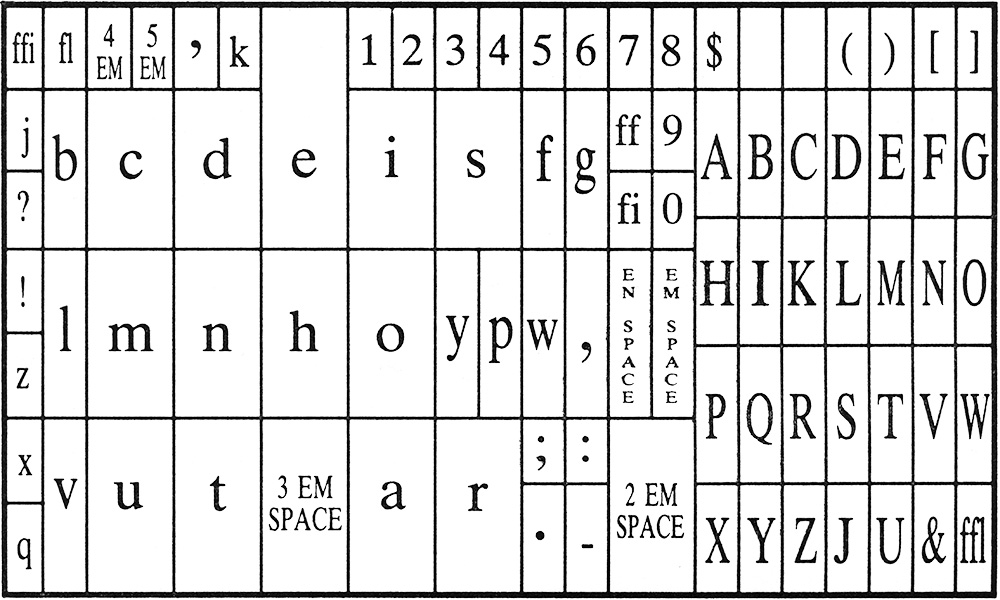
Dale Breeden, a Mergenthaler service engineer, was
fascinated with the California Job Case layout I was
passing out at my exhibit. He took it and, in a
relatively short time, drew the layout on his video
display keyboard, inserted all the appropriate
letters, condensing them electronically when
necessary, and the results of his effort are shown
here. All ruling was done with the typesetter.
There is a very apparent ignorance of the past
lessons learned in typography and typographic design
in earlier years. Those of us who bridge the gap
feel it most keenly. It seems the industry is
condemned to learn everything all over again.
For example, a recent issue of U&lc, a publication
put out by the International Typeface Corporation
(and most self-indulgent), carried a front-page
"discovery" of the frequency of use for the various
letters of the alphabet. No one who knows the first
thing about old foundryfont schemes would see
anything new in such information!
That is why it is refreshing to hear from folks like
John Lane of Thousand Oaks, California.
His letter is quoted here:
"I am working with Sumner
Stone at Autologic, Inc., attempting to introduce
some concept of quality into the digital type
industry. The technology of digital type has
advanced to the point where it is possible to
exercise control of the punchcutter to a greater
extent than has been possible with film typesetting,
but the industry is sadly lacking in the
punchcutter's (and justifier's) aesthetic knowledge
of the craft. The only hope for digital type is for
those of us in the field to study the work of Malin,
Radisch, and other masters, and to adapt what we
learn to the newer technology.
"For this reason, I was very excited to learn about
the formation of the American Typecasting Fellowship,
and... look forward to hearing from you, and wish
you the best of luck with this organization."
3
Within the past year,
Monotype International has opted to sell off both its
rental matrix library and its specimen room matrices
(those used to cast types for printing advertising and
specimen sheets).
Some fonts still are available. Contact Paul H.
Duensing, 10180 East U Avenue, Vicksburg, Michigan
49097, for the list.
Duensing, Norman Fritzberg of St. Louis, Missouri,
Harold Berliner of Nevada City, California, Roy Rice
of Atlanta, Georgia, and Rich Hopkins all have
acquired matrices from these two sales. Perhaps others
have too?
3
These photographic glimpses of American
Type Founders Company were taken by
Richard L. Hopkins June 30, 1980, during a
visit to ATF by members of the American
Typecasting Fellowship. The visit was part of
the group's second meeting, held at New
Rochelle, N. Y., during the summer of 1980.
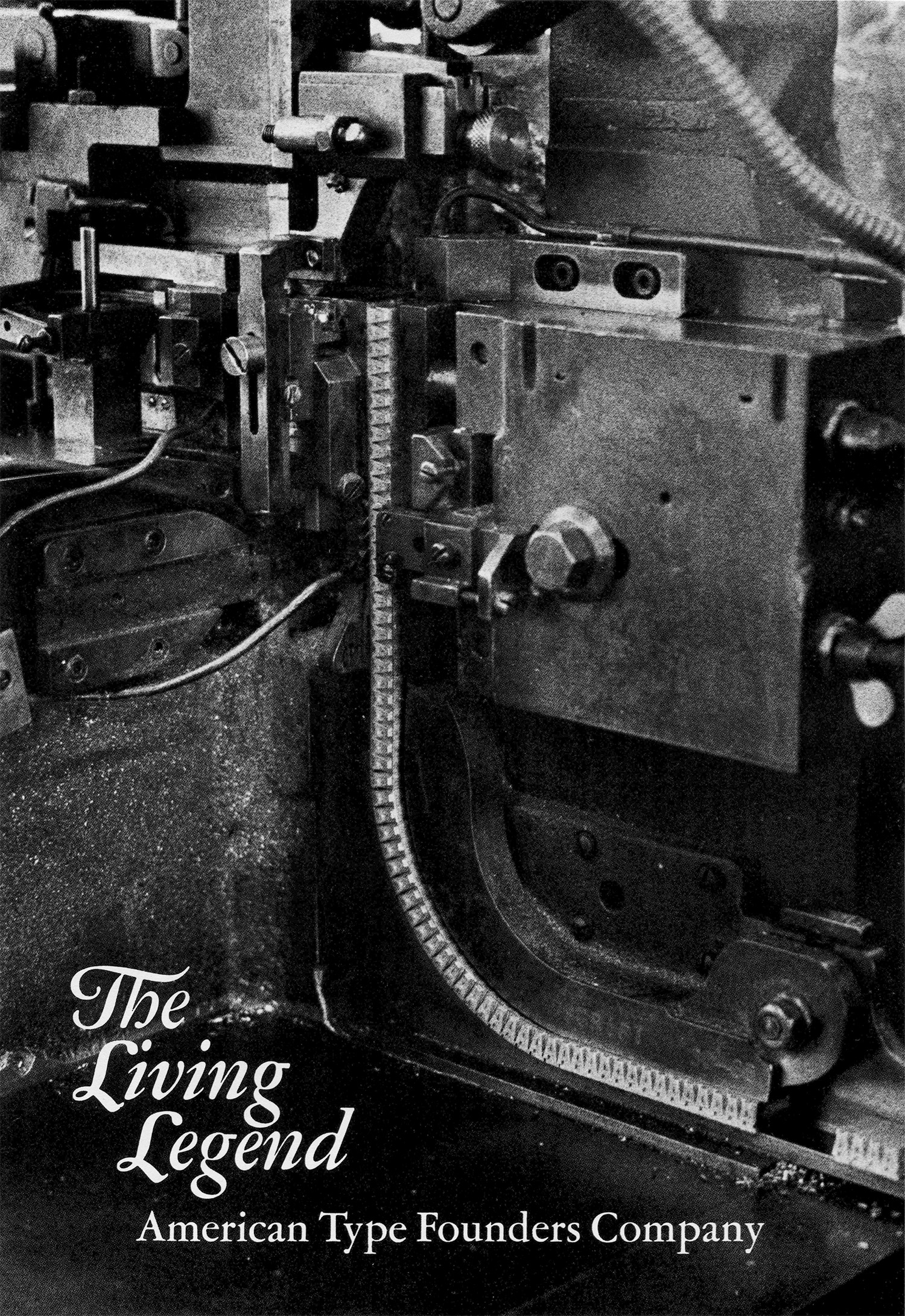
Freshly cast letters, after being
trimmed on all four sides, march through the curved
delivery channel on an ATF Barth caster.
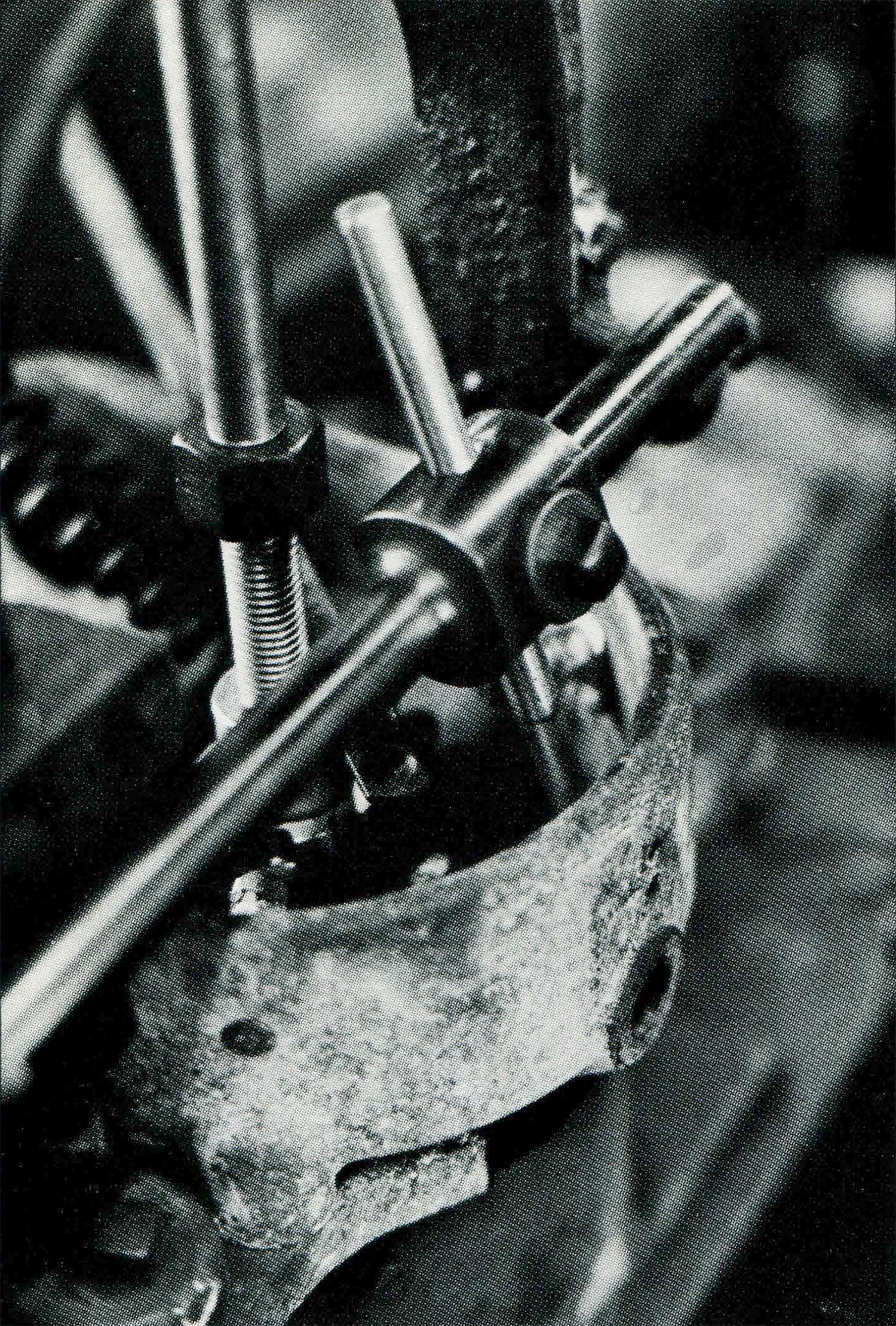
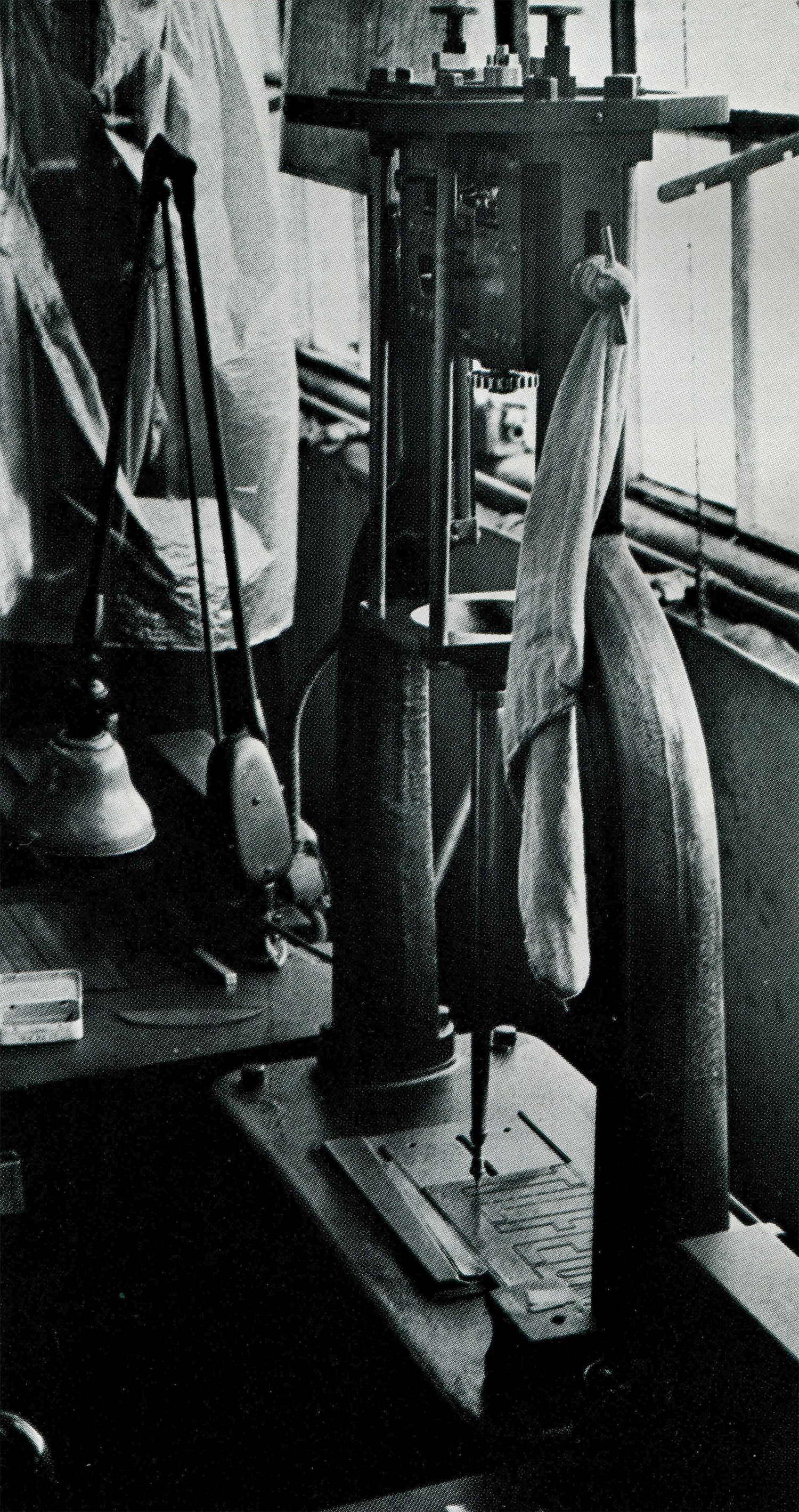
A new choker-valve operating arm and
other parts await installation in this
caster pot.
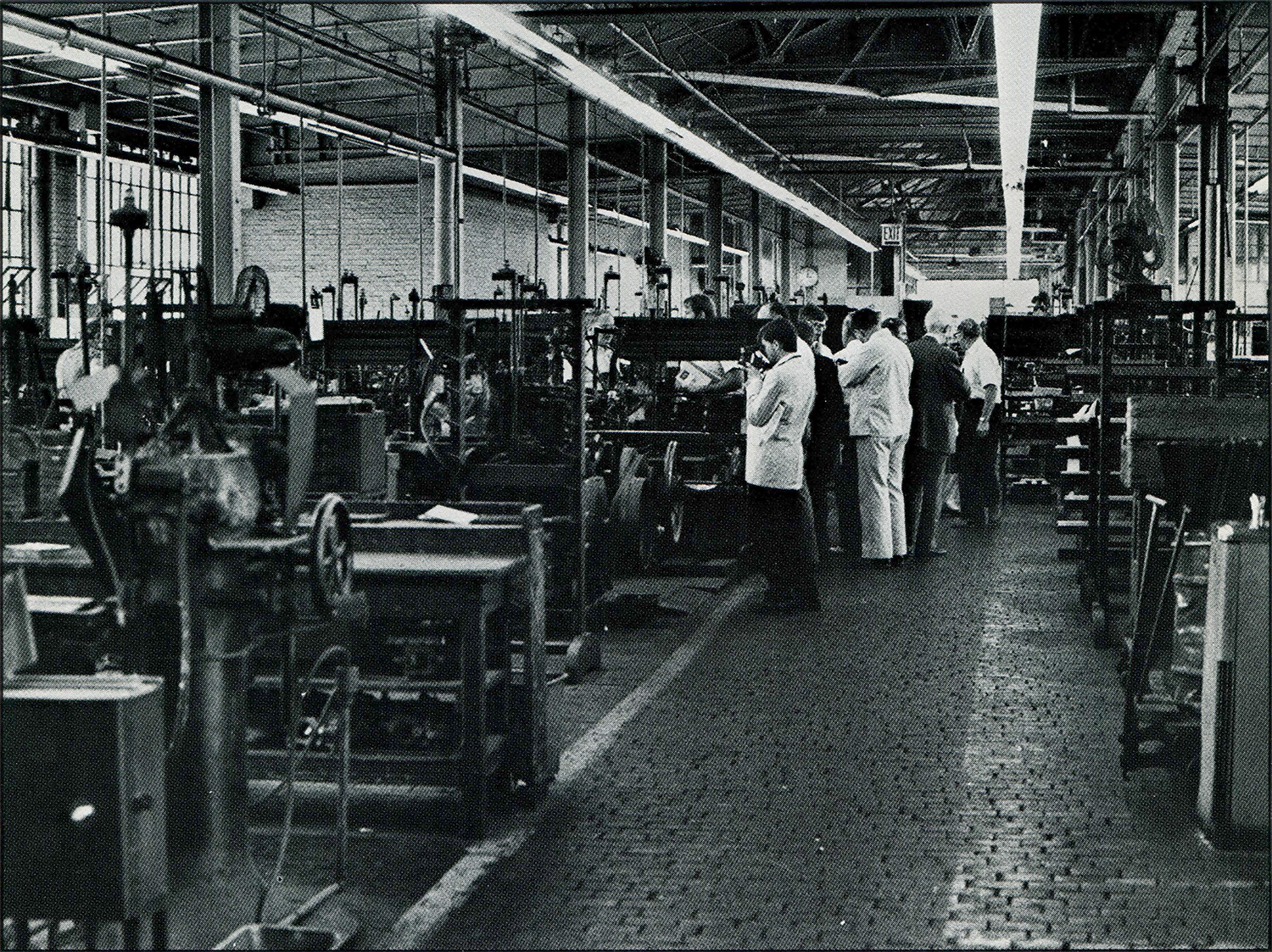
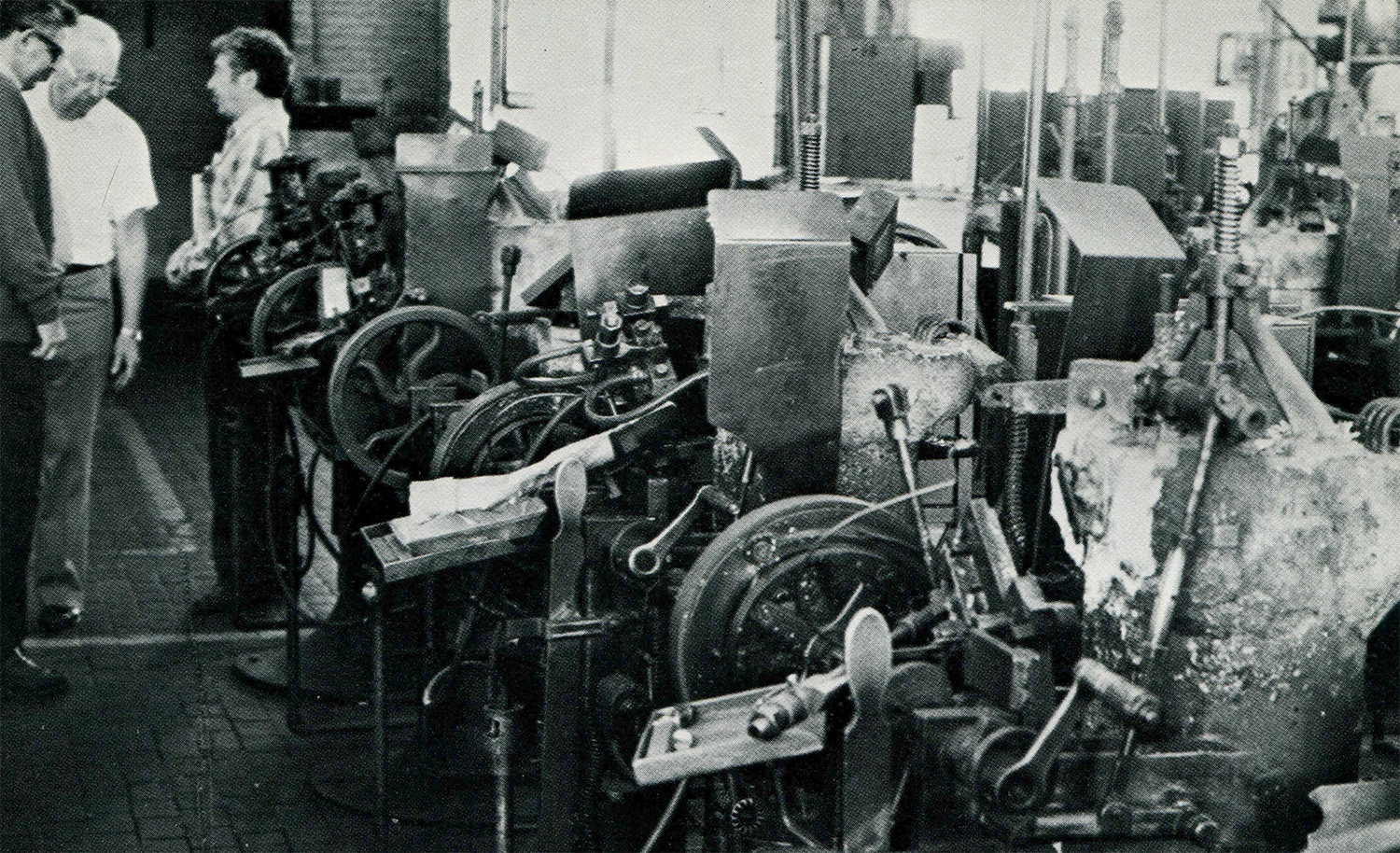
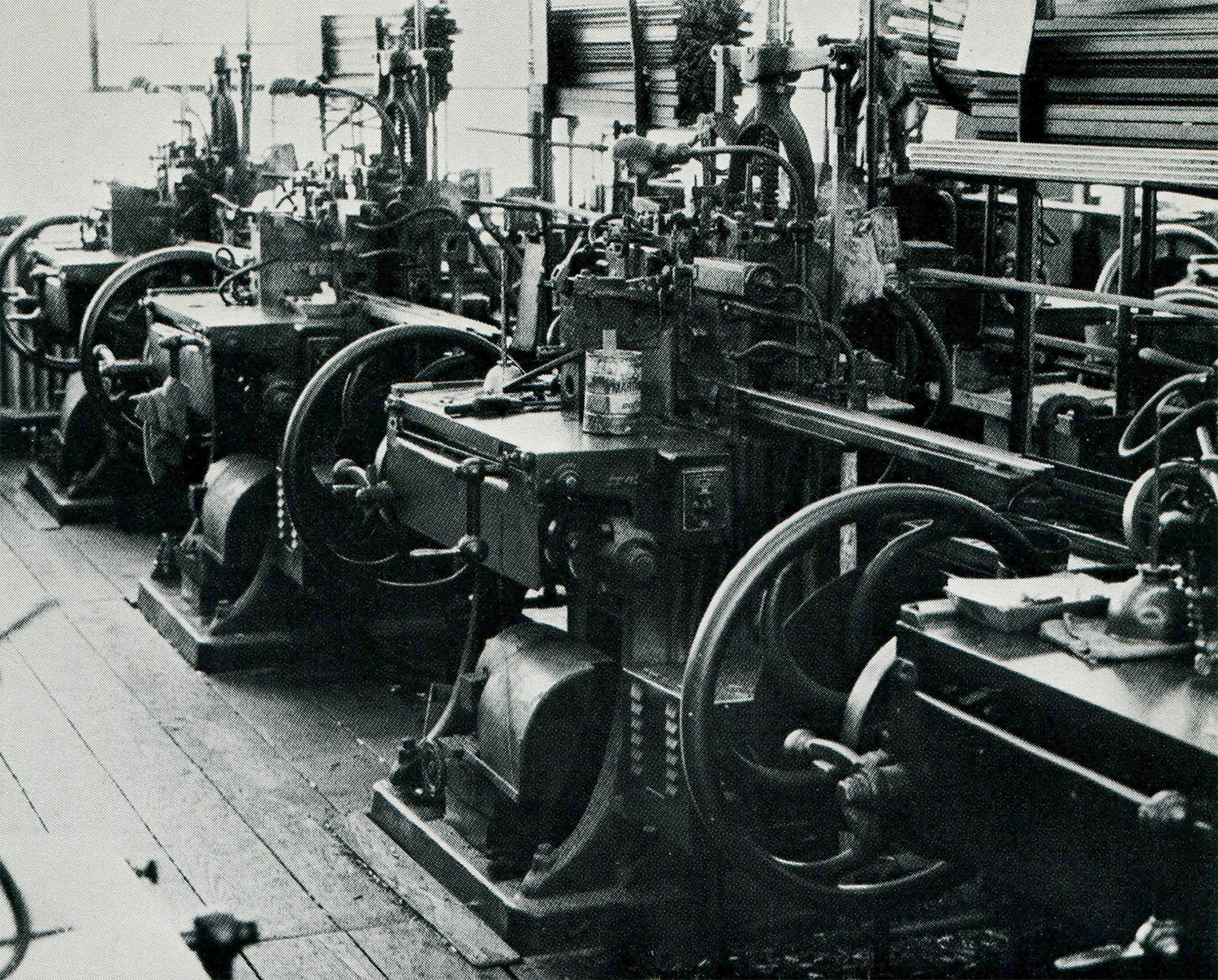
Lathes, drill presses, milling machines
and all sorts of specialized equipment
line the aisle in the machine department,
where worn or broken caster parts are
mended or replaced.
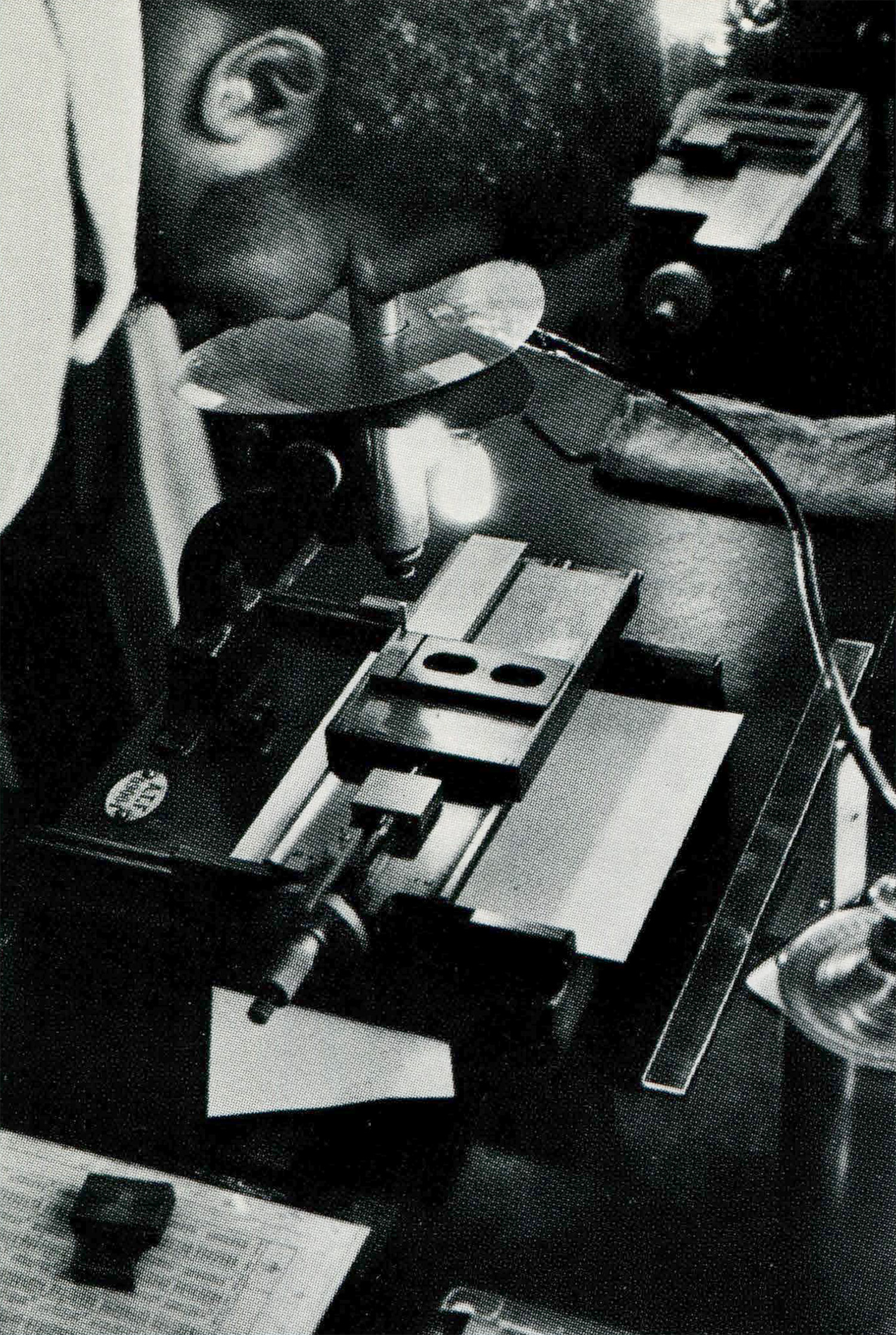
A member of the Typecasting Fellowship,
Willie Parker, gets a "full-screen" blowup
of a tiny 8-point piece of type through a
specially modified microscope.
"The celebrated Benton Matrix
Engraving Machine, invented
Irv L. B. Benton, director of
the General Manufacturing
Department of the American
Type Founders Company,
which manufactures the
machine. It has completely
revolutionized the art of
matrix making."
This and all other italicized quotes are from the 1923 ATF Specimen Book
Now reduced to only a few machines for
cutting an occasional replacement matrix,
these very same machines have served
masters such as the Bentons and numerous
other letter designers and matrix
engravers since the turn of the century.
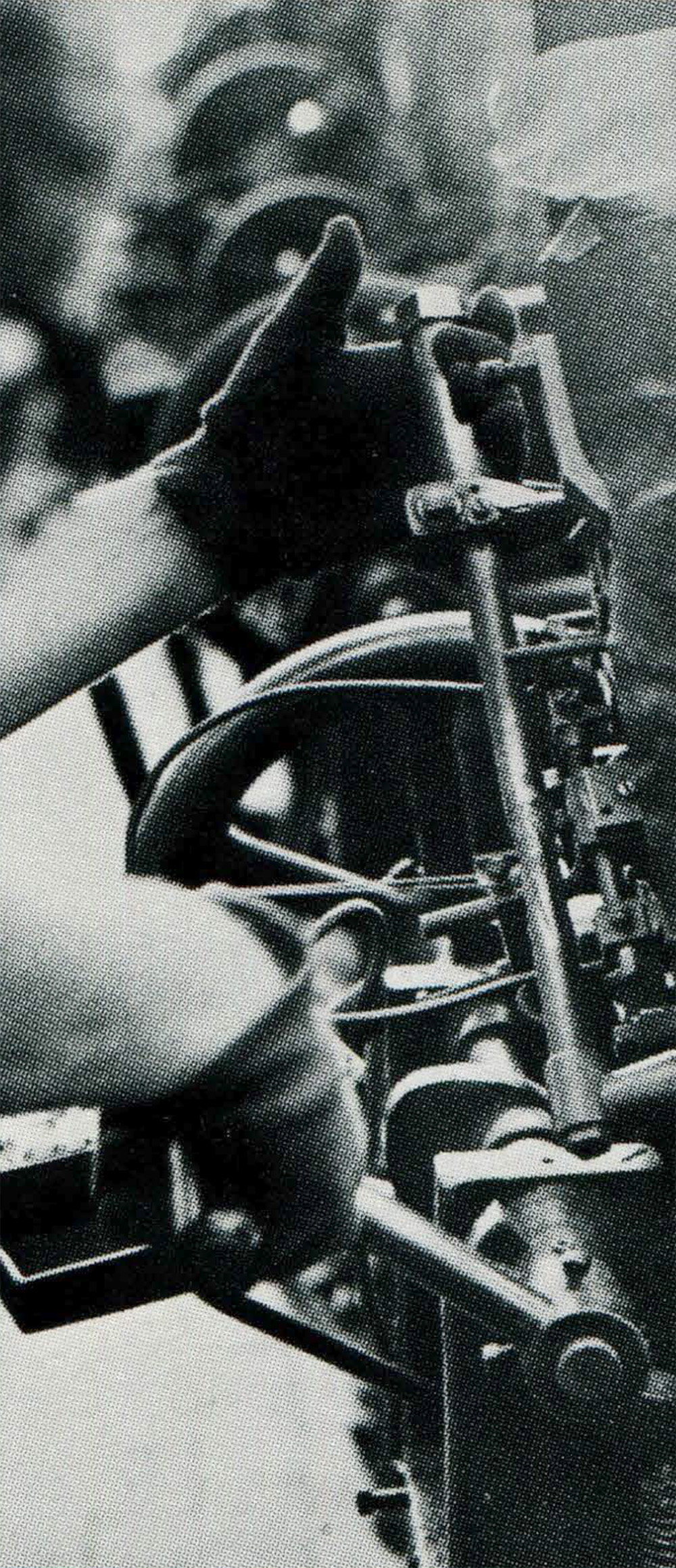
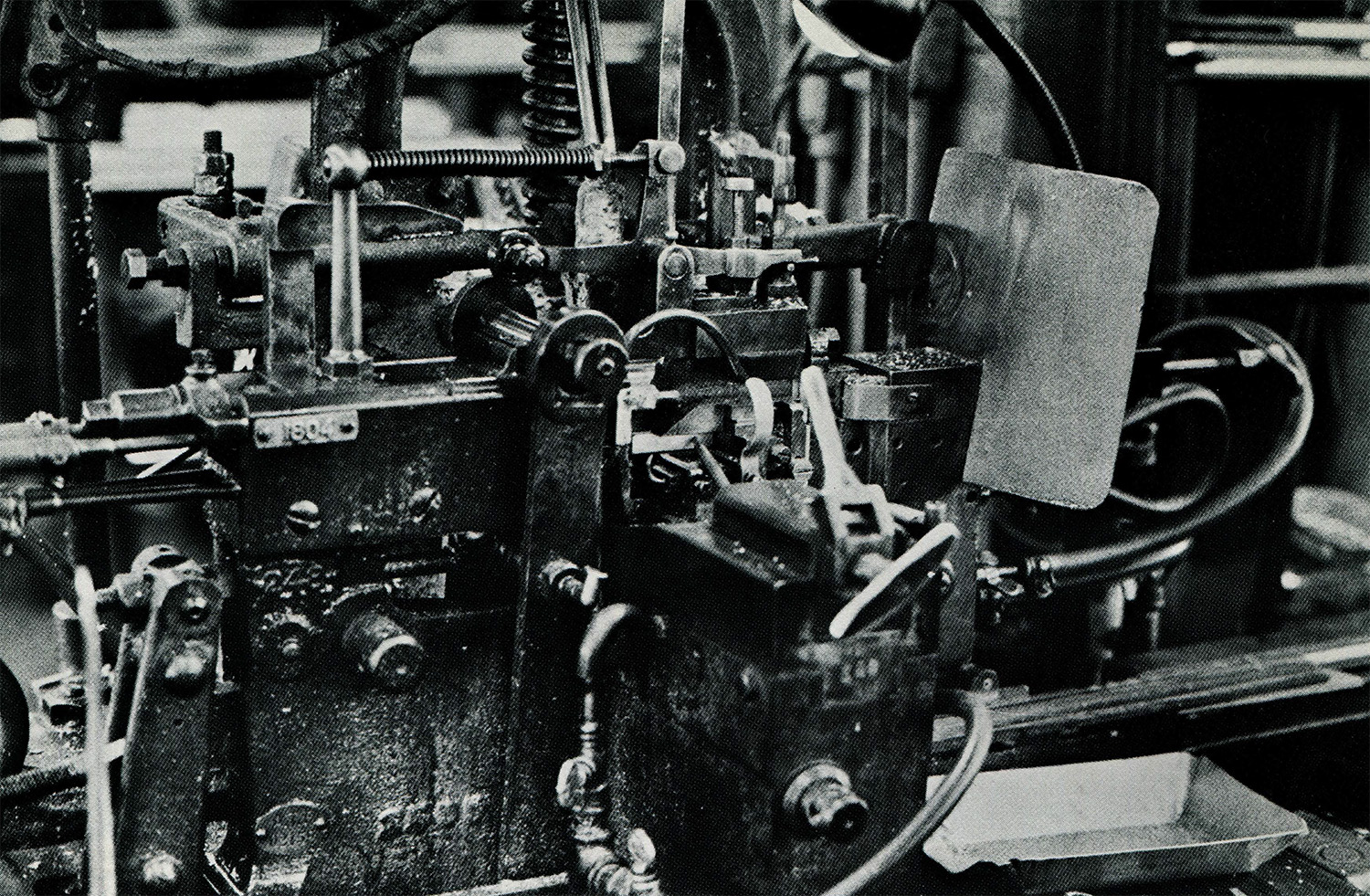
Undaunted by the march of time, ancient Bruce
casters stand ready to serve. And serve they do,
even in the 1980's, as the skillful hands of an
operator crank the machine, break open the
mold, remove the newly cast letter, and carefully
place it in the tray. Virtually unchanged, such a
process has been followed with these and similar
machines since the 1840's, when David Bruce
revolutionized the typecasting industry with the
invention of the Bruce caster-the first successful
device to automate the process of type casting.
"The American Type Founders Company
proceeds in its work and policy in the
consciousness that it has an ancient
and honorable reputation to sustain."
"Unequaled Barth Automatic Type
Casting Machine, invented by the
late Henry Barth, sometime manager
of the Cincinnati House of the
American Type Founders Company, which
manufactures this machine for its
exclusive use."
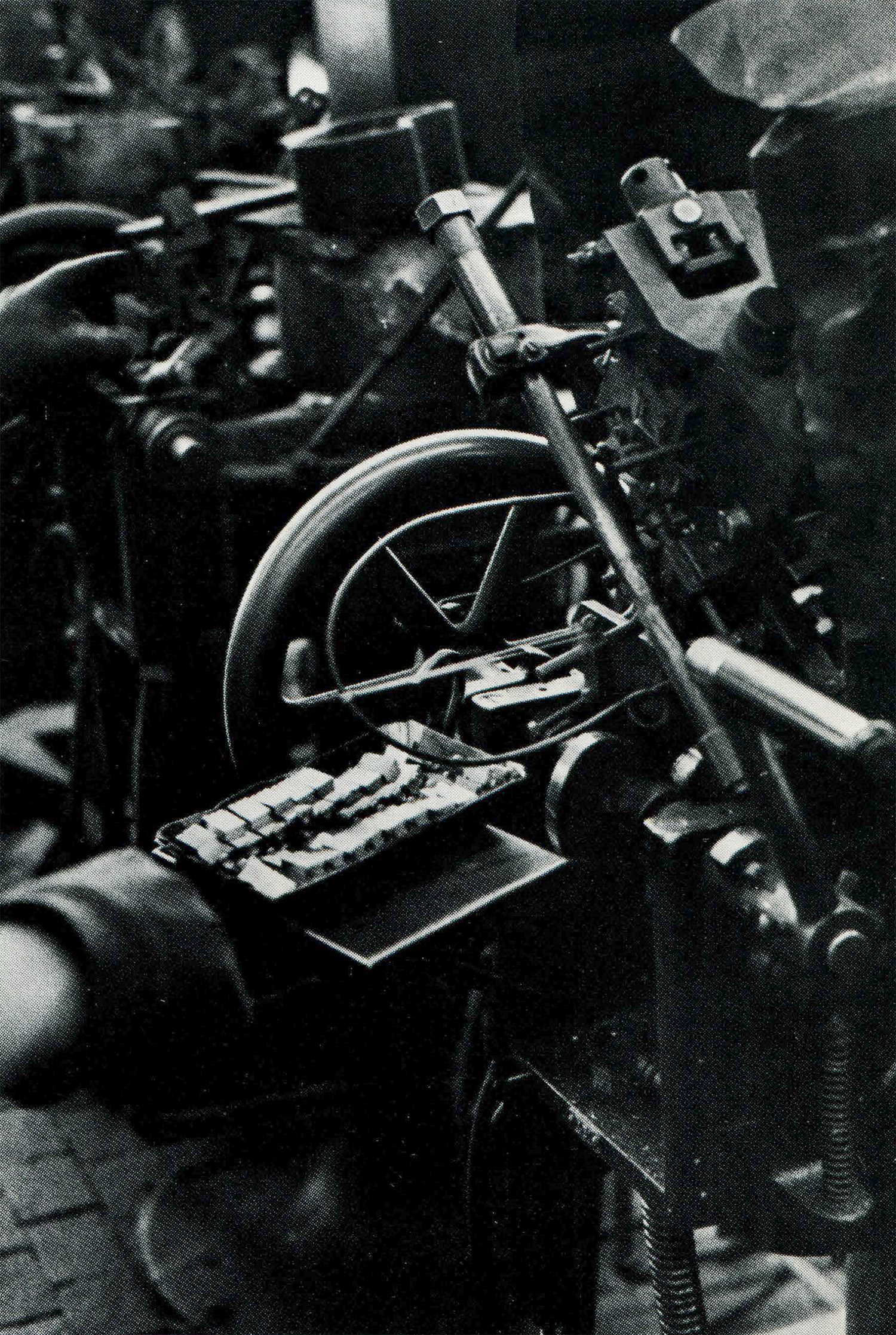
Closeup of the matrix and some of the
Barth caster's mechanism-working today
as it has for over 80 years. Each Barth
in the foundry is unique because of the
different mold it contains-different sizes,
angled bodies, etc. Thus, each is used only
when orders are filled for type requiring
such a mold.
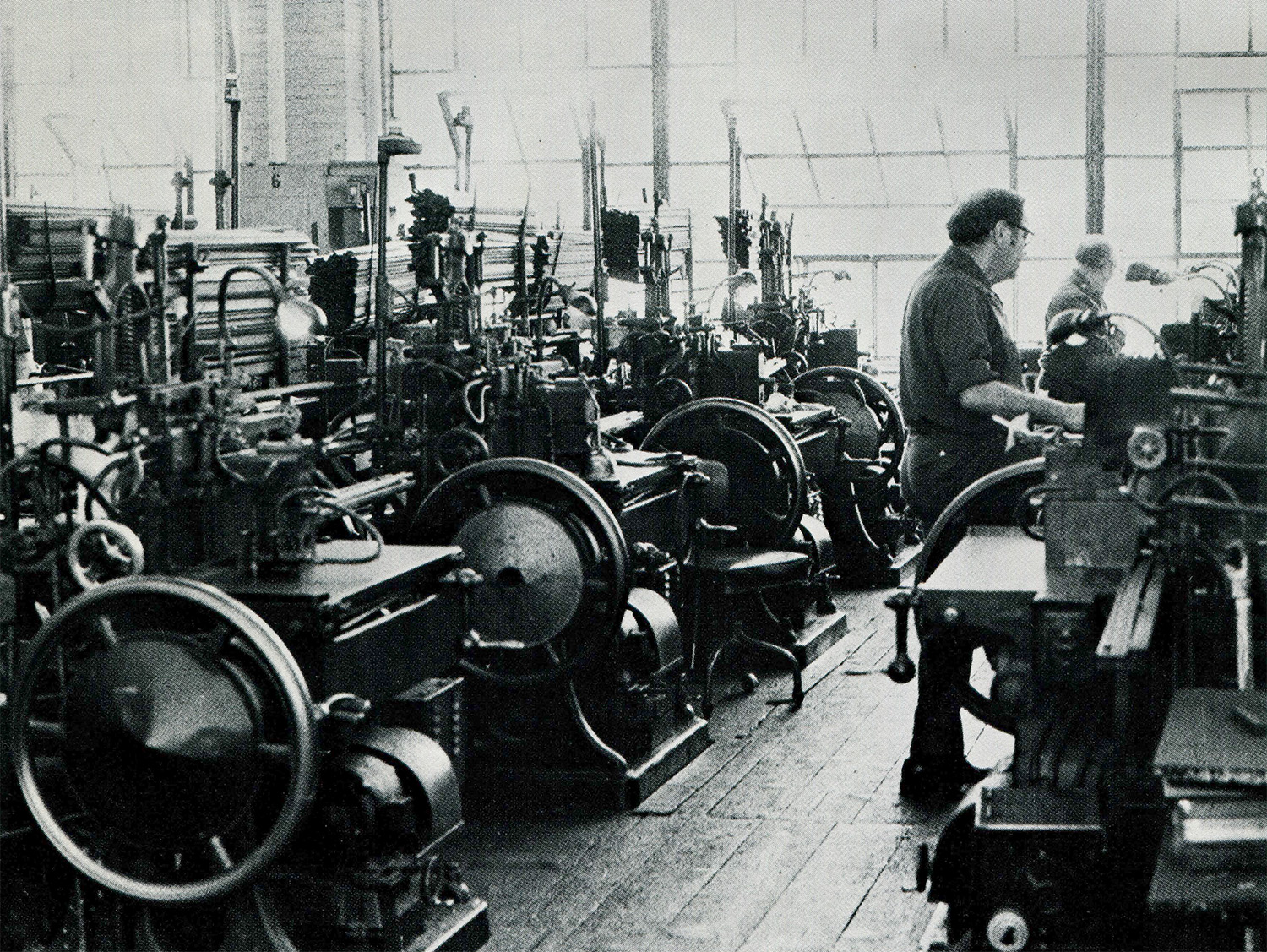
Comfortable amidst his ancient
typecasting machines, this operator
keeps an eye on the work as it
progresses on several nearby casters.
Seemingly tedious sticks are
used to transport long lines
of type from the casters to an
area in the foundry where
footing and packaging are done.
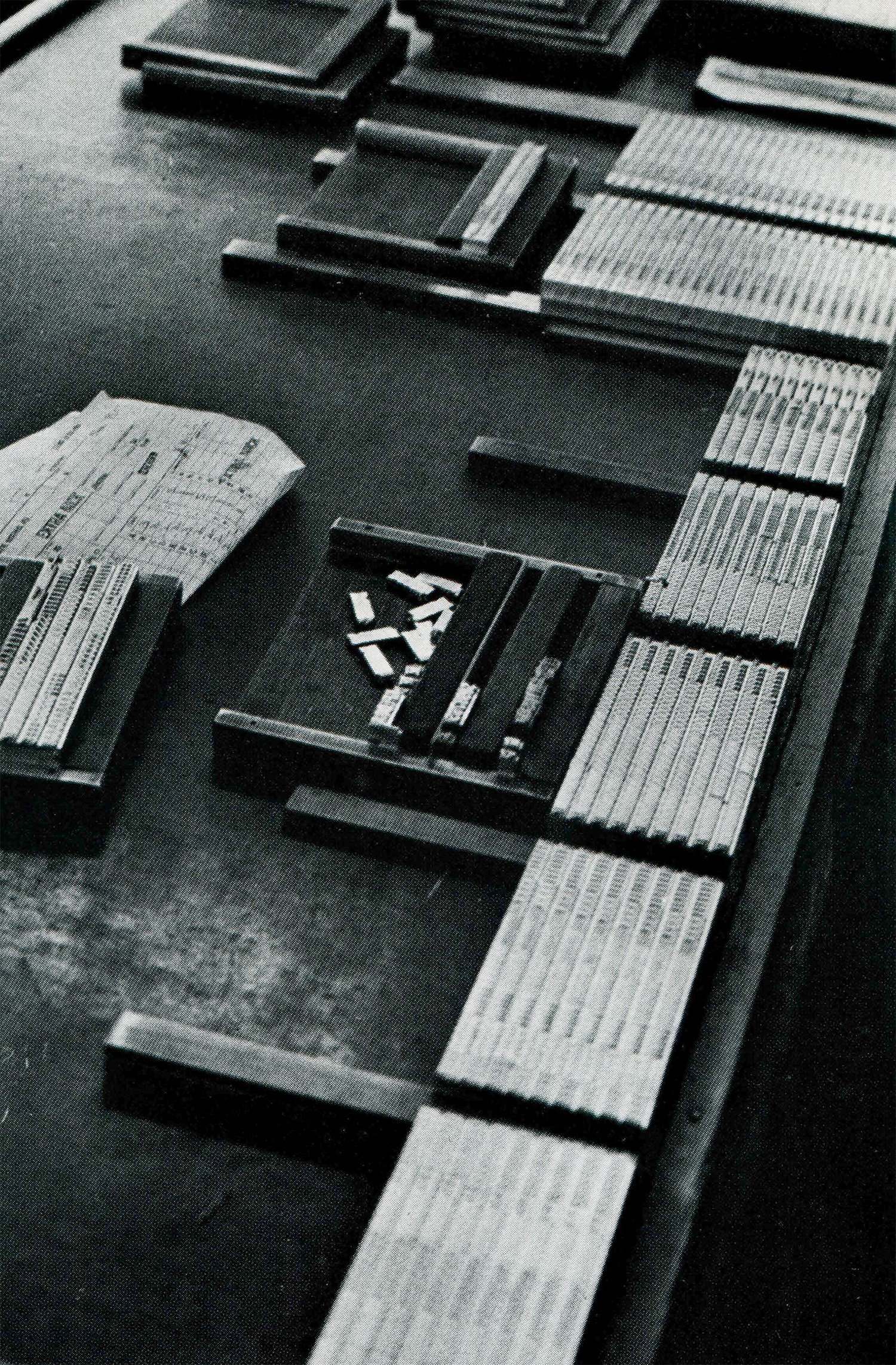
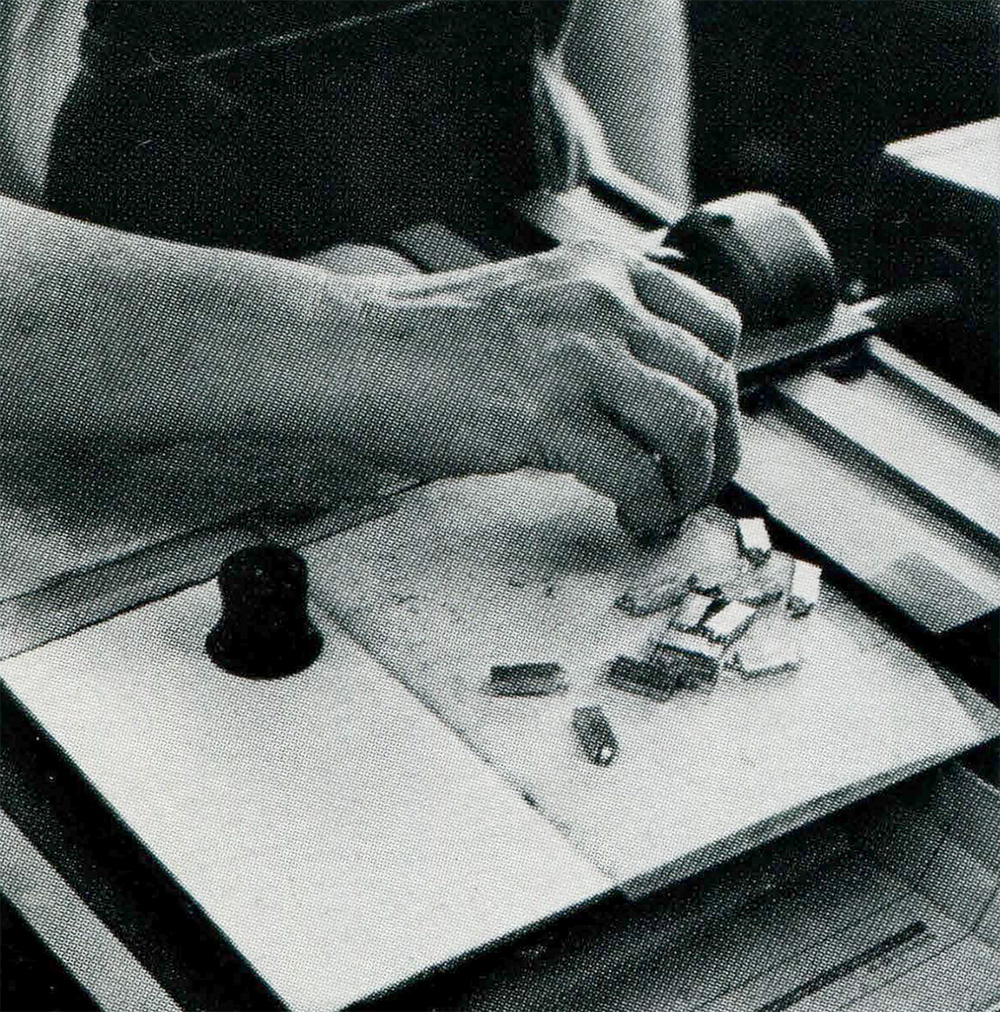
A few loose types give evidence of
the ongoing process of making up
individual fonts of type on a large
countertop.
Sorts lines stand in wood-and-brass
footing galleys prior to packaging.
Much of ATF's current output is in
sorts lines.
Below, the term "handfinished"
takes on greater meaning as one
watches the swift hands of an
operator trimming the undersides
of heavily kerned characters.
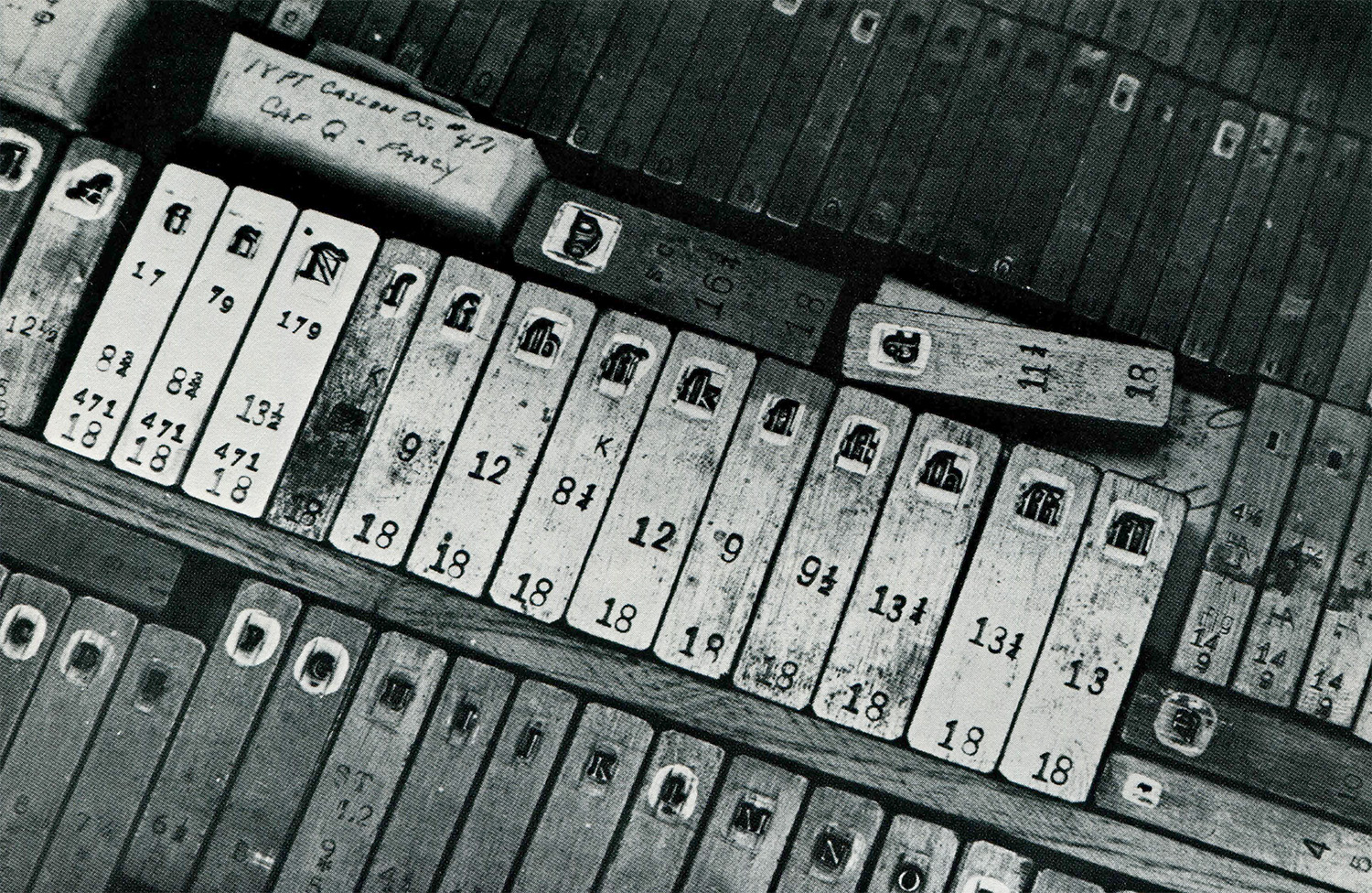
A close-up view of 9- and 14-point
Caslon 471, including the quaint
characters discontinued by ATF
some years ago. Note the brighter
steel matrices of accented
characters-no doubt recently cut
to accommodate South American
sales, which remain brisk for the
company. The tell-tale shiny core
indicates some of these mats have
been electrodeposited, while others
appear to be driven, perhaps giving
credence to ATF's claim that the
design was struck from William
Caslon's original steel punches.
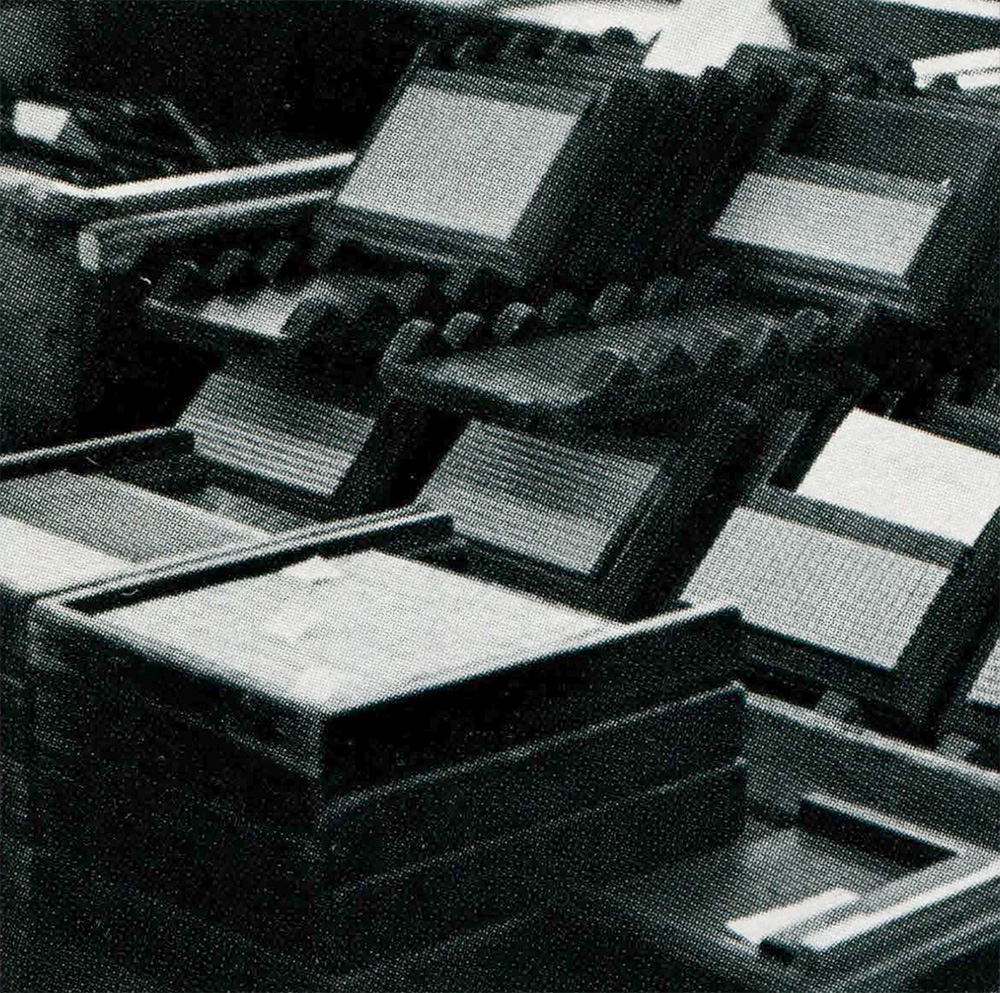
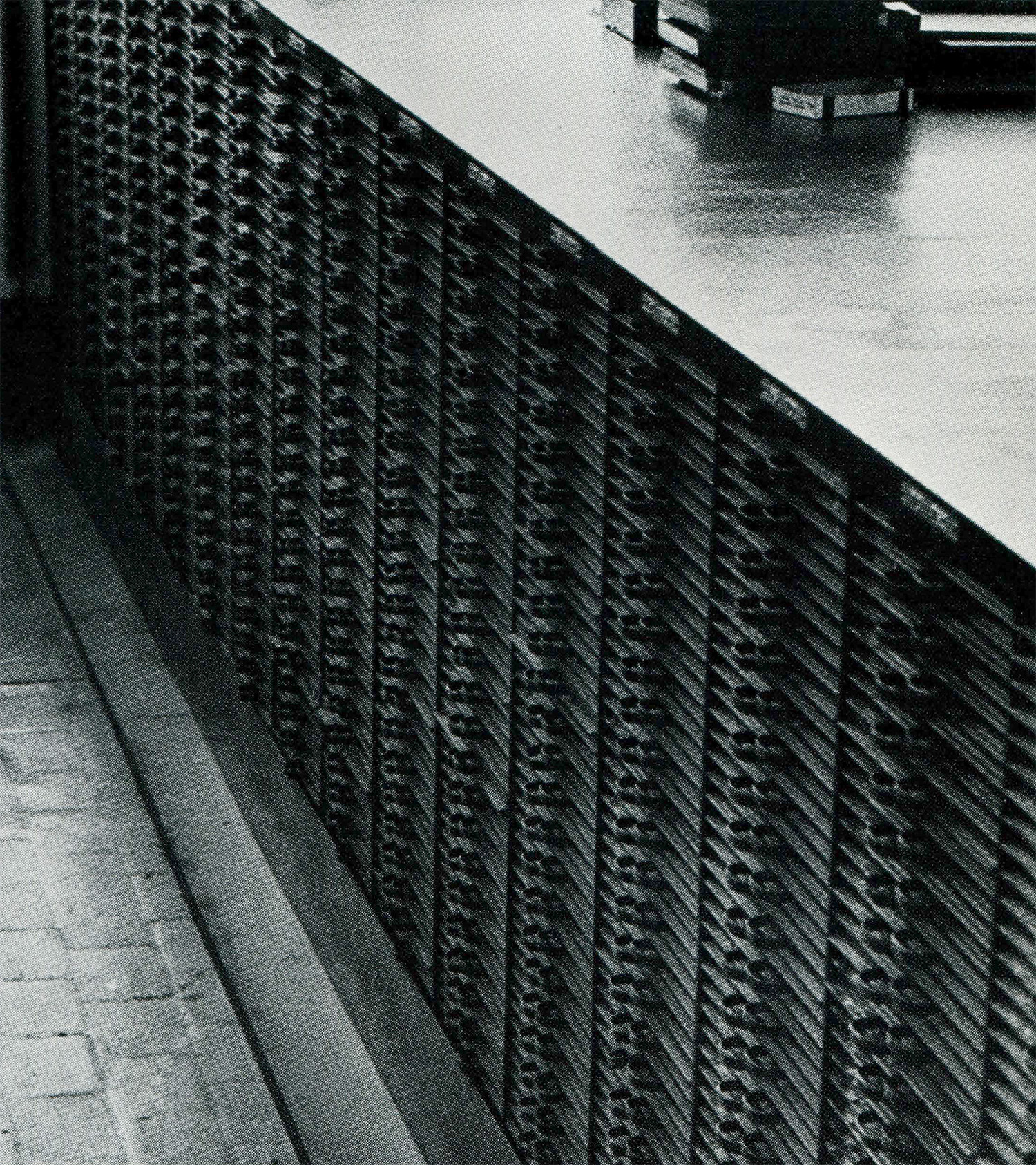
Numerous original type designs of
great variety are preserved in several
rows of catalogued matrix trays in
A TF' s matrix department. These
matrices, the partial result of nearly
100 years of type designing effort at
the company, form a collection of
inestimable value.
This Definitive Article Fills the Gaps in American
Type Founders' Illustrious History
Eighteen-Ninety should have
been the best of times for the typefounding industry.
More and more foundry type was being sold to satisfy the
increasing demands of typesetting machines as well as
hand comps, for most of the more-or-less successful
machines assembled foundry type. It was not at all
certain that the revolutionary idea of casting full
lines of type in one piece would ever amount to
anything... or the far-out idea of casting
individual letters in sequence for copy at hand.
But for the thirty-some American typefounders,
times were not good, for they had somehow gotten
bogged down in cut-throat competition that was
ruining the smaller ones and eliminating fair
profits for all of them. The dilemma was so bad
that many people were saying the only solution
would be consolidation of all of them into one
large corporation. Rumors and denials of this idea
were rampant. Some founders seemed to favor the
idea; others denounced it. Printers were alarmed
by the prospects of a monopoly or trust, with its
possibilities of stifled competition and soaring
prices.
On February 8, 1892, though, the rumors came true,
and American Typefounders' Company was
incorporated under the laws of the state of New
Jersey. Twenty-three founders were involved, while
eight or ten others refused to join in. Although
some of these independents advertised themselves
for years as "Not in the Trust," printers' fears
were soon dissipated. As an official explained,
"The making of type will be centralized into a few
centers and type will be manufactured on such a
large scale, with the most improved machinery,
that it can be made and will be sold to the trade
cheaper than ever before."
For the first few years advertising bore
signatures such as "Cast by Cleveland Type
Foundry; for sale by all foundries and branches
of the American Typefounders' Company." Some
called it American Type Founders'-two words-but
the apostrophe was retained for several years.
But when Henry Lewis Bullen became advertising
manager in 1895, the local names were subordinated
and before long dropped entirely. The new name was
emphasized, along with slogans such as "Everything
for the Printer" and "Leads the Fashions in Type."
And along the way, as predicted, list prices for
type were reduced.
Numerous persons contributed importantly to the
success of ATF, but a few deserve special mention.
Joseph W. Phinney had been with the Dickinson Type
Foundry in Boston, heading its specimen printing
department and designing many types. In 1894 he
induced Robert W. Nelson to buy in and become a
director. Nelson soon became general manager and
later president. His vigorous management brought
about reforms and coordination that eased its
early troubles and hastened its growth to
international prominence.
Henry Barth came from Cincinnati Type Foundry,
where he had invented a succession of typecasting
machines. His highly successful automatic caster,
patented in 1885, greatly increased the output and
reduced the labor of typecasting. After the
merger, ATF was owner and exclusive user of the
Barth patents, and secured his services as
director and expert.
Linn Boyd Benton came from the small Benton, Waldo
& Company. He had invented the punch-cutting
machine which eventually revolutionized
typefounding. He became a director and chief
technical advisor of the new company, and in 1903
became head of its manufacturing department.
Previously he had invented "self-spacing" type, so
called because all characters were cast on a few
multiples of points and half points, which saved
much time in justifying lines. In 1894 he
collaborated with Theodore L. DeVinne in the
development of Century Roman, and about 1900
worked with his son, Morris Fuller Benton, in
modifying this face into Century Expanded. During
his career, the elder Benton received 20 patents,
of which 18 were in the field of type making.
Benton's punch cutter, through a quirk of fate,
also was made available to Mergenthaler and
Lanston; without it, these inventions would have
had little chance for success. In an interview
many years later, Benton said, "Though a
typefounder, I am fully appreciative of the great
importance of the composing machines to the
printing industry. It is a great satisfaction to
me to have aided in their efficiency."
Morris Benton went on to become director of the
innovative Type Designing Department, and one of
the most prolific type designers of all time,
producing more than 200 faces during his career.
These include many basic American standards-all or
most of the Century, Bodoni, Cheltenham, Garamond
and Stymie families'; the Alternate, Franklin,
Bank and News Gothics; and scores of others. Henry
L. Bullen, who had gone on to found and nurture
the great ATF Typographical Library, played an
important part in influencing young Benton's
adaptation of historic faces such as Bodoni,
Cloister and Garamond to modern requirements.
By 1903 it was evident that local foundries were
no longer needed, and the great central
manufacturing plant in Jersey City was built and
gradually equipped with machinery from foundries
in Chicago, St. Louis, Philadelphia, New York and
Boston, making it the largest and best equipped
typefoundry in the world.
In the early years of the twentieth century, a new
form of competition developed, as Monotype,
Compositype, Thompson and others produced devices
that enabled the printer to cast his own type.
"So simple that any five-dollar-a-week office boy
can make perfect type," one of them advertised.
"As old foundry type can be melted down, the
product is the equal of foundry type in every
way," another advertised. The foundry countered
with claims that the temperature needed for its
processes would burn out other equipment, while
the greater precision built into its molds and
matrices was not subject to the individual
operator's level of competence in making
adjustments.
Perhaps the extravagant claims of this
competition strengthened ATF's determination to
make the best possible type, for their product
maintained an enviable reputation for hardness,
uniformity, point alignment, depth of drive,
extreme precision and careful finishing. And
throughout the period when all the typefaces of
the printers' machines were copies of foundry
types, ATF maintained the principle of
originating its own designs or making royalty
agreements.
In 1911 ATF sponsored the development of the
family of Kelly automatic flatbed job presses,
invented by William M . Kelly, a former employee.
In 1913 Henry L. Bullen organized the Efficiency
Department to develop and redesign composing
room equipment for greater efficiency. This
resulted in the Cut-Cost System of Printing
Plant Equipments. In 1915 the Education
Department was organized by Frank K. Phillips,
manager, for introducing printing as part of
vocational training in schools.
The independent foundries had gradually closed,
or merged with each other or with ATF. In 1929
Barnhart Brothers & Spindler closed its doors,
and its casting machines and matrices were
shipped to New Jersey, leaving ATF with no
direct domestic competition aside from the
foundries which operated primarily with Thompson
or Monotype casters.
The death of ATF's President Nelson in 1926 left
the company poorly prepared for the growing
depression, and eventually a petition of
voluntary bankruptcy was entered to save the
firm from disaster. One result of this was
removal of the foundry to the Kelly Press
Division plant at Elizabeth, New Jersey, in 1935.
Thomas Roy Jones was elected president in 1933,
and brought the company up out of bankruptcy by
1936. Two years later, the company entered the
offset field with the purchase of
Webendorfer-Wills Company, manufacturers of
lithographic printing presses. Several companies
in the electronics and furniture fields were
purchased over the next several years.
About 1960 ATF became a subsidiary of Whitin
Machine Works. Since that name tended to be
mispronounced, the old typeface Bold Antique
was reintroduced with the new name Whitin
Black, hoping the play on words would more
firmly establish the proper pronunciation.
But in 1966 Whitin and ATF and other
subsidiaries were acquired by White
Consolidated Industries, corporate descendant
of White Sewing Machine Company. These corporate
goings and comings need not concern us further,
but in 1970 ATF acquired Lanston Monotype and
moved some of its equipment to Elizabeth, where
it was operated for a few years, then
discontinued.
In 1980 American Type Founders Company is still
casting its high quality type in a range of sizes
from 4 point to 120 point, although in a greatly
reduced variety of styles.
3
International Correspondents Provide News from Afar
Bruce Casters in Use in India
I am a type founder by profession with five Bruce
typecasters, one Monotype, one Thompson
manufactured in India, one Elrod (also
manufactured in India). Bruce type-casting
machines are workhorses here, going strong. My
mats are electro mats and 'Mono' mats. New
Gujarati (one of the 14 scripts of India) type
designs were created by hand engraving on
lead-prototype and galvanized handengraved
punches were used for two designs. Punch cutting
craft has almost lost. One unit in India supplies
pantograph-cut mats. It is too costly for
Guiarati, having small trade area. If you will
inform me about the creative activities of the
fellows, it will bring us together and we will
share enthusiasm and may help each other.
Arvind Patel
Gozaris Pole, Shahpur
Ahmedabad 380001 India
Australian Obtains Mono Caster
I am now the proud (though somewhat bemused) owner
of a Mono caster. It is a late model, and in very
good condition, with the display type attachment.
It is gas equipped, and I asked the Monotype
Corporation here for a price on converting over
to electricity; the price was $1250. After
picking myself up off the floor, I have decided
to wait and take an electric pot off a caster
being scrapped. There are a number of small
printers who will be happy to have a source of
Mono hot metal, as it is now unobtainable here.
I missed out on the keyboards, as the lo-
cal technical college got there first ( they
use them for photo-setting training as well
as for the real thing).
C. D. Fitzhardinge-Bailey
St. Aubyn, 15 Dutton Street
Bankstown, N. S. W. 2200
Australia
Hand Mold Interests Canadian
I am very interested in the activities of the
ATF, though I haven't any casting equipment at
the moment. I'm particularly interested in the
development of a hand casting mold which will
accept Monotype display mats, of which I have
several fonts in sizes from 14 to 36 point.
R. MacG. Dawson
Dalhousie University
Department of English
Halifax, Nova Scotia
Canada B3H3]5
Lubrication: The Key to Successful Typecaster Operation
Abe Horowitz
(This article was written by Abe Horowitz of
Brooklyn, New York, after the second conference.
Abe has many years of practical experience as
Monotype machinist, operator, foreman and
supervisor. He shares his knowledge with a slant
for the beginner.)
Oiling is very important. Use a very good grade of No.
40 machine oil. Check for all the small oil holes on
the machine and turn the machine over and you will
notice additional oil holes now come into view.
Oiling the cam lever oil holes is important. The oil
pan where the cam lever rollers operate is especially
important. There is a small plate attached cautioning
the operator to see that the oil is level to the
small cup attached to the pan. It's a good idea to
take the pan out and dispose of the oil if it is
dirty or old. Put in new oil and fill it to the level
where the plate directs you.
The mold is the heart of the caster. A good deal of
wear can be avoided and expense can be reduced to a
minimum if simple directions are followed. I use an
oil made by Shell called S.A.E. 79 Vitria oil. If not
available in your area, get something similar. It is
a little heavier than other oils, but
experimentation with a lot of oils, I have found out
it's good when putting on a mold to put some oil on
the coupling (the part of the mold that hooks to the
type carrier) and then some oil on the mold blade.
Put oil in the rear mold cup, and the front mold cup.
Put your mold on, clamp it in tight, insert the mold
blade pin, turn the water on, but do not put in the
mat case. Don't put the pot up either. Instead, just
run the machine about a minute. Then take a flat
stick and clean cloth and wipe off the oil after the
machine has run a minute.
Then insert the mat case, put up the pot, and you're
ready to cast type. The mold should be oiled in both
mold oil cups about every 15 minutes.
If the mold oil cup shows the oil remaining a long
time, and if you note in cleaning the mold that the
blocks are getting cut, the oil is not going through
the oil pad that is in the mold. This pad acts as a
wiper and an oiler. The mold cup is dirty and no oil
is coming through.
Take the mold off, put it on a bench and put some
kerosene in the oil cup. Use an air blast in the
cup and see if bubbles of the kerosene come through
the pad. If not, take a sharp botkin or pointed tool
and remove the pad. Run a small wire through the oil
cup to reach where the pad was. You will punch out a
lot of dirt. Clean thoroughly and replace the oil
pad. Your mold will operate much better.
Neglect proper lubrication and your machine
will not serve you well for very long.
3
Recently, Alessandro Zanella, my partner, and I were
in Torino to visit Bianca Tallone. Quite by accident
we visited the "Nebiolo" typefoundry. What has
happened is this:
Fiat bought Nebiolo, the leading Italian typefoundry
and manufacturer of pbotocomposition machinery. The
hot metal section didn't yield the sort of profit
that the Fiat wolves were accustomed to and so they
eliminated that section—putting 300-plus workrs out
on the street. But these guys raised an Italian
finger to the eye bone and formed a cooperative,
installing all the equipment in a new plant and are
now surviving on orders from Arab countries for
foundry type in non-roman faces. But the good news
is that they are equipped to cut new mats, cast
mats from existing type, and are willing to cast
proprietary· types for private presses.
I am sure this will be welcome information for
your readers. I'll try to get more details the next
time I am in Torino.
3
A few years ago while my wife and I were casting
type for a long book we were planning we wrote
this song to pass the time.
Well it was late last night
And I was casting type
On my Lanston Monotype machine.
It was going real good
Just like it should
The type was coming out real clean.
Then I felt a squirt
And it really hurt
'Cause it bounced off the side of my head.
When I went to look
I was really shook
'Cause my ear was filled up with lead.
Then I felt a sneeze
And fell to my knees
I found myself in a daze.
When I came to
I knew it was true
'Cause my mouth was spitting A's.
"The Human Typecaster" should be sung accompanied
by the beat of a typecaster.
Steve & Meryl Chayt
Winter Haven, Florida
Broken Font of Music Type Offered
Incidentally, I have a broken font of nonpareil
music type (unusable because several of the
characters are missing) which I plan to melt
down unless there is some ATF member that would
like to use it as a museum specimen. If so I
will sell it at the junk metal price.
Owen Stout
Route 3, Box 108
Paoli, Indiana 47454
Now Closer to Running Comp Caster
I finally received my type metal from Olley Baker,
so I should have at least a lifetime supply! Now
all I have to do is fix the keyboard, make a
phase converter, extend 220 volts to the caster
location, figure out if any more parts are broken,
adjust the machine, and I am in business.
Roy Rice
Atlanta, Georgia
Halbert Acquires Second Super Caster
I have another Super Caster now-got it from Ft.
Worth. As far as I know, the two I have are the
only ones in the South. I got it because they had
a lot of molds that I wanted and didn't have.
I also have been stacking up mats almost as fast
as I can. I got all the mats from Crosby in Ft.
Worth, Gulf Printing in Houston, Thomas P. Henry
in Detroit, National in St. Louis, and a few
others in the past few months. Several have told
me that only American Type Founders have a better
library. But I still am on the lookout for mats I
don't have.
Bob Halbert
Tyler, Texas
Mats to Go with Book on Cheltenham
My interest is not in typecasting. Just the love
of type and collecting old faces. However, I did
take advantage of the sale of Giant mats from
that fellow in Bellvue, Illinois. I bought the
72-point Goudy Handtooled, roman and italic with
swashes. Now I'm looking for someone to cast me
some type from them.
I also bought a font of 72-point Cheltenham Bold
which I plan to do a miniature book on the story
of Cheltenham and include a mat in each book.
Charlie Hinde, Sr.
Santa Clara, California
Al Piccoli Beats Me Out on Matrices
Thank you for your letter inquiring about our
Monotype matrices. It's nice to know people still
care about old type. We just finished boxing up
the mats today. We sold the entire collection to
Al Piccoli, Rochester, New York.
The Friday Harbor Journal
Friday Harbor, Washington
Three Possible Sites to Be Considered far Third ATF Conference
Richard L. Hopkins
In keeping with the informal,
unstructured nature of the Fellowship, nothing formal
such as voting will be undertaken, nor is a precise
schedule of conferences established.
However, three locations were suggested at the
second conference as possible sites for the third
meeting, with no specific dates set.
Individuals are asked to give their comments on
these possible sites to Rich Hopkins, and those
comments will be reported in subsequent
Newsletters. The only recommendation at the second
conference was that the decision be weighted in
favor of the wishes of persons who are actually
casting type, rather than those who are more
accurately defined as "observers."
The three sites mentioned were Washington, D.C.,
which could tap the resources of the Smithsonian
Institution; San Francisco, California, which is
home of the MacKenzie & Harris Typefoundry; and
London, England, which obviously would include a
visit to Monotype International at nearby
Salfords.
David Belfort of Monotype International extended
the invitation to England; Stan Nelson extended
the invitation for Washington; and Harold Berliner
invited us to San Francisco.
3
Roster of Persons Attending 1980 New Rochelle Conference
David E. Belfort | Monotype International
London, England
Harold Berliner
Nevada City, California
Charles Bigelow
Cambridge, Massachusetts
Guy Botterill
Baltimore, Maryland
David Churchman
Indianapolis, Indiana
Dale Dippre
Colonial Williamsburg, Virgina
Paul H. Duensing
Vicksburg, Michigan
Rodger Glessner
York, Pennsylvania
Glen Goluska
Toronto, Canada
Robert Halbert
Tyler, Texax
Elizabeth Harris | Smithsonian Institution
Washington, D.C.
G. R. Hartzell | Hartzeil Machine Works
Twin Oaks, Pennsylvania
John Haydock
Oregon House, California
Roland Hoover
Washington, D.C.
Richard Hopkins |
Terra Alta, West Virgina
Herbert Johnson
Pittsford, New York
Michael Kipps
Colonial Williamsburg, Virgina
Charles Klensch
New York, New York
Ben Lieberman
New Rochelle, New York
Ernest Linder
Los Angeles, California
Benton Marder, Jr.
Portland, Maine
Richard Mathews
Gulfport, Florida
Mark Matteau
West Scarborough, Maine
Mac McGrew
Pittsburgh, Pennsylvania
Stan Nelson | Smithsonian Institution
Washington, D.C.
Mike Parker | Mergenthaler Linotype
Melville, New York
Willie Parker
Colonial Williamsburg, Virgina
Al Piccoli
Rochester, New York
Bamey Rabin
Marblehead, Massachusetts
Roy Rice
Atlanta, Georgia
William Riess | Quaker City Type Foundry
Honey Brook, Pennsylvania
Robert Richter
Hanson, Massachusetts
S. F. Royall
Williamsburg, Virgina
William Reuter
Toronto, Canada
Leonard Sandick
Brooklyn, New York
Steve Saxe
New York, New York
Fred Sholty
Indianapolis. Indiania
Andy Soule
Los Gatos, California
E. H. "Pat" Taylor — Host
Larchmont, New York
Have a Mold for a Monotype material maker for
casting 2-point leads. First person to send $5-10
to cover shipping can have it. Gerald Lange,
P. 0. Box 3856, St. Paul, Minn. 55165.
Am Seeking Mat Cases for a 16xl 7 caster. Also
single-phase motor for caster. Paul Duensing,
10180 East U Avenue, Vicksburg, Mich. 49097.
Holder Insert for English Mats for a Thompson
caster-I have a machinist willing to make
them but cost will be about $180. If you are
in need of an insert, write for details. Richard
Hopkins, Box 263, Terra Alta, W. Va. 26764.
Several Elektrons, Comp Casters, hand type
and letterpress material available from Typo
Service Corp., 1233 West 18th Street,
Indianapolis, Ind. 46202. Contact Doug Overbay
with your specific needs.
Hobby Printers Open House in Indianapolis,
Ind., August 15-16, 1981. If you want details,
contact Dave Churchman, the original clutter
printer, P. 0. Box 50096, Castleton, Ind. 46250.
Monotype Material Maker with 8 different
molds and 113 mats for fancy border and rule,
three pump bodies and miscellaneous tools. All
for $350. Midland Typesetting, 816 Wyandotte,
Kansas City, Mo. 64105. Nat Cassingham