It is becoming obvious that several members of
the American Typecasting Fellowship are going
to take the British Printing Historical Society
seriously, and will be attending the Society's
special meeting July 16–20, 1982, at Oxford
University.
Theme of the conference will be “Type Founding,
Past and Future,” and will include
presentations by scholars, curators and
practicing specialists in the making of type,
and will include visits to the type foundry at
the University Press, Oxford, to the Monotype
Works at Salfords, and possibly to Sheffield
and the Stephenson-Blake Foundry. St. Bride’s
Printing Library will have specially arranged
displays of typefounding material and type
specimens for the occasion.
PHS has invited our group and has reserved
(tentatively) a day of the program for
presentations by our representatives.
It is explained that Britain now is undergoing
a wholesale demolition of letterpress
operations similar to what happened in the
United States several years ago. To date, there
is very little activity in the realm of private
preservation of casting equipment in Britain,
and PHS members seek ATF’s advice and example
to foster a similar movement in their country.
Michael Turner, chairman of PHS; John Dreyfus,
James Moseley and Michael Twyman have formed a
sub-committee to begin work on arrangements and
Stan Nelson is handling liaison in this
country.
Harold Berliner of Nevada City, Calif., filed
this report Nov. 15th:
“Last week I had occasion to be in London on
business and saw James Moseley who is most
enthusiastic about the coming conference.
Moseley is very happy to have American
attendance and American participation. (I
should note here that Mr. Turner is actually
the organizer.)
“Arrangements include lodging at St.
Catherine’s College, Oxford. Cost is £75
including a meal Friday evening and a breakfast
on Monday and all intervening meals. The
registration fee will be £25. This amounts to
roughly $200 per person at today’s money rates,
which fluctuate.
“I pointed out that anyone arriving from
America on Friday would be in poor shape to
take much part in any kind of program that
evening and suggested that arrangements be
considered for lodging to commence on Thursday
at a supplementary rate, and perhaps Monday
night also.
“Saturday would be given to the ATF to present
films, slides and demonstrations. Interest is
high in exactly how amateurs cope with the
variety of things they attempt, including punch
cutting, matrix engraving, the running of
Monotypes and Thompsons, etc. A special request
was made for Stan Nelson’s remarkable set of
slides with his talk on the making of hand
molds and punches, matrices and type.
“Monday we would go to London on a bus to visit
exhibits at the St. Bride Institute and the
British Museum and hear lectures on
conservation of the surviving materials for
metal type casting.”
"In addition to this, I have been told we would
be welcome to make at least two visits: one to
the Monotype Works at Salfords, 40 minutes
south of London, and the other to the Barcham
Green Mill at Maidstone, which is about 30
minutes southwest of London.
"There would be many other opportunities to
pursue individual interests.
"It seems to me most important that we obtain a
tentative count of how many members (and
others) would likely attend.
"One interesting note is that trans-Atlantic
travel cost is now at an all-time low, although
I doubt this will last through next summer.
Opportunities still exist to travel on World
Airways and Laker Airways from Los Angeles,
Baltimore, and these always will be very
reasonable."
A one-page questionnaire is included with this
Newsletter. Please take a moment to complete
this form and return it to Stan Nelson
immediately.
Stan estimates expenses for travel, lodging and
meals will be from $1000 to $1500 per person.
More details on cost, scheduling, the
possibility of chartered air transportation,
etc., will be forthcoming. Because of the
uniqueness of the opportunity and expenses
involved, as much advance warning is given as
possible.
Begin now by making a commitment to attend.
Don't let anything get in your way. It's not
an opportunity you're likely to have again.
3
After Rodger Glessner volunteered to print the
photo supplement to the last ATF Newsletter, I
decided to pull out all the stops and do
everything I could to make it an issue of
substance. Naturally, the principal item
discussed therein was going to be the rare
visit to American Type Founders Company in
Elizabeth, N.J., and for that reason, I sought
help from the foundry in compiling the article.
To this day, no official correspondence has
been received from ATF—only a note scrawled
across a Xerox copy of a letter I had sent to
Frank Hinkel, retired product manager for the
foundry.
I didn’t want to bother folks involved in the
daily ATF routine by asking time-consuming
answers to a big list of questions. That was my
reason for approaching Frank Hinkel in the
first place.
“Note: I have asked Frank Hinkel to refrain
from answering your questions.” The note was
signed “George R. Gasparik.” That’s the only
response I received. And, indeed, no answer
followed, even though I sent a two-page letter
to Gasparik detailing my objectives and desire
to be accurate in my account.
Fortunately, we had an “ace in the hole” with
Mac McGrew. His excellent article filled what
otherwise would have been an awful gap in that
issue.
Three interesting things have come to light
since publication of that issue. First was that
Mac McGrew had been in the foundry before—given
the cook’s tour by Whedon Davis, then type
director for the foundry, and the
aforementioned Frank Hinkel. Surely many of
the “answers” provided in Mac’s article came
from that visit in the early 1960s.
Second was information from Benton Marder
regarding the Caslon matrices (and others)
mentioned in my account. It was my assumption
that ATF only engraved matrices now—that the
processes of electroplating or driving matrices
were no longer used. His comment:
“Well, a lot of us had that impression. The
Caslon mats were purchased as drives from the
Caslon foundry. These drives were fitted for
the casters and used. However, since the
punches weren’t available, a casting was made
for that purpose and the types stored in the
vault. Whenever the mats burned out, new mats
were made by electro-deposit. ATF still has the
apparatus and does use it to this day.
“Copper mats, and this includes electro mats,
start to burn from the very beginning. This
means that, if a face is to be perpetuated, a
casting for the purpose must be made at the
very beginning of the working life of the
matrix.
“This reminds me of your remarks concerning the
Oxford mats. The Boston set was the best of the
lot when the consolidation of the matrix
collection was done in the 90s. Probably they
were next to brand new and the type punches
were just made. There was a certain amount of
legitimate borrowing going on at the same time
as the not-so-legitimate borrowing. The
foundries did work together when it suited
them...”
Third was information, also from Benton Marder
that ATF was for sale — that White Consolidated
Industries would entertain a legitimate,
serious offer for the typefoundry operation.
Benton has additional details, should anyone
want the information. My only comment is that
it’s one thing to muse and dream about owning
the foundry, and quite another to think of the
marketing, management, financing, and the vast
technical and mechanical knowledge which would
be necessary to keep such an organization
going. Moving the foundry and all its machinery
would, apparently, be necessary, and that alone
frightens the hell out of me.
Copies of the completed Newsletter were sent to
Mr. Gasparik again in hopes some kind of
comment would be forthcoming. Via Pat Taylor, I
got word he wanted more copies, which also were
sent. But never any comment from ATF.
My knowledge of ATF’s “cold shoulder” attitude
had been secondhand in the past, and, I
thought, a bit exaggerated. But now I wonder.
A most gratifying letter (of the several
received after the last issue) came from Mr.
Hinkel, who departed from Gasparik’s
instructions and broke the silence.
“Many, many thanks for the copy of the ATF
Newsletter about your conference. I guess I
have read it four or five times from cover to
cover... I think Mac McGrew did a good job with
his article, ‘The Other ATF.’ Again, thanks for
the Newsletter.”
Thank you, too, Frank Hinkel. Your letter,
finally, gives some semi-official recognition
to the effort made, and to the credibility of
the information contained in the issue.
3
Three incidents, two comical and one serious,
have come to light regarding machine operations
of late.
First-reported was an event in Harold
Berliner’s shop in Nevada City, Calif. It seems
he was attempting to cast some exotic British
decorative matrices from a full case of British
side-hole matrices. Paul Duensing was witness
to what happened shortly after the mat case was
inserted into the caster. It seems somehow the
rods were not inserted through the matrices in
the case and shortly thereafter, Paul and
Harold went fishing—fishing in the pot and
elsewhere for matrices, all of which fell out
of the case.
And then I was casting display type on my comp
caster. To do this, you must disconnect the
type carrier from the cam lever and
re-position same in another hole. It seems I
failed to replace the cotter pin and after
about an hour of successful casting, the
connecting pin worked out. The caster pumped
metal when the mold was wide open, and welded
(with type metal) the carrier, mold, and
bridge all together. I had to virtually
disassemble the machine and spent nearly two
hours cleaning up the mess. Fortunately, only
one tiny piece got broken in the cleanup
process.
The serious event occurred with Owen Stout of
Paoli, Ind. He reports: “My gas burner on the
composition caster was emitting fumes (and
carbon monoxide) and I was overcome and
collapsed as a result of this. In the process I
fell and did some rather serious injury to my
ribs and head. I guess I was a bit careless,
for I have operated this old caster for over 20
years and ‘smelled’ those all-too familiar gas
fumes many times over.
“Yes, I have vents over the pots, and a large
circulating fan; but still apparently they were
not enough. Damp outside weather takes its toll
on ventilating systems, so this probably
contributed to my fall... I am OK now except
for soreness...”
As Owen indicates, even long experience won’t
help when we’re careless with gas.
3
The Haas Typefoundry—World’s Oldest Operation Continues Tradition of Letterfounding
Richard L. Hopkins
Overwhelmed!
That can be my only reaction after receiving
correspondence from Alfred Hoffman of the Haas
Typefoundry LTD., of Munchenstein, near Basle,
Switzerland.
(One simply cannot ignore the obvious contrast
of Haas and the American Type Founders Company
and the reaction of each to our efforts.)
“You have to be congratulated for having taken
an initiative to preserve hot metal casting and
letterpress printing for the next generations.
“As the world’s oldest typefoundry we are
pursuing the same footsteps: we are continuing
casting foundry types... I think we should
indeed start a close contact which I am sure
will be of mutual benefit.
“Over here it may not be too late since there
still is a huge amount of Monotype, Linotype,
Ludlow and letterpress in use or for sale at
reasonable prices.
“I feel that your Newsletter is of high
interest... HAAS will certainly be able to
contribute with articles on its activities in
typefounding, what it has been doing in the
past decades and its engagement in the new
Basle Paper and Book Museum.
“The fact is we have become a rather small
company and all of us are working quite hard to
make a decent living... At any rate, I would
wish the Haas Typefoundry would become a member
of the American Typecasting Fellowship (how I
like your statutes!) and I am sending a check
to the ‘affiliation.’”
Hoffman pointed out that the foundry has been
expanding its casting operations somewhat,
serving printers in both Europe and Africa, and
is now in a position to offer some 200
different faces in current sizes, sometimes
down to 2 point and up to 96 point Didot.
He notes HAAS has acquired the foundries of
Deberny Peignot, Paris; Olive, Marseille; and
Berthold and Stempel, Vienna; and now offers
many faces made famous by those founders.
He followed his letter with a wonderful
collection of keepsakes commemorating Haas’
400th anniversary in 1980, and an awesome
assortment of type specimens from the various
foundries. Included: Sabon, Eurostile, Optima,
Syntax, Palatino, Kompakt, Saphyr, Trajanus,
Diethelm, Meridien, Vendôme, Antique Olive,
Mistral, Calypso, and of course, Haas’ own
Helvetica, which now is also redrawn in what
the foundry calls Haas Unica.
Should anyone have particular need of specimens
of any of the faces mentioned, I would be most
happy to share them.
Indeed, it’s heart-warming, though, to know of
people like Albert Hoffman who are busily
searching for new vistas in typecasting today.
His foundry is continuing a most noble
tradition. Long live the Haas Typefoundry!3
Precisely what our organization is still
remains up in the air, but one important thing
is that we continue seeking out others
interested in preserving the metal typecasting
processes. One good way is through articles
about our group in the media.
I am quite pleased with coverage given to us
recently in Printing News, a weekly newspaper
published for the trade in New York City.
Nearly half of page 17 in the July 18, 1981,
issue was devoted to ATF; as a result many new
names are on our list.
3
Death Claims Pioneer Private Typecaster; Shop Virtually Lost! Harry Weidmann
Richard L. Hopkins
In late May, just as Newsletter 6 was being
mailed, news came in a "distress call": Harry
Weidemann of Nyssa, Ore., had died and his
estate was to be sold.
Through several letters since publication of
the first Newsletter, I had come to know Harry
as a long-time typecaster with some strong
opinions, but that was all.
The "distress call" was from Lew Pryor of
Arcata, Calif., who by the slimmest
circumstances, was asked by Harry's
state-appointed executor to come, look over and
try to evaluate Harry's casting and printing
equipment.
The story of what has happened should press
some of us into making better plans for our own
equipment's future, after we're gone. Even
though he had very much which should have been
preserved, most of Harry's equipment now is
broken up or rusting somewhere.
Harry apparently had no ready cash. He died
without heirs, and he died without a will.
Apparently, too, he was quite a hermit living
on a small farm several miles out of town with
a reputation for chasing away uninvited
visitors with a shotgun blast.
"He had enough gunpowder stashed to blow up
half the state," Lew observed upon first
inspecting the farm.
Lew was contacted only because he had visited
Harry a couple of years earlier, having first
stopped at the local newspaper to ask
directions. The newspaper editor remembered
Lew's visit; that was the only reason the
state-appointed executor contacted Lew.
Because of Harry's "stay-away" attitude
guards had to be hired to protect property
until it was sold. People were all too curious
to see what Harry's shotgun was protecting.
The expense of this protection, added to the
fact that Harry had little cash on hand,
prompted a very quick estate sale-about a week
after his death.
Lew dropped everything and went to Nyssa, a
tiny town on the Oregon-Idaho border about 50
miles from Boise. But he was ill-prepared to
assess or identify typecasting equipment; he
knew printing literature and traditional
letterpress printing equipment, but that wasn't
enough.
Although Lew and I had a very lengthy
conversation, I had great difficulty helping
him. We had to cover so much so fast-like what
a matrix looked like and what constituted a
matrix font. It was impossible to get into
equipment and typecasting paraphernalia.
From correspondence, for example, I knew Harry
had a lead-and-rule attachment for his Thompson
caster-an extremely rare item-but how do you
describe something of that nature to someone
overwhelmed with piles of steel and iron pieces
scattered both inside and outside the house?
The sale was held and Lew did obtain several
items-some on behalf of Harold Berliner, whom I
had suggested he contact because of Harold's
relative proximity. There were 13 ornate fonts
and over 100 decorative border and ornament
matrices.
"I tell you I felt so helpless watching all the
typecasting machinery and parts, attachments,
etc., being sold off to people who, I am sure,
didn't know a mat from a mattress. I sure wish
someone from the Fellowship had been there to
save what I am sure the membership would have
dearly loved to own. I am sorry my knowledge of
typecasting paraphernalia was so unequal to the
occasion."
Most of Harry Weidemann's legacy now is
destroyed, or is rusting in a junkyard
somewhere. Things like Universal Casters,
Thompsons, and, perhaps, a couple of Bruce
casters too.
In future issues, I hope to delve into the
problem of estate planning and prior
arrangements for the inevitable-especially with
regard to how our Fellowship might take a
meaningful role in the process of assuring such
equipment will continue in the hands of folks
who know it and want to keep it alive.
But for now, I wish to complete the story about
Harry Weidemann, thanks to information provided
to me by John S. Carroll, another "pioneer" in
the private typecasting business who knew Harry
for several years.
The late Charles Broad of Phoenix, Ariz., was
reputed to have started the "Gay 90s" type
revival back in the 1950s. A letter I had
received from Harry had made this statement:
"I was the first to cast old-time types. My
first face was Arboret, which I called Arboral.
I picked all the letters out of a can of scrap
at Republic of Chicago. I cleaned up the type
and we shipped it to Williams Engineering in
England to have the mats made... "
I asked John Carroll to comment:
"Hell yes, he was way ahea<;l of Charles Broad
and anybody else, for that matter. Broad was a
Johnny-come-lately in this field, but was the
exuberant type who learned a few things about
old-time types and promptly took the name 'Mr.
Antique.'
(Broad's matrices now are in the hands of the
Los Angeles Type Foundry, which still markets
the faces.)
"Harry Weidemann learned the typefounding trade
in Chicago, and worked for a time with the
Nuernburger-Rettig Co., which made the
Universal Type Caster, a highly refined version
of the Bruce pivotal machine, with trick molds
that broke off the jet below the surface of the
feet so you didn't have to plow a groove.
"Anyway, he learned type casting,
electro-matrix making, etc., in Chicago, then
moved back to Nyssa to care for his aged
mother, and set up a type foundry there in his
back yard, using a N-R Universal caster and
getting his matrices made by Williams
Engineering of England (maker of the Nodis
caster). He put out the half-dozen or so ornate
faces and sold quite a bit, back in the late
1940s, early 1950s.
"I got into the business in 1955; he sold me
some old type from which I had mats made and
cast some; he approved of my workmanship in a
letter.
"I had bought another N-R caster from a local
junk dealer, with about 25 molds and other
stuff, but never could get the thing to run. I
finally bought a used Monotype sorts caster
from Charlie Broad, who was at that time in
Chicago, a dealer in second-hand Monotype
equipment.
"Broad had to move to Arizona when his wife
became ill and died; he asked me if I wanted to
sell my antique matrices and I sold them to him
and that's when he became Mr. Antique.
"He was a quick learner, though; copied
everything he could lay hands on. He had a
run-in with Harry Weidemann who hated him ever
after.
"On that score, you had to be careful with
Harry; if he got mad at you, there was no way
to correct it because he not only wouldn't
answer your letters-he wouldn't even open them.
It seemed like he was mad at the whole world.
"I thought he was mad at me, because I hadn't
heard from him for many years. But just last
year I had a letter from him; he had seen an ad
of mine in Shutterbug and wanted to buy an item
I was offering, and asked how I was getting
along, etc.
"That is pretty much all I know about him; he
was a toolmaker and die maker by trade-was
always building odd gadgets such as a special
surface grinder to recondition molds for
pivotal casters, etc.
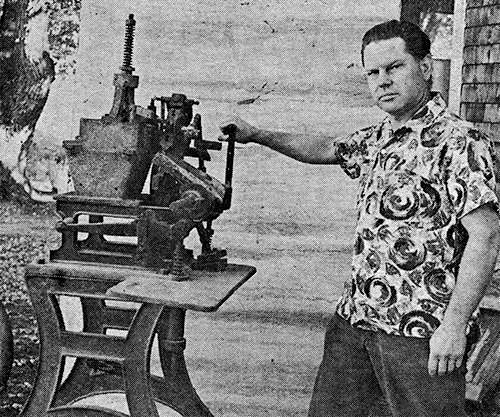
"I enclose a picture of Harry with an ancient
Bruce caster he picked up in his travels
somewhere. He said it was not workable, but
asked me if I could sell it for him, which I
did, to some fellow in the Mother Lode. I
don't remember the felow's name, but I am told
he was a good machinist and rebuilt it and got
it to casting type... "
Harry was into everything, as evidenced by this
undated letter to Rich:
"Why don't you include in your Newsletter
photoengraving and electrotyping? I purchased
the etching machines and whirler from the
Statesman newspaper and I have a roughing
machine. Also cameras. All I need is a
hydraulic molding press and some halftone
screens and more shop room to make electros
and engravings."
And from another letter:
"I just unloaded a beautiful little 15" by 4"
planer yesterday. Now I can build an engraving
machine. If you want to run a type foundry,
first buy a planer and a lathe. This is all you
need."
I expressed interest in the typeface used at
the head of this article and asked if I could
purchase a font, if still available; Shortly
thereafter a font arrived with a note telling
me not to bother about payment. Harry figured a
conspiracy of postal and banking folks would
prevent him from ever receiving the funds. The
type is solidly and sharply cast (far better
than the rubdown lettering which now represents
this fine face to today’s world). Obviously,
Harry did it on his N-R Universal Caster.
Too bad Harry’s experience and equipment are
lost. He had volunteered to write articles for
the Newsletter, but wanted to provide
photoengravings too. Father Time beat us out of
what surely would have been interesting
reading.
3
Three cheers go out to Joe Joyce, “Chick”
Felser and others at Herbick & Held, a massive,
modern printing operation in Pittsburgh, Pa.
They have made every effort to see that
hobbyists and small printers get a good crack
at the hand-set letterpress equipment before
all the materials are discarded. “This stuff
was our bread and butter so long,” Chick notes.
“We wanted to see that as much of it survives
as possible.” The company’s phase-out now is
complete, but lots of equipment was saved
thanks to their concern—and the sacrifice of
much time on their part.
Also accolades for Ronnie Harlowe of Harlowe
Typography, formerly of Washington, D.C.; now
located at Brentwood, Md. When his firm moved
to the suburbs several years ago, instead of
junking the Monotype department on the spot, he
had it all moved and kept it in storage several
years until someone (yours truly, ultimately)
was able to give the equipment a new home. “I
have always loved Monotype,” the
third-generation typographer noted, “and I
hated to see it end up in the junk yard.”
Three loud “boos” go to present owners of the
Armstrong Typography Co. house in Philadelphia,
once “divinely” equipped with Monotype with
such special stuff as the Goudy Californian
series, large comp in Baskerville, Bembo, Times
and other good book faces—a first-class shop.
When they made the decision to upgrade to new
technology a few years ago, it all went out the
back door into the scrap dealer’s hearse, even
though I, for one, had been courting them for
several years regarding the matrices and other
items. With no warning, it all was scrapped.
Loudest of all are the “boos” aimed at the
liquidators who sold a couple of tons of
matrices to Bob Halbert of Tyler, Tex. Al
Piccoli went to Canada to personally inspect
the items for Bob prior to shipment and found
everything in order. But when it arrived in
Texas, much of what Bob got was empty matrix
boxes. It’ll be hard to match this outrage, and
what a disappointment for Bob, even with
financial considerations aside.
Al Piccoli also warns against buying mats sight
unseen. One deal he completed included flat
mats. They all were there, but they were
aluminum and had corroded to the point of
uselessness.
monotype display matrices. 24-pt. in excellent
condition. Also accents for 2941, most brand
new. About 70 mats. $40 for entire lot. Abe
Horowitz, 2850 Ocean Ave., Brooklyn, N.Y.,
11235.
giant caster fonts for sale. The following
faces: 51, 88, 861, 107, 140, 2751, 330, 404,
and 609. Sizes from 48 to 72. $9.00 per font.
Ray Adkins, 76 University, Mitchell, Ill.
62040.
english Monotype matrices sought by C. F.
Bailey, 15 Dutton St., Bankstown, NSW 2200
Australia.
3
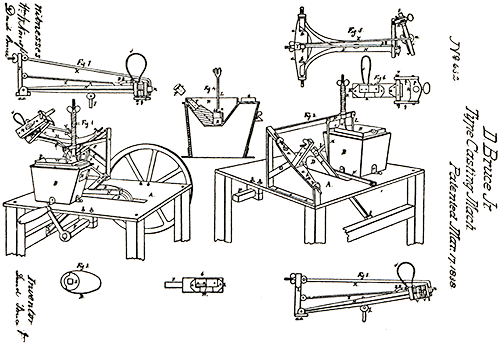
"Be it known that I, David Bruce Jr., of
Burlington County, State of New Jersey, have
devised, constructed, and fully tested a new
machine for casting printers' types, by which
the labor of the workman is much abridged and
the rapidity of the operation of casting much
increased."
So begins the specifications dated March 17,
1838, fully detailed in patent number 632
issued by the United States Patent Office. A
copy of that historic document was forwarded to
me several months ago by Bill Royall of
Williamsburg, Va.
The engraving printed here was taken from that
application and bears Bruce's signature as
inventor. We now know this patent to be a
description of the first successful machine for
casting types-the machine which put the hand
mold out of business and rapidly automated an
industry which had been a manual operation
since the time of Gutenberg.
The document completely describes the device,
giving dimensions, and fully explaining its
operation, step by step.
"The... dimensions of... the principal parts
will enable a workman to make a machine, and
the drawings may be considered sufficiently
correct in their relative proportions to guide
him in its general construction." Perhaps one
could build a caster from the application's
full descriptions, but I wouldn't want to try.
It is noted that the machine was to be heated
by bituminous coal or charcoal.
Bill also forwarded a copy of Bruce's patent
dated November 6, 1843, for an "improved" type
casting machine. The drawings with the second
patent more closely resemble the Bruce casters
I have seen, including the ones at American
Type Founders last year.
For a person seriously interested in
construction or operation of the historic
caster, these documents are a "must." At one
time they were readily available from the
Patent Office. Bill has copies of the original
printed patents.
Write him if you need this info. Write Bill
Royall, 405 Lafayette Street, Williamsburg, Va.
23185.
3
“I have a Monotype composition caster and
keyboard, two skeleton casters and six Giant
casters. I have lead-and-rule attachments on
one of the skeleton machines. I have plenty of
mats. I make my own mats. So far the mats have
been electroplated but soon we will have
installed two pantographs and punchpresses...
“I have just brought in a man and his family
from England to run our casting department. We
will do some trade setting, but expect to
become more of a founder. He of course does all
the internal typesetting from tabular work to
fine bookwork. We shall produce our
typographical journal The Fount on the Monotype
composition caster. Cobblestone Press was
established in 1964.”
Gerald Giampa
Cobblestone Press Limited
Vancouver, B. C., Canada
Not too many weeks ago, I had a lengthy
conversation with Jack Murphy of Elyria, Ohio,
detailing what to look for, what to get, etc.,
when acquiring Monotype equipment. At the time,
Jack was only “considering” an acquisition.
Then, recently, he called again reporting
success at acquiring a 15 × 17 composition
caster, two keyboards, bars, wedges, unit
wheels and lots of matrices.
I asked whether he had obtained display
equipment. He said no, and I jumped at the
opportunity to suggest he come to West Virginia
and get my spare Orphan Annie sorts caster.
“I don’t have any room,” he said.
So I casually suggested he build a room just
for his Monotype.
“I already did,” he exclaimed, “and I have
already got it filled up even though it is less
than two months old.”
Richard L. Hopkins
"A Sensational ATF Newsletter. It's just great;
you really outdid yourself and summarized the
conference perfectly (except for the
misspelling of my surname)."
William Rueter
Toronto, Canada
"As to the caster (Thompson), still looking for
a mat holder for the flat mats. I'm set up to
cast from Ludlow mats. Only thing I haven't
found a font of mats that looked interesting
enough to buy. Maybe someday..."
Herb Harnish
Ft. Wayne, Ind.
"Perhaps the press we operate diverges slightly
from others described or mentioned in your
magazine, but some things are the same:
typecasting and a love of letterpress. The only
difference obvious is our full-time operation
for publication. Your Newsletter lifted my
spirits; there is hope where there is help to
keep these arts alive..."
Dan Carr
Four Zoas Night House Ltd.
Boston, Mass.
"Our most exciting current project has been
having a Monotype mat engraved by Carl
Solomonson with a border ornament design in 18
point to set a palm-motif border decoration for
a current title."
Richard Mathews
Konglomerati Press
Gulfport, Fla.
(I have a copy of the completed book and
the border effect mentioned is most pleasing-
something easily done with Monotype, but
quite difficult with other processes.)
A most interesting newspaper clipping was
received recently from Darrell Hyder, who runs
a one-person custom printing shop in North
Brookfield, Mass.
"Hyder persists and delights in using
letterpress printing," the article from the
Sept. 14, 1979, edition of the Worcester,
Mass., Evening Gazette notes. To this a lot of
us would say, "Amen." Hyder had obtained a
Monotype composition caster and a recent note
from him says, "finally geting my comp caster
going."
More power to you, Darrell Hyder.
Richard L. Hopkins
"For those of us who did not have the foresight
to sign up for such a wonderful conference or
for some reason could not make it, you sure
told the whole story as if we were there."
Charles Hinde, SR.
Bean Creek Press
Santa Clara, Calif.
"Sometimes I wonder if all the trouble we are
going to to save these Monotype items from the
junk pile will ever be appreciated. Seems we
are at a time where no one is too interested.
But with most things, when everything is gone,
then everyone will want it."
Bob Halbert
Halbert Publishing Co.
Tyler, Tex.
I never worked so hard over a form and I don't
think I ever made up one that printed so
poorly. I ran a proof on my tired old C&P and
had to underlay the type just to get a halfway
decent impression. This was caused partly by
the border, but I suspect my press is hollow in
the center. You have caused a diabolical
problem by asking for 24 x 35 pica border. I
know you use 17-pica setting, but 24 x 35 is
impossible mathematically. You must have done
that on purpose. I used a joining border so all
the gaps would show. Anyway, I wish you luck in
printing the next Newsletter."
Sometimes a little incidental knowledge can
save you bucks and lots of hassle. For example,
did you know typecasting matrices are
specifically exempted from tariff when imported
into the U.S.?
The provision probably dates back to the days
when our nation’s leaders were trying to
encourage an infant typecasting industry by
letting tools come in free, while taxing cast
type at 20 per cent—probably in the 1820s. But
the provision still is on the books.
Paul Duensing brought this to my attention in a
casual conversation a couple of years ago. When
British Monotype liquidated its rental library,
I jumped at the opportunity to gain a few
fonts, which arrived in a 100-pound box last
August.
The customs man was going to hassle the guy I
sent to pick up the parcel at Pittsburgh
International Airport. He wanted us to get a
broker to represent us, establish a fair value,
etc., and it was getting quite involved when,
by phone, I noted the exemption provision. He
looked and quickly found the necessary
reference and turned the package over to us
with no hassle.
3
Vance Gerry of Pasadena, Calif., has written
adding a bit of information to that which
already has been reported concerning earlier
manufacturers of matrices for Monotype and
other typecasting machines. He has forwarded a
prospectus from the National Matrix Company on
South Frederick Street in Baltimore, Md.
The mats were explained to be flat mats for use
on the Thompson or Mono sorts casters from 12
to 48 point. Further, the mats were labeled as
being electro mats.
3
Missing, Missing. There Always Seems to be One Mat Missing
Richard L. Hopkins
“As is. No sorts.” That’s generally the way
most used Monotype cellular matrix cases come
to us. Invariably, an odd mat has been stuck in
where a lesser important letter should be.
Thus, an incomplete font.
Fortunately, most of these mats can be made by
Hartzell Machine Works—or we simply do without
the mats. And, occasionally, blind luck
intervenes on our side.
I give praise to Owen Stout of Paoli, Ind., who
wins the award for good observation and
successful hunting. A deal we had was for a mat
case with 6-point Ionic. But when I cast the
font, I discovered the cap Z missing. Owen
received the piece I printed, noted the missing
character, and, by golly, found it amidst a
pile of cellular sorts he had obtained with the
lot. Yes, a Z comes in handy from time to
time—many thanks, Owen, for a complete font.
Then I got all the mats from another shop.
Boxes of loose mats here and there. I found
about 30 mats for 12-point Powell in one box.
Other boxes revealed more mats until I had all
but one mat for a full font. I had given up
when I spotted a lone mat on the ground where
I’d unloaded. Talking about a needle in the
haystack—wow! Complete font.
But let’s consider what makes a genuine
mat-collecting “veteran”:
You’re not a serious Monotype owner until
you’ve sorted out a pound-size coffee can full
of cellular mats—and discovered nothing worthy
of the effort!
3
A Giant of a Hot-Metal Shop Slowly Fades Into Silent Oblivion
Richard L. Hopkins
The march of progress simply cannot be stopped,
yet we are saddened to see the huge hot-metal
composing rooms of yesteryear fade into memory.
I have only recently received a U.S. Government
surplus property bid request detailing
50—that’s right, fifty—Model 29 Linotypes which
were to have been sold individually by sealed
bid Dec. 28, 1981.
Those aren’t all the machines by far—others
have gone to retirement before these at the
Government Printing Office.
Standing in a composing room humming
with dozens of chattering Linotypes gave a
person the feeling of excitement and a sub-
liminal sense of being at the center of lots of
important action. But the dismantling of
the few remaining operations as the GPO
only goes to emphasize to us all that these
sensations can be no more. They are only
fond memories. The history book’s pages
have been turned. But as long as there’s a
Typecasting Fellowship, the days of metal
will not go completely “cold.” Certainly
a single machine in a person’s basement
doesn’t match the excitement of a room full
of machines operating simultaneously, but
the single machine sure beats total silence!
3
Keeping an inventory of Monotype metal in the
form of old dumped type has an advantage I
hadn’t considered before. In Terra Alta, the
ground gets covered with snow in late November
and stays that way through April. Getting sand
for the pot at the base of the Christmas tree
often is a problem. This year, I used type
instead and it probably worked better. It’s
porous enough to allow watering, but holds the
tree in place nicely. Wasn’t as messy either.
Another use for type metal? A couple of
five-gallon drums full of type in the car trunk
increases traction on snow-covered roads. Metal
pigs are better, if available.
3
Richard E. Huss Proposes Book on 'The Composition Matrix'
Richard L. Hopkins
Most of our readers would recognize a Linotype
matrix, and many of us know the story of
Mergenthaler’s near failure because of his
inability to mass produce matrices for his
machine.
Linn Boyd Benton’s matrix- and punch-cutting
machine gave Mergenthaler the device needed for
his machine’s success.
The heart of any typecasting machine is its
matrix, and this is the subject of Richard E.
Huss’ most detailed followup to his book, The
Development of Printers’ Mechanical Typesetting
Methods 1822–1925 (University of Virginia
Press, 1973). Entitled “The Composition
Matrix,” it explains the numerous approaches
taken to the matrix (and the patrix) by various
early machine inventors. He illustrates over 20
different matrix “inventions.”
Huss is curious to know if ATF members are
interested in having the project carried
through production either as a paperback or
hardback. “Would the membership accept a book
at a sensible cost?”
I guarantee the treatise contains information
simply unavailable elsewhere.
Please take a moment and write Richard E. Huss,
15 Meadia Ave., Lancaster, Pa. 17602.
Hopefully, our combined interest will
encourage him to bring the project to
completion.
3
A logo for our organization? Al Piccoli of
Rochester, N. Y., feels such an item is a must
and has taken it upon himself to do a design
for all of us to use on our printed works. I
note Bob Halbert of Tyler, Tex., already has
begun using the design.
The representation you see here is printed from
a zinc photoengraving Al has had made. His next
step is to have it further reduced and engraved
as a 86-point mat so typecast versions will be
cast in quantity for use by all of us.
Since our organization is totally informal in
makeup, it seems unlikely that we ever could
have an "official" logo; each person is free to
develop his or her design.
But if you want to get in on the typecast logo,
drop him a note. Al Piccoli, 86 Glendale Park,
Rochester, N. Y. 14618.
3
Thirty 15×17 Monotypes to be Auctioned by GPO March 1, 1982
Richard L. Hopkins
Probably one of the largest auctions of
Monotype casters ever to be held currently is
underway at the Government Printing Office in
Washington—and it’s not too late for you to get
in on the bidding.
Thirty 15×17 casters, all with three-phase
motors and electric pots, and all bought new
between 1964 and 1967, will be sold.
Molds, mats, wedges and accessories are not
included in the sale.
Nevertheless, the sale probably offers an
excellent opportunity to upgrade equipment—or
start your own casting operation with minimal
investment.
Also, three 1975-vintage material makers are
offered in the sale. All the equipment is
offered “as is, where is” and inspection is
encouraged before bidding.
Written bids must be submitted to the GPO
before March 1, 1982.
I have the sale bill which provides all the
particulars and will be most anxious to help
you in any way possible. Call me daytime at
(304) 789-2309, or in the evening call
789-6153.
3
With this issue you will find a card detailing
the issues of ATF Newsletter you have received
to date, and a recapitulation of funds received
from you.
The list of persons wanting this journal now
exceeds 200 and includes many from outside the
United States. I have never asked for
reimbursement for production costs, but, with
the latest postal increases, I must request
that you bring your account up to date—or be
dropped. The last issue cost over $115 for
postage alone. Such expenses cut into my
Monotype contingency fund severely, and I just
can’t let that continue to happen.
I ask for one dollar for each issue. If you are
overseas, I request the fee be doubled.
Otherwise, I will send your issue by surface
mail, which is quite slow in arrival.
3
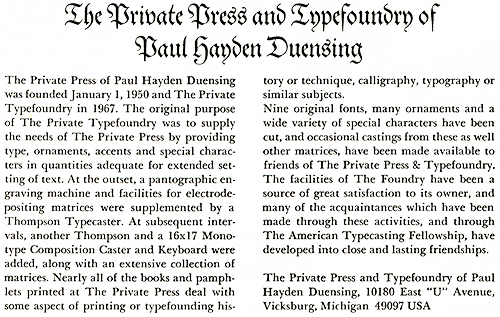
The Private Press & Typefoundry of Paul Duensing
proprietor: Paul Hayden Duensing
The Private Press of Paul Hayden Duensing was
founded January 1, 1950 and The Private
Typefoundry in 1967; The original purpose of
The Private , Typefoundry was to supply the
needs of The· Private Press by providing type,
ornaments, accents and special characters in
quantities adequate for extended setting of
text. At the outset, a pantographic engraving
machine and facilities for electrodepositing
matrices were supplemented by a Thompson
Typecaster. At subsequent intervals, another
Thompson and a 16xl7 Monotype Composition
Caster and Keyboard were added, along with an
extensive collection of matrices. Nearly all of
the books and pamphlets printed at The Private
Press deal with some aspect of printing or
typefotinding history or technique,
calligraphy, typography or similar subjects.
Nine original fonts, many ornaments and a wide
variety of special characters have been cut,
and occasional castings from these as well
other matrices, have been made available to
friends of The Private Press & Typefoundry. The
facilities of The Foundry have been a source of
great satisfaction to its owner, and many of
the acquaintances which have been made through
these activities, and through The American
Typecasting Fellowship, have developed into
close and lasting friendships.
The Private Press and Typefoundry of Paul
Hayden Duensing, 10180 East "U" Avenue,
Vicksburg, Michigan 49097 USA
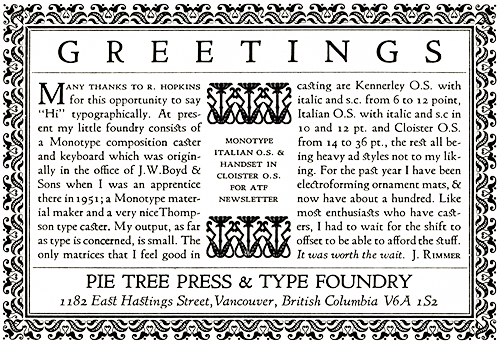
Pie Tree Press & Type Foundry
proprietor: Jim Rimmer
Many thanks to R. Hopkins for this opportunity
to say "Hi" typographically. At present my
little foundry consists of a Monotype
composition caster and keyboard which was
originally in the office of J.W.Boyd & Sons
when I was an apprentice there in 1951; a
Monotype material maker and a very nice
Thompson type caster. My output, as far as type
is concerned, is small. The only matrices that
I feel good in casting are Kennerley O.S. with
italic and s.c. from 6 to 12 point, Italian
O.S. with italic and s.c. in 10 and 12 pt. and
Cloister O.S. from 14 to 36 pt., the rest all
being heavy ad styles not to my liking. For the
past year I have been electroforming ornament
mats, & now have about a hundred. Like most
enthusiasts who have casters, I had to wait for
the shift to offset to able to afford the
stuff. It was worth the wait.
Pie Tree Press & Type Foundry
1182 East Hastings Street,
Vancouver, British Columbia V6A 1S2
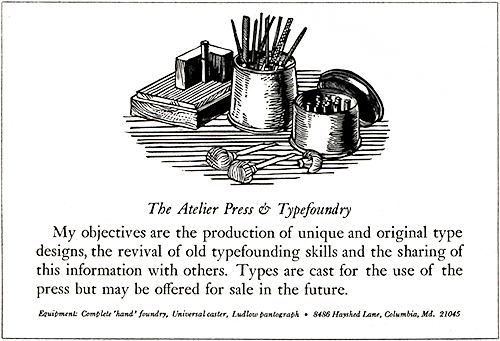
The Atelier Press & Typefoundry
proprietor: Stan Nelson
My objectives are the production of unique and
original type designs, the revival of old
typefounding skills and the sharing of this
information with others. Types are cast for the
use of the press but may be offered for sale in
the future.
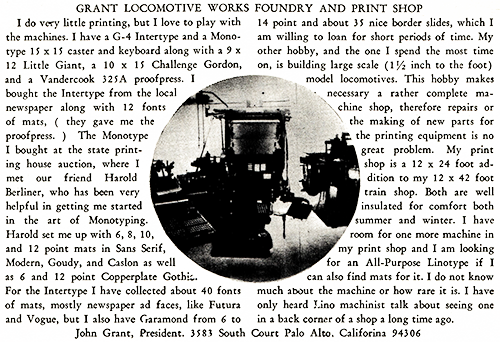
Grant Locomotive Works Foundry and Print Shop
president: John Grant
I do very little printing, but I love to play
with the machines. I have a G-4 Intertype and a
Monotype 15 × 15 caster and keyboard along with
a 9 × 12 Little Giant, a 10 × 15 Challenge
Gordon, and a Vandercook 325 A proof press. I
bought the Intertype from the local newspaper
along with 12 fonts of mats (they gave me the
proof press). The Monotype I bought at the
state printing house auction, where I met our
friend Harold Berliner, who has been very
helpful in getting me started in the art of
Monotyping. Harold set me up with 6, 8, 10, and
12 point mats in Sans Serif, Modern, Goudy, and
Caslon as well as 6 and 12 point Copperplate
Gothic. For the Intertype I have collected
about 40 fonts of mats, mostly newspaper ad
faces, like Futura and Vogue, but I also have
Garamond from 6 to 14 point and about 35 nice
border slides, which I am willing to loan for
short periods of time. My other hobby, and the
one I spend the most time on, is building large
scale (1½ inch to the foot) model locomotives.
This hobby makes necessary a rather complete
machine shop, therefore repairs or the making
of new parts for the printing equipment is no
great problem. My print shop is a 12 × 24 foot
addition to my 12 × 42 foot train shop. Both
are well insulated for comfort both summer and
winter. I have room for one more machine in my
print shop and I am looking for an All-Purpose
Linotype if I can also find mats for it. I do
not know much about the machine or how rare it
is. I have only heard Lino machinists talk
about seeing one in a back corner of a shop a
long time ago.
John Grant, President
3583 South Court Palo Alto, California 94306
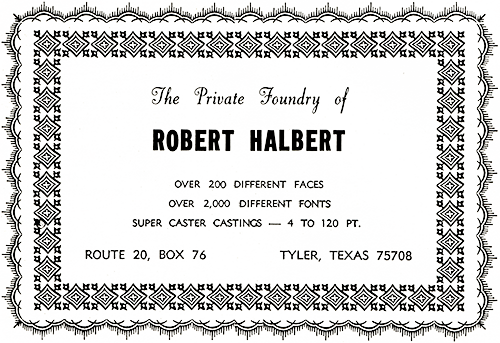
The Private Foundry of Robert Halbert
proprietor: Robert Halbert
Over 200 different faces
Over 2,000 different fonts
Super Caster Castings—4 to 120 pt.
Route 20, Box 76, Tyler, Texas 75708
The Recalcitrant Press & Typefoundry
proprietor: Roy Rice
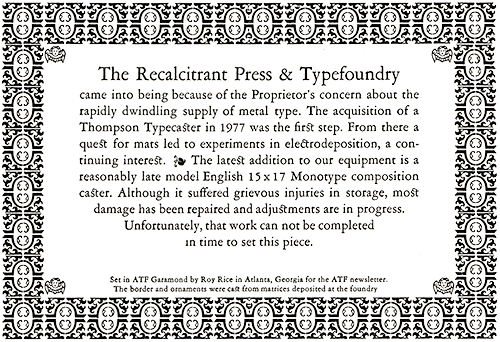
The Recalcitrant Press & Typefoundry came into
being because of the Proprietor's concern about
the rapidly dwindling supply of metal type. The
acquisition of a Thompson typecaster in 1977
was the first step. From there a quest for mats
led to experiments in electrodeposition, a
continuing interest.
The latest addition to our
equipment is a reasonably late model English
15 x 17 Monotype composition caster. Although it
suffered grievous injuries in storage, most
damage has been repaired and adjustments are in
progress. Unfortunately, that work can not be
completed in time to set this piece.
Set in ATF Garamond by Roy Rice in Atlanta,
Georgia for the ATF newsletter. The bird and
ornaments were cast from matrices deposited at
the foundry.
Cade Type Foundry
proprietor: Phil Cade
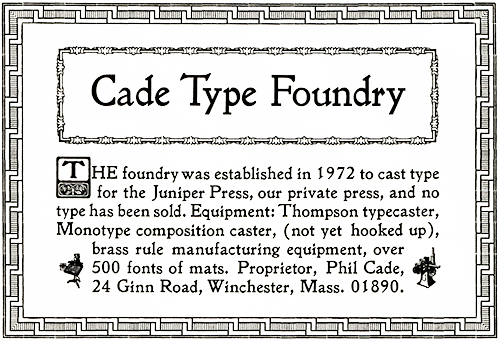
The foundry was established in 1972 to cast
type for the Juniper Press, our private press,
and no type has been sold. Equipment: Thompson
typecaster, Monotype compositions caster, (not
yet hooked up), brass rule manufacturing
equipment, over 500 fonts of mats. Proprietor,
Phil Cade, 24 Ginn Road, Winchester, Mass.
01890.
[No Name for Type Foundry]
proprietor: A. R. Soule
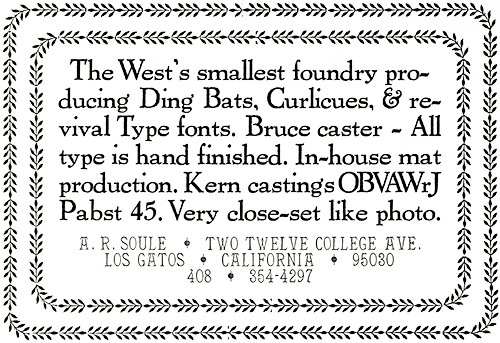
The West’s smallest foundry producing Ding
Bats, Curlicues, & revival Type fonts. Bruce
caster — All type is hand finished. In-house
mat production. Kern castings OBVAWrJ Pabst 45.
Very close-set like photo.
A.R. Soule,
Two Twelve College Ave.,
Los Gatos, California 95030
408—354-4297
[No Name for Type Foundry]
proprietor: Owen Stout
My Old Machines and I agree, it’s been a Great
Life
My first print job was an original poem I set
up and printed with rubber type and a stamp
pad, in 1913 when I was ten. Then and there I
became infected with the “bug” later identified
as Licesus typus.
In 1924 I bought a 5×8 Model hand press and
printed some funny little cards for my own
entertainment. One read, I’d like to kiss a
girl like you; will you let me?
She did, so we were married, raised a couple of
sons who learned their ABC’s on a type case and
both became printers.
We sold our first job, 100 small labels, in
1933 for 35 cents! Anybody remember the Great
Depression? Talk about optimism; we built a new
shop building, hung out our shingle; and by
1940 had our first Monotype outfit casting and
setting type.
Some forty years and three buildings later, I
decided to retire; sold the business to my son;
but kept all the type-making equipment, since
we had gone electronic.
So now there stands along my basement wall old
grandpa Nuernberger-Rettig, the Thompson, four
Monotypes, a keyboard, alongside their molds,
wedges, keybars and banks together with over
750 matrix fonts.
We still make some type; and meditate on those
good old days when you could buy something for
35 cents! We all agree that it has been a GREAT
LIFE, and we’ve enjoyed every minute of it!
Owen Stout, R. 3, Paoli, Indiana 47454
Hill & Dale Private Press and Typefoundry
proprietor: Richard L. Hopkins
A consuming addiction enveloped me with my
first “injection” of printing at the age of 12.
By age 17, I had a press, two dozen cases of
type and other paraphernalia. Going to college
subdued my passion, but after graduation,
marriage & the Army, the addiction took charge.
My first Monotype was acquired in 1971. Then I
went completely haywire, sold my home and
launched a full-fledged career in modern offset
printing. Alas, that only fanned the fire and
deepened my passion for letterpress. Ten years
of acquisition leave me with a basement crammed
with letterpress equipment the likes of which
would make yesterday’s printer gawk in awe.
There are four presses, 11 casters, well over
1500 fonts of matrices and accessories you
wouldn’t believe.
Typecasting equipment includes a 15×15, a
15×17, two Monomatics, two Orphan Annies, two
Thompsons, a Giant, a Material Maker, and
another 15×15 for parts. Four of these are set
up and operating.
Plans are underway to set up three more, to be
hooked up and in production later this year.
My passion to gather equipment is equaled only
by my desire to use the stuff—making type for
myself and others, and writing and printing
publications related to the history and
practice of our ancient craft. This Newsletter
is one example.
Richard Hopkins, prop. of the Hill & Dale
Private Press and Typefoundery, hidden in the
hills of West Virginia. Post Office Box 263,
Terra Alta, West Virginia 26764.
The Weather Bird Press
proprietor: Vance Gerry
The Weather Bird Press does its composition on
a Linotype but in the garage there is a
Thompson. In fact, the very machine once
exposed in these pages as being a harborage for
mice, an expose not entirely without basis of
fact. Although the machine has only a mold for
.43 drive mats, and can’t be budged out of its
slowest speed, some lino mat ornaments have
been coaxed out of it. Promises to cut punches
and make some decorative proprietary mats lie
strewn along the boulevard of broken dreams.
Meanwhile, here are some things cast on the
pathetic old Thompson. (Rich, poor lad, has had
to make it print.) Everything shown was made on
the Thompson and the Linotype machines.
The Weather Bird Press,
450 South Arroyo Boulevard, Pasadena,
California 91105
Hartzell Machine Works, Inc.
president: G. Richard Hartzell
Since 1937—providing precision machine work for
Monotype and related typecasting equipment.
Success in our diversified manufacturing
business assures our continued commitment to
Monotype users as a source for molds, American
cellular mats, and spares. Distributor for
Monotype International. A limited number of
used casters remains from our warehouse
clearance. Write or call for listing.