The ancient, historic, and still-thriving city
of Oxford, England, was a most fitting setting
for the third conference held by our infant
organization (the American Typecasting
Fellowship) in conjunction with the Printing
Historical Society July 16–19, 1982.
The most successful conference will be treated
fully in a special edition of this Newsletter
with photos and commentary by various members
of our group. For now, only a capsule report
will be made, primarily to set the stage for
things to come.
PHS Chairman Michael Turner did an excellent
job of putting together a program of
significance for the nearly 100 persons
attending, yet the delegates themselves—from
the United Kingdom, Canada, the United States,
Germany, the Netherlands, Australia, Spain, and
Switzerland—were the ones who propelled the c
onference into the landmark event it became.
Whether by British custom or by good planning,
much of the time each day (from lunch to
4 p.m.) was idle time which let delegates
mingle and get to know each other. The results
were phenomenal, for we discovered a very
strong common bond among us all—compelling
interest in historic, personal, and incidental
facts related to both type design and the
processes and machines involved in casting
metal printers’ type.
Americans, for the most part, had their first
contact with European founders we had known
only as “historic giants.” We knew little of
their present activities nor their commitment
to preserving their ancient and honorable
processes.
Having Gertrude Bencehr of D. Stempel, Bram
deDoes and Hendrick Drost of Joh. Enschedé,
Wolfgang Hartman of Fundicion Tipografica
Neufville, Alfred Hoffman of the Haas
Typefoundry, and Geoffrey Hulett and Roy
Millington of Stephenson-Blake all in the same
room intensely discussing type and typography
with you... it's bound to get the juices
moving, and it certainly did.
Add noted designers such as Dr. Berthold Wolpe
(Monotype Albertus, etc.), and the various
conference speakers who, in general, took part
in all activities, and you begin to get a
picture of the typographic “feast” it was.
Then top it all off with a most cordial
red-carpet treatment of the American contingent
by David Belfort, Duncan Avery, John Dreyfus
and all the other enthusiastic, knowledgeable
folks who provided a no-holds-barred tour of
Monotype International, and you finally come to
understand the numbness and extended silence of
the 24 United States delegates who attended the
conference.
Our silence is not a mark of disappointment;
the conference was an event of such
far-reaching significance it must be pondered
and put in proper perspective. That is what
we’ll attempt in the next Newsletter—to report
all that went on.
3
Surely as a compliment, Stan Nelson recently
said to me that the high quality of the ATF
Newsletter fooled many into believing a
full-fledged organization supported the
publication. Those who know ATF know this not
only to be untrue, but impossible because of
our Rules.
But perhaps Stan explains something to me.
Often I’m confronted by someone demanding his
or her Newsletter. Surely this attitude would
not continue if everyone understood how this
publication comes into being.
First I must write it. Then I have to design
it, keyboard it, cast it, make up the pages,
and then I have to print, collate, bind and
mail the thing.
Hey! That takes time, and it also takes time to
answer letters and keep the mailing list.
About the time I wanted to start this issue,
for example, I ended up in the hospital. That
got me behind in my commercial shop and
certainly food on the table comes first.
That also explains all the unanswered letters.
This doesn’t imply that others don’t help. It’s
amazing what others will do for me. An example:
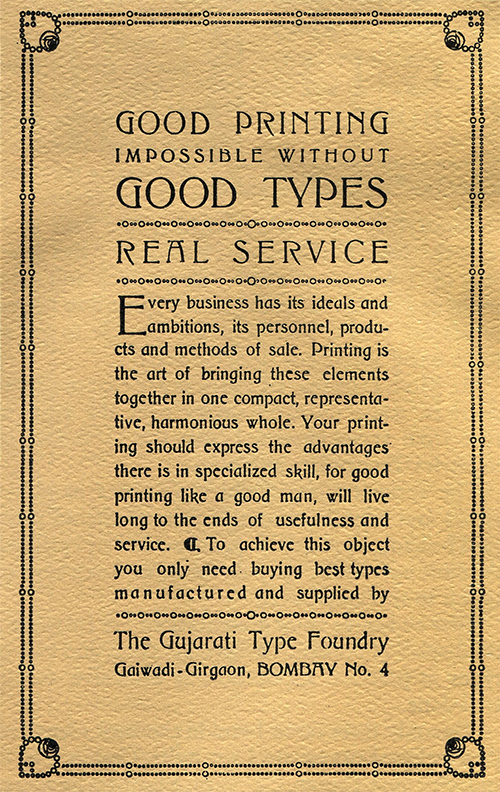
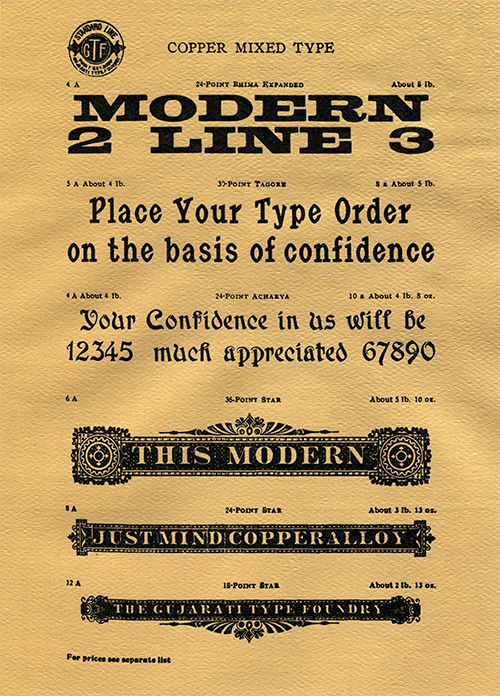
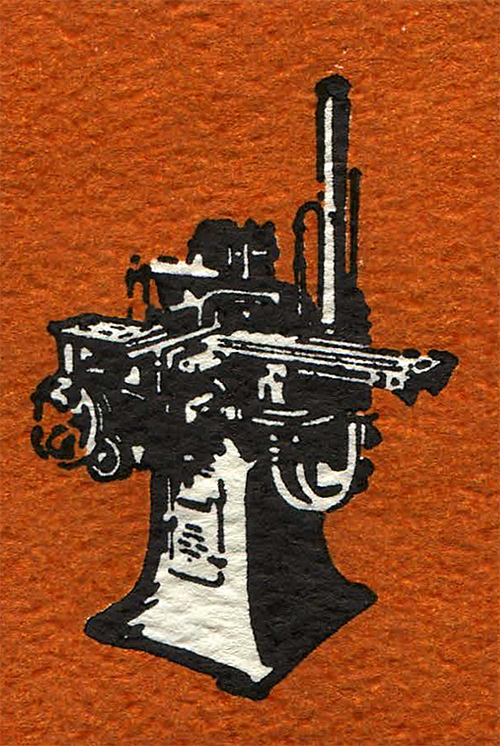
I spotted a unique die-stamp on the back cover
of the Gujarati Type Book. I asked Mr. Modi
about it and darned if he wasn’t able to find
the cut (which hadn’t been used for 50 years)
and provide a repro-proof which I have enlarged
and used at the top of our first page.
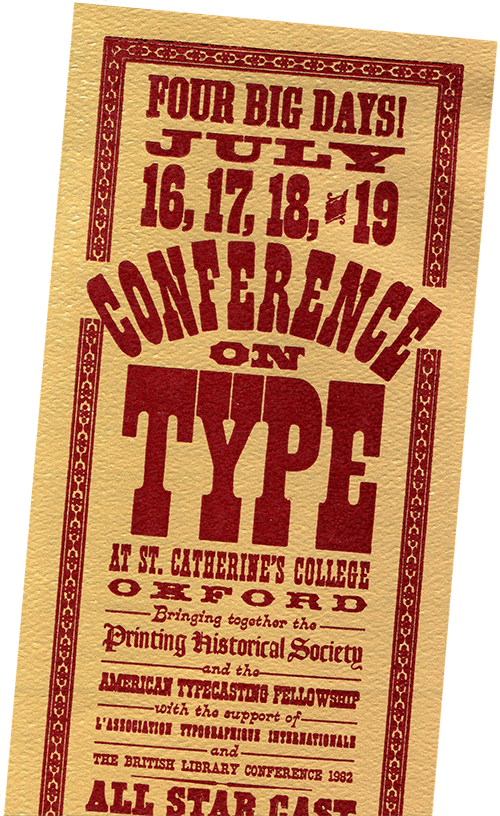
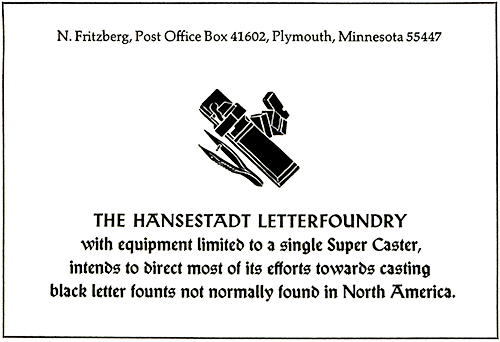
The other front-page illustration is a
reduction of a handsome keepsake for the Oxford
meeting done by Charles Hinde at his Bean Creek
Printery in Santa Clara, Calif.
The next issue is taking shape with articles
already submitted by Paul Quyle, Paul Duensing,
Guy Botterill, Roy Rice, and Barney Rabin. Mac
McGrew has provided his complete list of
American Monotype faces and their numbers (the
specimen books generally deleted numbers and
faces out of vogue at the time, so no specimen
book is totally comprehensive).
I definitely solicit your support, your
comments and your contributions. I ask that you
be tolerant of my slow letter answering.
How about helping right now? Get to your shop
and put together your self-description like the
ones you have seen in the last two issues. I’ll
expect your 24×35 pica made-up form in the mail
very soon.
3
How would you read if I told you there was a
typefoundry—still very much alive today—which
offers a variety of designs and ornaments so
reminiscent of the early days of this century
in America that you get in a time warp studying
its specimens?
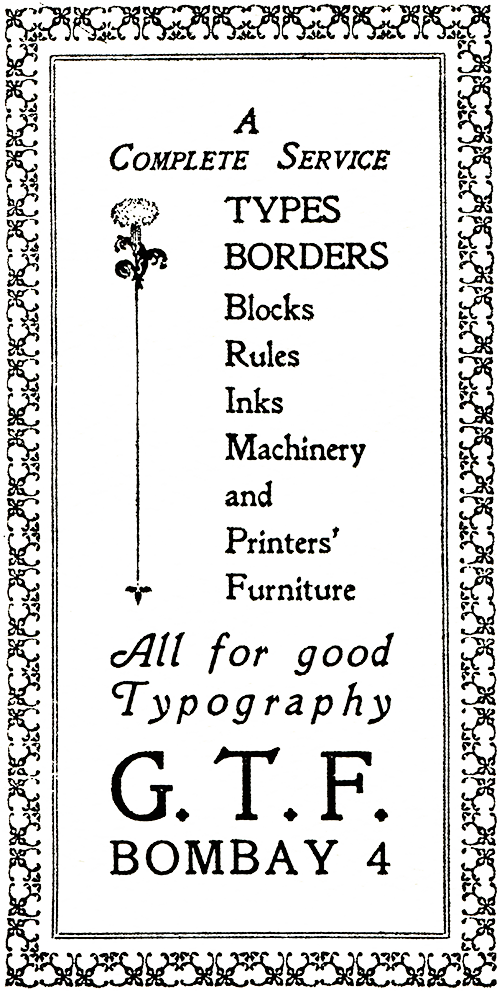
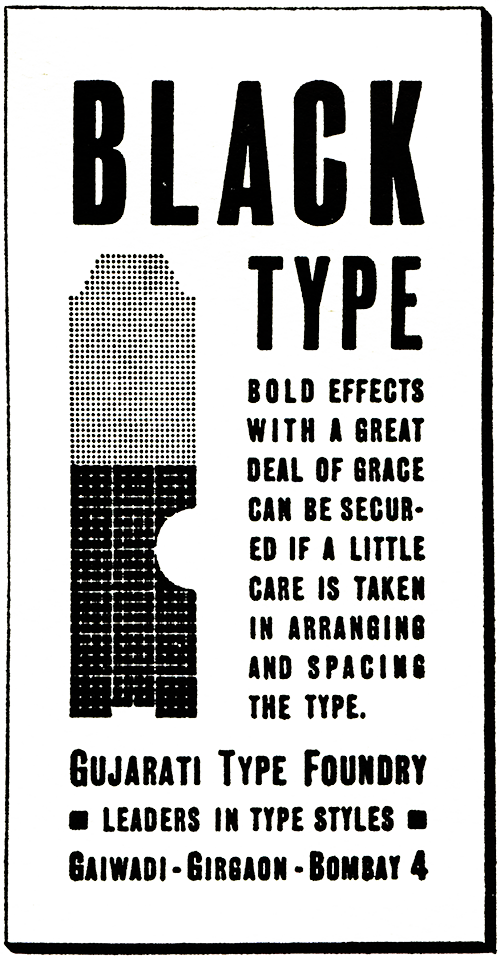
Arvind Patel, our correspondent and typefounder
from Islamabad, in India, passed knowledge of
our typecasting fellowship to Mr. Gopalkrishna
Modi, partner in the Gujarati Type Foundry at
Bombay, India. A series of letters and a
specimen book have developed.
Commenting on Newsletter 7, Mr. Modi says “I
now realize that all the things that we have
inherited are, in your light, extremely
valuable. You have made me aware of the
‘Treasure House’ that I have inherited by the
Grace of God. I have decided to send you a copy
of my type catalog, prepared, compiled and
designed by my late uncle Mr. Manilal C. Modi,
who adorned the highest place in this
institution for a span of 72 years (from Oct.
3, 1900, until October, 1972).
"Our firm was founded on Oct. 3, 1900, at the
very place now occupied by us. Over and above
the the types of Roman Script, we have with us
types for a few Indian Scripts, the decorators,
emblems, borders, special signs, etc., seen in
the catalog.
"The American point system was accepted by us
from the beginning. Yet, we had to carry on
with the old Pica system for quite some time.
We do have some molds for types, spaces, quads
and borders on the Didot system and heights.
We have with us hand-molds for types, leads and
rules. We have in running order the following
machines:
20
Pivotal type casting machines
3
Monotype Supercasters
1
Japanese automatic type caster
1
Original Foucher automatic type caster
2
Indian-make automatic type casters
1
Canning-make Dynamo for preparing
electro-deposited copper matrices.
1
English-make matrix having lathe.
"All our matrices are of full-growth copper and
we have about half a million matrices. We have
about 800 molds for pivotal type casters, but
the shoulder heights of these as well as the
nicks are not uniform. This means that except
for the body size and height-to-paper, there
has not been a planned standardization.
“I myself joined this family institution
April 1, 1937, and at my present age of 67 am
the senior partner.
"Most of my machines are operated with
electrical power, but the heating is done
either by kerosene, liquid petroleum gas, or
even by steam coal.”
Mr. Modi, in response to my questions, has
agreed to send photographs of the Japanese and
Foucher casters, and the Indian-made machines.
“The first lot of pivotal type casters was
received from Messrs. R. P. Bannerman & Co. and
after that some more machines were secured from
Messrs. C. A. Wood & Co., London. Subsequently,
these machines were copied in India, but no
specific innovations were introduced.”
The specimen book is total fascination, and Mr.
Modi assures me that “all the matrices are
still in stock and therefore, I can cast the
required types even if the same may not be in
stock.”
Upon reviewing the Gujarati Type Book when
visiting the Hill & Dale recently, Mac McGrew
of Pittsburgh (who is wrapping up a project of
many years, which will display, credit, and
explain all 20th-century American hot-metal
typefaces), mused that he might be able to get
some still-missing specimens from Gujarati.
As Modi explains, all matrices are
electro-deposited matrices, made by the foundry
over the years since 1900 from types imported
from the U.S. and other countries (England,
principally).
The specimen book, which measures roughly 6×9
inches and contains about 600 un-numbered pages
in hard binding, apparently was compiled and
printed for the most part about 1927–28, for
those dates most often appear in specimen
pages.
Two- and three-color presentations are
frequent, and the display of borders,
background tints, and two-color types in
practical application is extensive and quite
well-done.
The only three faces I find in the book
identified by their original names are Law
Italic, Caslon Old Face, and DeVinne. Caslon
Old Face, Mac McGrew assures me, is copied from
Stephenson-Blake in England and thus, is the
original design. Other faces have come from
American Type Founders, Barnhart Brothers &
Spindler, and many others are quite reminiscent
of faces originated by the Bruce, Conners, and
other early American foundries, especially some
of the ornamented faces, three-dimensional
faces, and “gay nineties” designs which appear
crisp and very well reproduced.
The only items which bring the observer to
realization that the foundry comes from a
different culture is the presence of several
pages of specimens for native Indian alphabets,
Indian deity emblems, and obviously Indian
names applied to foreign designs. Some
examples:
Goudy Old Style
Rumpam Series
Della Robbia
Vivekand Series
Post Oldstyle and Italic
Placard Series
BB&S Lining Concave
Miran Series
BB&S Pantagraph (a script)
Pratap Series
ATF Lining Jenson and Italic
Narmad Old Style
Bodoni is Govind, Caslon Open is Ushakant,
Cheltenham Oldstyle is Ranade, but Cheltenham
Bold Condensed is Mahendra. Generally, only one
weight of a series has been copied—the medium.
The foundry is, apparently, very much alive,
and Mr. Modi indicates a strong willingness to
supply types to those with special interests.
His current pricelist shows type at about 100
rupees per kilo. If my math is right, that’s
about $2.20 per pound. Taxes, shipping and
import duty would be additional (perhaps double
the cost?).
(If you know anything about importing type,
please share your information with us in the
next Newsletter.)
As knowledge spreads of our revived interest in
typecasting on a world-wide basis, it’s
absolutely surprising what information is
coming to light. We welcome Mr. Modi into our
ever-growing fraternity of typecasters.
3
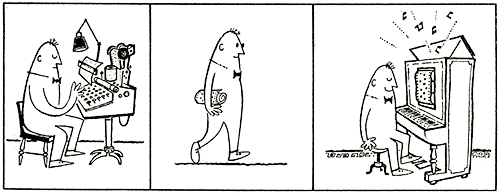
The cartoon found on this page was clipped from
an unnamed publication and forwarded by Paul
Duensing. Would it have been better had the
player piano been putting out letters instead
of music?
It does, however, bring to our attention the
theory I have heard advanced before—that
Tolbert Lanston, while working in the U.S.
Patent Office, got his idea for the controller
tape to run his Monotype after reviewing patent
applications for the player piano.
Anyone ever research this idea? If you have, I
would appreciate hearing from you.
3
We have moved to another location (five years
ago) and I am now set up in a garage. And I
still have the Linotype though I had toyed with
abandoning it at the last place since I had to
take out a wall of the garage to remove it. But
now that it is here, I'm glad I brought it. I'm
about determined to add some fonts of 10 and 12
bookfaces if I can find some nice classic
romans, good for antique papers. Can you
suggest any good sources currently for mats?
Above I said Linotype-actually mine is an
Intertype. Don't know why I persist in saying
Linotype.
James L. Weygand
852 East Marion Street
Nappanee, Ind. 46550
Monotype Setup in The Netherlands
Concerning my Monotype equipment, I can write
to you that I own a composition caster, a super
caster, a type-and-rule caster, and a keyboard.
The collection of molds covers the whole range
from 6 Didot points up to 72.
I have looked for Monotype equipment or spares
throughout the whole country, being most of the
time too late. But in spite of this, I have
collected a large collection representative of
the Dutch printing industry.
Wim Klein
Groenhoven 754
1103 LX Amsterdam, Netherlands
New Designs Slow to Pay Off in India
New (letter) designs in Gujerati in which we
cast are not accepted as enthusiastically as
expected. The printing presses situated in
small towns or village areas insist on old or
traditional-design type fonts. New designs pay
costs in 10 years. I have prepared those
type-designs in lead prototypes and
electroplate matrices. It was self-service, so
business was or did not affect at all.
In India, as I have written earlier, we, the
type, founders, have enough work. The economic
conditions will detain the growth of
offset-process in India for at least 10 years.
Arvind M. Patel
Gozaria Pole, Shahpur
Ahmedabad 380 001 India
Not Yet Casting, But He's Equipped!
I am not at the moment actually casting type,
but am looking forward to trying it in the
future. I do have the equipment, starting with
hand molds, a Bruce pivotal caster, a Monotype
Caster, a Thompson caster, and two Linotypes,
and over 200 fonts of mats. I live with
anticipation of getting this into my shop and
out of storage.
Paul B. Quyle
Murphys, Calif. 95247
Equipment is Available in Lancaster
I'd appreciate your giving the Lancaster Press
a brief write up in the next ATF Newsletter as
they are really nice people. They have eight
Linotypes, a material maker, 1O Monotypes, type
cabinets, proof presses, etc., ad infinitum,
and they'd prefer that someone who could use
the stuff get it rather than the junk man.
George Stadler is the man to contact. They're
located at Prince and Lemon Streets in downtown
Lancaster, Pa. Phone (717) 394-7241.
Harry A. Bollinger
At the Blue Mill
Alden, Mich. 49612
Pioneer Hobbyist is Still Making Mats
I still am interested in typecasting, although
not doing any of it for some time. If I live
long enough, I may again have the caster
running and come out with a little type now and
then. For the present, I'm still quite busy
making matrices for illustrious individuals
like Paul Duensing.
Most of my later-day efforts were devoted to
the revival of some of the better oldtime
decorative faces which I found to be
well-received by many of the hobby printers.
This, of course, means that aside from having
good type to start with, the necessary mats had
to be made first, a lonely occupation back in
the 195os with information hard to come by. I'm
glad to see others getting into this interesting
and fascinating art.
Andrew W. Dunker
833 North Waterloo Avenue
Jackson, Mich. 49202
Error in ATF Article Corrected
Jotted a note to write you about No. 6 but
stuck it in the folder instead of things to do.
On page 3 "Duritan" should be "Duratin."
Wouldn't mention it except I'm afraid the
Newsletter will be used as a reference and the
misspelling perpetuated:
David M. Norton
976 Westmoreland Avenue
Syracuse, N.Y. 13210
Impressed by Report on Haas Foundry
My shop is a very small "public press" without
casting equipment but with a_ good collection
of foundry metal and hand presses for limited
printing. For years I worked closely with
Richard Ansell when he was deeply involved in
importing European foundry type. If you would
send him a copy of your latest issue describing
the resurgence of the Haas foundry it might
persuade him to get out of his doldrums and do
something concrete about makihg foreign types
again more available. I know ATF fell flat on
their face in their meagre efforts. Yours is a
very worthwhile cause. I wish you luck.
John Anderson
28 East Woodcrest
Maple Shade, N. J. 08052
Wants to 'Ease Into' Monotype
Bill Murray of Americus, Ga., has telephoned
indicating his interest in our group. A lawyer
with a basement full of presses, he wants to
ease into Monotype and would like to buy a
caster, keyboard with accessories, and possibly
a Thompson.
William J. Murray
124 West Forsyth Street
Americus, Ga. 31709
Hyden Sizemore's Death Revealed
Hyden passed away Feb. 6 of a heart attack.
Thank you for sending the Newsletters to Hyden
as I know he enjoyed reading them.
Hyden and his great knowledge of Monotype will be
greatly missed.
Richard L. Hopkins
Seeks a Source for Keyboard Paper
I am currently making plans to purchase some
Monotype equipment in Dallas, including a giant
caster, material maker, and a couple of 15x15
composition casters plus the keyboards, mats
and mat cases. You mentioned having noticed s
ome controller tape at your local Radio Shack
store. Does this store still have any of this
tape? Is Hartzell the only place that carries
this particular kind of tape, or can it still
be obtained from other sources?
Raymond Branscom
Rou.te 2, Box 5
Bullard, Tex. 75757
Hartzell is your best bet, although they too
are having troubles getting the stuff in the
U.S. No, the Radio Shack does not have it. It
was a "fluke"; the guy had only one lot and he
has sold it now.
Richard L. Hopkins
Quite a Letterpress Setup!
Note we've moved recently to our new location
which is another mill building and allows us to
accommodate three comp casters in service, a
Thompson, a giant, and a material maker as well
as a Meihle vertical press and a Vandercook
325G and a Hacker hand press and a Golding
Pearl as well as our bindery... Our composition
facility includes two keyboards in service.
Some of our latest news includes the casting of
Hebrew types, some progress toward casting
Arabic and the composition of a book of poetry
in Cryllic.
Dan Carr
Golgonooza Letter Foundry & Press
Box III
Ashuelot Village, N.H. 03441
He's Searching for Mats in Australia
I now have two Monotype casters and a double
keyboard, but in common with just about
everyone else, I am very short on mats.
C. D. Fitzhardinge-Bailey
St. Aubyn, I 5 Dutton Street
Bankstown, N.S.W. 2200 Australia
Is Lynda Subsidizing ATF-NL?
We send you a five so that you'll continue the
ATF-NL (sounds like a football playoff). We do
think you should consider your costs more and
charge at least $2.50 per issue. Think about
it. Being unique—one of the kind in format,
content and design, and being of such high
quality, the Newsletter should be worth more.
Is Lynds subsidizing you?
Lillian and Parker Worley
310 Jess Avenue
Haddonfield, NJ. 08033
Yes, to a very large extent she is.
Richard L. Hopkins
Information Needed on Charles Broad
I am presently researching the activities of
Mr. Charles Broad. After writing a descriptive
history of his business and the antique type he
cast, I will print a limited edition book in
the new book arts studio I have set up here at
Arizona State University in the School of Art.
I know that Mr. Broad had contacts with
thousands of private, hobby, and small printers
and I would greatly appreciate any information
you have regarding him or his business or his
types.
John Risseeuw, Assistant Professor
Department of Art
Arizona State University
Tempe, Ariz. 85281
English Linotype Supplier 'Thriving'
What is even more interesting is that we are
still producing hot metal machines, both new
and reconstructed, and these are sold in our
traditional markets of Africa, the Middle East
and India. There are still some thousands of
machines spread throughout Europe earning their
keep at the hands of small printers. Behind all
this, of course, is an enthusiastic band of
people who love the Linotype linecasting
machine...
We have a very thriving business not only with
spares but also with matrices and we have
punchcutting facilities which enable us to
produce matrices for almost any face.
Unfortunately, because the production of
special punches or matrices is labor-intensive,
they tend to be expensive. But it is a service
which we might offer to any of your members
should occasion arise and certainly we will
always make an attempt at the production of the
impossible before we admit defeat.
F. Bryant, Sales Director
Linotype and Machinery, Ltd.
Altrincham Cheshire, England
Almost Bought a Thompson
The Newsletters have been great. The "ads" in
the last one were a good addition. I'm still
not even close to typefounding, but am very
interested in what other people are doing. The
closest I came was trying to buy a Thompson
which the company would not sell.
Ken Leenhouts
W 250S6475 Center Road
Waukesha, Wisc. 53186
As this edition of the Newsletter was being put
to bed, word arrived of the death of Frank
Sassaman, proprietor of the Sterling Type
Foundry in Charlotte, Mich. The announcement
was forwarded by Paul Duensing, who said Frank
died peacefully in his sleep while on a hunting
trip Nov. 14, 1982.
Born in 1904, Sassaman purchased from a cousin,
Oliver E. McLaughlin, the foundry which was
established in 1920. The foundry will cease
operations although current orders will be
filled as long as shelf stock lasts. "Frank
Sassaman was a good man, an accomplished
typefounder and a fine friend. The printing
fraternity will be poorer without him and I
shall miss him long and greatly," Duensing
said.
3
What do John Thompson, J. W. Paige, Tolbert
Lanston and Ottmar Mergenthaler have in
common?
All contrived inventions which affected the
printing industry. By discussing their work,
perhaps it will be better understood why it is
so important for us to preserve the working
technology of an era which has rapidly
disappeared.
I, obviously, am a Monotype aficionado, and
even after 11 years of operating a machine,
when everything is working properly, I still am
mesmerized by the genius of the operation.
The static, disconnected machines in my garage
are of very little interest to the uninitiated
visitor to the Hill & Dale. But turn on the
power, the heat and the air and watch that
same visitor become entranced by a working
machine.
At a distance it is captivating. But the closer
you get, the more detailed and fascinating the
numerous moving parts become. As the mold and
mat case are closely examined, a far greater
appreciation is gained for the perfect little
types marching forth into lines in the galley.
It is this attraction which draws me to the
Monotype. But what about other machines? When I
was teaching, I often alluded to J. W. Paige's
machine as an example of "failure" and I always
mentioned financial involvement on the part of
Samuel Clemens (Mark Twain). Yet the Paige
typesetter remained for me only a mass of cold
steel in a not-too-good photograph. Nearly all
the understanding I had of the machine was
gained from quotes from a report on the Paige
Compositor in History of Composing Machines by
John Thompson, inventor of the Thompson
typecaster.
First Thompson praised the machine by saying
"Perhaps the most wonderful typesetting machine
ever invented was the Paige Compositor, the
product of the brain of James W. Paige, of
Rochester, N . Y."
But other damning bits of misinformation were
proffered: "Before the first Paige machine was
constructed, the promoters had spent
$1,300,000. Probably another million was
expended before the end came.
"The (patent) application was filed in 1887 and
was pending eight years, mainly owing to the
work of examination by the Patent Office. One
of the examiners died while the case was
pending, another died insane, while the patent
attorney who originally prepared the case also
died in an insane asylum."
Contrast the comments above to that of Samuel
Clemens upon seeing it in operation about 1890
"We only need one more thing: a phonograph on
the distributor to yell, 'where the hell is the
printer's devil. I want more type.'"
Now these conflicting statements have been
cleared up in my mind thanks to an excellent
book recently re-issued by the Garland
Publishing Co., New York: Typographical
Printing Surfaces, by Legros and Grant, first
printed in 1916 and acknowledged as a most
excellent reference on the state of the art as
of that date.
A lengthy article therein concerns the Paige
machine and the article makes it obvious that
Thompson was off base or just misinformed when
he wrote his report.
Did it ever work? It did indeed!
In September, 1894, it was erected in the
offices of the Chicago Herald for a 6o-day
test. "During the test two or three radical
changes were necessary, but even in the face of
this handicap the Paige Compositor, with all
its delays counted against it, delivered more
corrected live matter to the imposing stone,
ready for the forms, per operator employed,
than any one of the 32 Linotype machines which
were in operation in the same composing
department, although the latter had had several
years' use on newspaper work. This record may
fairly claim never to have been equaled by any
composing machine on its maiden trial."
It composed type, it justified lines, and it
distributed type simultaneously. The keyboard
allowed single strokes for syllables and
sometimes full words and afforded speeds of up
to 12,000 ems per hour in justified lines of
type. The distributor would throw out battered
or ink-caked letters, and upside-down letters.
There were thousands of moving parts. It
weighed 5,000-pounds. It was 11 feet long,
3½ feet wide, and 6 feet high. Yet:
"The power required was transmitted through a
½-inch round belt to a grooved pulley 14 inches
in diameter; it consumed about one-fourth to
one-third horsepower. It could be started and
turned up to speed with one finger at a 7-inch
leverage."
A description of the machine published by
Mergenthaler Linotype Co. made this incredible
statement: “It is not a mere typesetting
machine. It is a compositor in the truest sense
of the word, as it performs simultaneously all
the work of human compositor.”
Its failure was more a matter of timing than
anything else. The numerous delays caused for
various reasons allowed Ottmar Mergenthaler’s
Linotype to get a tremendous head start in the
marketplace. Viewing the situation after the
Chicago Herald success, backers of the machine
concluded that the Mergenthaler machine’s lower
cost and great jump on the Paige would be two
obstacles too difficult to overcome. Those were
the primary reasons for abandoning the project.
The patent attorney Thompson reported to have
died insane wrote his impressions of the Paige
machine in 1913 in a letter to Legros and
Grant:
“This extraordinary creation was both a triumph
and a tragedy... I have tried to dismiss
prejudice and to measure its merits with those
of great inventors of the world, and as an
automatic device, considering the character of
the varying problems solved by it, I am of the
opinion that it is the greatest thing of the
kind that has been accomplished in all of the
ages... It was an intellectual miracle and its
relation to men, as indicating the creative
power of mind, is a suggestive verification of
the prophecy ‘they shall become as Gods.’”
Doesn’t sound insane or dead, does he?
Legros and Grant continue: “According to C. E.
Davis, who was closely associated with the
matter and who examined the accounts, the total
expenditure did not exceed $1 million. Davis
believes that about $800,000 represents the
actual expenditure on the engineering,
experimental work, production and patent work
for all the Paige machines manufactured.”
The full written report in Legros and Grant
brings the Paige machine to life in an enticing
way. I’d love to see it operate, yet I know the
machines remaining (there are two, I believe)
are static museum pieces—strictly "hands off."
The report on Monotype in Legros and Grant also
is interesting, yet far less involved. It is
massively inadequate when compared with seeing
a machine in action.
The history of type casting and typecasting
machines is flat and totally dead when the
various machines—the results of millions of
hours of human endeavor—all fall silent. Both
the machines and knowledge of their operation
must be preserved.
Going through a very modern printing plant a
couple of years ago, the typesetting manager
told me: “We really have a high-powered
computerized typesetting system here. But
invariably people touring the plant are drawn
to the few Linotypes we still have running. We
can’t get them to leave once they’ve caught
sight of the machines operating.”
There’s no better reason than this for us to
continue to pursue our lively interest in
typecasting. Our printing heritage will be
richer in the years to come because of the
efforts we’re making right now. So let’s keep
the machines alive and running!3
Did you see Dan Solo’s piece on Tom Lyons’ shop
in Graphic Arts Monthly? The headline (May,
1981 issue) reads “Tom Lyons has over 3,000
typefaces and endless antique bric-a-brac in his
unique New England storefront shop.” Interesting
reading for us all.
3
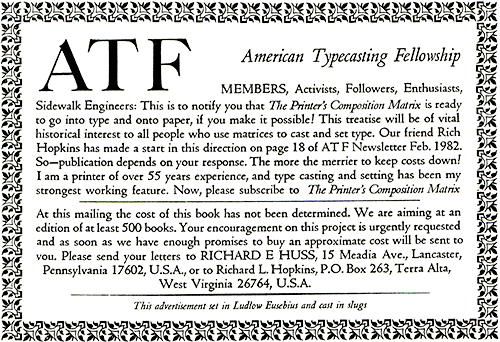
Members, Activists, Followers, Enthusiasts,
Sidewalk Engineers: This is to notify you that
The Printer's Composition Matrix is ready to go
into type and onto paper, if you make it
possible! This treatise will be of vital
historical interest to all people who use
matrices to cast and set type. Our friend Rich
Hopkins has made a start in this direction on
page 18 of ATF Newsletter Feb. 1982.
So—publication depends on your response. The
more the merrier to keep costs down! I am a
printer of over 55 years experience, and type
casting and setting has been my strongest
working feature. Now, please subscribe to The
Printer's Composition Matrix.
At this mailing the cost of this book has not
been determined. We are aiming at an edition of
at least 500 books. Your encouragement on this
project is urgently requested and as soon as we
have enough promises to buy an approximate cost
will be sent to you. Please send your letters
to Richard E. Huss, 15 Meadia Ave., Lancaster,
Pennsylvania 17602, U.S.A., or to Richard L.
Hopkins, P.O. Box 263, Terra Alta, West
Virginia 26764, U.S.A.
3
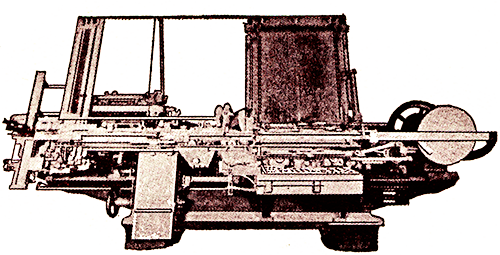
Many would-be enthusiasts work on the
assumption that it takes a crew of hefty men to
move a Monotype caster and therefore, they shy
away from acquiring a machine. Also, they
assume that wide doors everywhere are necessary
to get a machine into a garage or basement. Not
so.
With a hydraulic tailgate, three people can
handle a machine. With a ramp setup, you’re
better off with four. But once the machine is
on the floor, one person can take it from
there. If you’ve got a 35-inch opening, you can
strip your caster so it can be moved in.
Going down a stairwell is virtually
prohibitive. Even one or two steps are major
obstacles. If you can off-load onto a garage or
basement floor, your problems are kept to a
minimum.
Machine setup in a garage, it should be noted,
is not advisable if the garage is below grade
and thus, is damp in the summertime.
Composition casters, keyboards, and especially
key bars don’t get along well with moisture, so
you would be better off moving your caster into
the basement where you can keep the room
tightly closed with a dehumidifier running all
the time when the machine is not in use.
(Obviously, ventilation is mandatory when the
caster is fired up!)
To move into the basement, you may have to go
through a doorway and this may necessitate
stripping the machine to fit the opening. There
are two ways:
The hard way is to strip off all the front
mechanism such as galley, line delivery, galley
trip cam, main flywheel and associated stuff.
This means getting gears out of
synchronization, adjustments screwed up, and so
forth. The only advantage: no detached part is
too heavy for one person to lift easily.
The easy way is to strip off the complete pot
assembly and the under-structure that holds the
galley. All this is accomplished by removing
eight screws and two cotter pins. The only
drawback is the matter of handling the pot once
detached from the machine.
Practical advice: Empty the pot before
detaching. A full pot is awfully heavy. An
empty pot still is too heavy for a person to
handle alone. More advice: Buy or borrow an
impact screwdriver with a wide blade and a
long shaft. The screws which hold the pot to
the machine never want to come out easily.
Finally, have someone help you lift off (and
later reposition) the pot. The entire pump
operating mechanism is connected to the machine
by an arm which can be reached from the back of
the machine. Remove two cotter pins and the arm
is detached. Then the pot can be removed.
If there’s a motor attached to the machine base
under the pot, it too will need to be removed.
And if you’re moving a sorts caster (Orphan
Annie), you’ll have to remove one gearbox (four
screws) on the opposite (left) side to clear a
35-inch doorway. You’ll have to do a lot more
stripping if the door is narrower. It would be
possible to tear down a caster to the width of
its base and go through a 26-inch opening but
that’s drastic medicine. My advice is don’t
remove anything you don’t have to.
Moving the machine, once it’s on the floor, can
be done by one person if you’re patient, have
several lengths of ¾-inch pipe and a good
crowbar. That is, moving a machine across a
flat floor or through a doorway with no
floor-level obstructions.
A word of caution on transporting a Monotype.
Be there when it’s done and insist that all
persons involved know they should get handholds
on solid pieces, not fragile things sticking
out here and there. Bent or broken pieces are
easily avoided with a bit of caution. Also, be
aware that the machine is top heavy and will
topple easily in transit or when off-loading.
(And a final note: The aluminum ramp with a
U-Haul truck is not strong enough to hold a
Mono plus the people moving it. It will work
only if you underpin it with a couple of 4×4
timbers propped up by cinder blocks top and
bottom.)
I have personally U-Hauled two machines now,
and know it can be done without damage or
tragedy, providing caution and common sense are
applied. Where there’s a will, there’s a way to
be a typecaster—so get moving!3
Paul Duensing of Vicksburg, Mich., Roy Rice of
Atlanta, Ga., and Jack Murphy of Elyria, Ohio,
all have commented on the invaluable help they
have received from professional and retired
Monotype operators living in their areas. Help
both with first instruction and with
troubleshooting once the machine is running.
Understanding just what that meant was a little
difficult for me, however, because being
isolated in the hills of West Virginia, finding
another person with any knowledge of Monotype
never happened.
As I have explained at past ATF conferences,
every bit of my Monotype knowledge has been
gleaned from the various manuals—plus a huge
portion of trial and error. I ran my comp
caster three months before I found the galley
trip—and that’s only one example of the
problems this unguided neophyte has had.
But the real value of “help” still evaded
me—that is, until Herb Czarnowsky, the Volker
brothers (Tom and Bob), and Rich Worch, all
from Baltimore and formerly with Baltimore Type
Founders, visited this spring to pick up a
Thompson caster.
I was “loaded for bear.” I had my caster fired
up and had my head stuffed with questions to
ask.
“It’s rather disgusting to have fought a
problem for months with no success and then
have a guy simply turn the machine one
revolution, immediately pinpoint the problem,
and solve it with a twist of a wrench.
Certainly my experiences over the last 11 years
put me ahead of the rank beginner, but the
short time I had with these men proved I have a
lot yet to learn.
Never in my life did I learn so much in such a
short time. If you have cooperative
professionals in your area, by all means, take
advantage of their knowledge!”
3
Since type cases have been such a rage for so
long in "flea markets" and crafts shops across
the country, I guess it was only a matter of
time before the Monotype matrix case becomes a
"collector's item." Here is the ad hype from a
catalog order house in Ft. Lauderdale, Fla.:
"Antique printing case. This Monotype mat case
was a mold for making lead printing type. The
225 tiny brass squares have letter and symbols
engraved. Mats are dated 1894-1914. Mounted on
4-inch wood bases, they make one-of-a-kind
trivets, paperweights, wall hangings for book
lovers, historians. $29.95."
3
Hartzell Will No Longer Make Matrices 80-Year Commercial Manufacturing Era Coming to End
Richard L. Hopkins
The end to over 80 years of commercial Monotype
matrix manufacture in the United States was
announced in September by the Hartzell Machine
Works, Inc., successor to Lanston Monotype Co.
G. Richard Hartzell, president, told of his
intention to discontinue manufacturing
operations because of a continuing low volume
of orders for the product—cellular composition
matrices for use with the Monotype composition
caster.
Hartzell already has disposed of a very
significant lot of Monotype machines and
accessories in clearing out a warehouse nearby;
floor space in his main building, now occupied
by matrix-making paraphernalia, must be moved
soon to make room for general machining
equipment. As the commercial Monotype market
has dried up in recent years, the company has
been forced into diverse fields to survive.
It is fortunate that Dick Hartzell knows and u
nderstands the heritage represented by the
matrix-making facilities he acquired from
American Type Founders in 1975.
“It is our desire to move it as a unit, even
though a higher monetary figure could be
realized by breaking it down,” he explains.
“With this equipment, it is possible, with
proper instruction, to either pull from stock
(if available) or manufacture matrices 6 point
through 12 point of most type series listed in
the American Lanston type specimen book, plus
borders, ornaments, special signs, math
fractions, etc.”
The collection includes over 63,300 3×3 inch
and 5½×5½-inch brass patterns, 338,000 .2×.2
punches, 300,000 mathematical cut cards,
350,000 matrices already manufactured, and over
20 precision specialized machines and devices
designed for the manufacture of Monotype
matrices.
Upon hearing of Hartzell’s plans, I felt
compelled to see the setup while still running
and made a whirlwind visit Nov. 19 for that
purpose. I was amazed on two counts: First, I
was struck by the large volume of material in
the matrix-making facility and its excellent
organization; second, I was most impressed with
Hartzell’s deep involvement (in years past) in
the actual manufacture of numerous parts and
components to the Monotype—and, indeed,
complete re-manufacture of the machine.
Hartzell retains a surprisingly large volume of
parts in inventory, most parts having been made
in the Hartzell plant. The company will retain
its mold rebuilding capability and will provide
parts from inventory while the existing supply
lasts. Users are encouraged to ask about the parts
they need, for it is likely the parts needed
are in stock.
Hartzell Machine Works was founded in 1937 by
Maurice H. Hartzell, Dick’s father. Maurice
worked in the Lanston Monotype factory in
Philadelphia in the 1920s, later becoming a
Monotype operator and machinist at the Chester
(Pa.) Times. He set up for repairing and
rebuilding molds in his own garage, and slowly
built a business which grew to significance
and, indeed, out-performed and outlasted the
Lanston company itself.
All Lanston matrix-making facilities were
bought by American Type Founders in 1969 when
Lanston was liquidated. In 1975, when ATF
decided to quit making Monotype matrices,
Hartzell purchased equipment for making
cellular mats from ATF and moved it to Twin
Oaks, Pa., where the firm has made matrices to
the present time.
(Patterns and equipment for making display
matrices were not acquired by Hartzell; ATF
retained the patterns but disposed of the
equipment.)
The amazing fact is that everything still
remains in a very well-organized, systematic
state, despite the moves and changes in
ownership. The system begun by Lanston is the
one still used.
All patterns and most matrices already
manufactured are housed in a 35-foot trailer
next to the Hartzell building. Reference cards,
records, all punches, and equipment are in the
building itself.
One can tell at a glance the use rate and
history of many letters by checking their
“mathematical card”—a card which closey details
alignment information and lists precise decimal
dimensions for all strokes and serifs involved
in the letter. These figures are used to check
each matrix for accuracy after it is made.
On the back side of each card—there are over
300,000 of them on file—is a record of how many
punches have been made and when. It’s not
unusual for entries to go back to the early
1900s.
The Lanston collection represents millions of
hours of original design work, and a precise
technology which helped change the world. The
forward march of technology has rendered it
unprofitable today, yet it’s horrifying to
think that such a national treasure might have
to be broken up or disposed of as junk.
On the other hand, Hartzell must put valuable
floor space in his plant to active use if his
firm is to survive.
Should you have ideas for solving this dilemma,
call me—or Dick Hartzell—immediately. Time is
running out and our organization is challenged
to find a way to save this invaluable
collection and manufacturing process.
3
Four brand new 15×17 .050 drive English
side-hole fonts Univers with cap, lowercase,
accents, wedges. No matrix cases. $100. 10D and
12D 687, 12D 691 and 12D 696.
Abe Horowitz,
2850 Ocean Ave.,
Brooklyn, N.Y. 11235.
We still make leads and slugs, 1-pt. leads,
Elrod rule in 10 and 25-pound packages ready
for shipment.
Printers Rule & Slug Co.,
1248 South Ashland Ave.,
Chicago, Ill. 60608.
Wanted: Photo Lathe or Scan-a-graver by
Fairchild for letterpress halftones.
Dan Testa,
390 Lincoln Ave.,
Newark, N.J. 07104.
Linotype mats wanted. Interested in acquiring
any of the typographical refinement logo mats
such as: Tr, Tu, Ty, Va, Ve, Vo, Wo, Ye, fa,
fo, f,, ffe, ffr, f., fi, ct, st and any others
for 11-point Caslon Old Face 12 pt. 236. Also
interested in learning of any potential sources
for the above.
Fred C. Williams,
24667 Heather
Courte, Hayward,
Calif. 94545.
Phone (415) 782-3674.
Hot-type composition. Linotype and display
Monotype. Send your job for
lower-than-cold-type price.
Copyfire,
441 W. 11th St.,
Indianapolis, Ind. 46202.
Sale. Many Lino fonts, parts, supplies. Also
Mono molds (new).
Fred Sholty,
441 W. 11th St.,
Indianapolis, Ind. 46202.
For sale: Rouse Panameric hand miterer. Brand
new, never used. Any reasonable offer.
Leonard Sandick,
350 65th St., Apt. 14-P,
Brooklyn, N.Y. 11220.