News of ATF Formation Spreads Quickly; Enquiries Are Varied
Richard L. Hopkins
As information has spread regarding the
typecasting conference held in July, enquiries
have come from far and wide requesting
information about our American Typecasting
Fellowship.
These enquiries make it abundantly clear there
is a strong interest in metal typecasting, even
though there aren’t that many folks writing
telling of having their own casting equipment.
Several enquiries have come from persons still
involved in hot-metal typecasting commercially.
They wish to keep “in contact” with others
doing the same, whether commercially or as a
hobby.
Other enquiries come from persons still in
typesetting but now removed from their first
love—hot metal. They’re happy to hear the art
is being kept alive and want to receive our
newsletter, etc.
The third category includes persons interested
in typography and specifically metal
typography. They, generally, are hobbyists with
their own private presses who wish to take up
casting so to assure themselves of future
supplies of “precious” metal type.
All are welcome to receive future editions of
this newsletter and certainly would be welcome
at any future meetings we might have. They are
welcome, too, to participate in the two-way
communication this newsletter might afford as
long as their requests, etc., relate to matters
of typecasting and metal typography.
A strong emphasis will continue, however, on
the specifics of typecasting and on those who
have their own equipment. That will be in
keeping with ATF’s mission as implied by its
name—a fellowship among American typecasters.
There obviously is a need for what amateur
typecasters, collectively, can provide. To-wit:
“I am an amateur book printer and printmaker.
I’d like to design, cut, and hand-cast type for
my press and need all the advice I can get.”
This comes from Kirklynn Cook of Mt. Kisco,
N.Y.
Barney Rabin of Florida indicates he makes his
own Linotype matrices. This interest, along
with that of several others, indicates a
“section” of ATF, perhaps, should be devoted to
linecasters.
All told, the American Typecasting Fellowship
is off to a good start. Your comments and
advice will be appreciated—and especially
technical information on the subject of
typecasting as it is being re-discovered by
hobbyists from Maine to California.
3
I thought the Radio Shack had to be the last
place I ever would encounter Monotype equipment
or accessories, but the sign on the binder
obviously was made of keyboard controller tape.
So I had to enquire.
The response: “Oh, that’s very specialized
tractor tape for an advanced computer. I bought
the surplus from a run at a paper converter
factory where I used to work.”
A computer my foot. I proceeded to explain that
it was a very close resemblance to controller
tape and after all was said, he admitted he
didn’t know what it was, but that he had
several cartons of the stuff. Well, I too,
would like to get it from him. I brought a
sample home. Any idea of the source? It is the
real stuff—looks like genuine controller tape.
3
Enquiry has been received from Old Sturbridge
Village, Sturbridge, Mass. 01566. Craig P.
Mabius seeks an authentic “fat face” for the
shop there, which seeks to be authentic for the
1820–1840 period. Does anyone have or know of
the availability of such matrices? The
contemporary Ultra Bodoni is a poor copy of the
fat face letters he seeks. Write directly to
him. He says, “Before becoming director of
crafts at Old Sturbridge Village, I was in
charge of the Isaiah Thomas Print Office. And
of all the problems to overcome, good
reproduction type posed the biggest dilemma.”
3
If you have been feeding your Thompson a diet
of scrap-type, you know the trouble caused by
excess dross, not to mention the exciting aroma
of an occasional rubber band. The most
desirable arrangement would be an automatic
feeder gently lowering a long ingot of metal
into the pot, maintaining a constant level of
beautifully clean metal. But, lacking that,
feeding your pride and joy small pigs of clean
metal is the next best thing, and to do that
you need to remelt your old type.
I had been on the trail of a remelt furnace,
but had not been able to find one I could
afford. A chance conversation at Terra Alta
gave me a solution. Andy Soule commented that
he had used a common deep fryer to melt old
type. On my return home, I canvassed the
neighborhood and found a retired but still
usable deep fryer for $3.00 cash.
This fryer had a cast aluminum pot with an
integral heating element. The thermostat was
erratic, was only calibrated to 500°, so I
wired it out. Temperature can be controlled by
simply unplugging the pot when the temperature
gets too high. My pot holds eight quarts—almost
100 pounds of type metal.
To retain heat and assure high enough remelting
temperature (750°), I insulated the pot. I
finally found an insulation supply house that
stocked high-temperature insulation in the
Yellow Pages under “Pipe and Boiler Covering
Materials.” They had a ceramic fiber
insulation, Durablanket, manufactured by
Carborundum. This is a white flexible fiber
blanket about one inch thick and withstands
temperatures up to 2300°F. It is
expensive—$4.00 per square foot. But when I
went out, they had a scrap about 24" x 18" left
over from a roll and they gave it to me. I
offered to hug the young lady at the front desk
for her kindness, but she declined...
I removed the bottom from the fryer,
disconnected and removed both the pilot light
and the thermostat, and connected the cord
directly to the posts of the heating element. I
then lined the pot with insulation—between the
side of the pot and the outer liner and between
the bottom of the pot and the bottom shell. I
reassembled the fryer, filled it with type,
plugged it in, and within an hour the
temperature was crossing 600° on the way up.
If you have gotten this far on your remelter,
you will find a few other implements
indispensable. First is a pig mold. I was lucky
enough to have one. Or you might try to find an
old-fashioned cast-iron cornbread pan. Little
lead corn cobs should give your foundry that
down-home look.
Another necessary item is a skimmer—or better,
two: a small rectangular one for the Thompson,
and a larger, round or oval one for the
remelter. You can make them out of sheet
iron—not galvanized. Tom, my printer’s devil,
is in metal shop at high school, and sheared
mine out of stock about a sixteenth inch
thick. The small one is 1¼ x 2½". Drill 3/32
holes all over the skimmer to let the metal
flow through while stopping the dross. Mount it
on a piece of ¼" steel rod either by welding or
riveting. Plain steel rod is rather hard to
find, so I used galvanized by grinding the zinc
coating off. My handles are 18 inches long,
which is satisfactory for a small operation.
The larger skimmer for the remelter is 2½"
diameter, again with the holes and the 18-inch
handle. After drilling it, I worked it over
with a ball pein hammer until it was slightly
convex. This helps hold the dross on the
skimmer as you dip it out.
To complete the outfit, I liberated a stainless
steel soup ladle from Hazel’s kitchen. I have
now converted about 150 pounds of miscellaneous
type into neat little pigs, and have a much
cleaner pot on the Thompson. Operations, though
infrequent, are much simpler and no aroma of
burning rubber bands lingers to make my foundry
an unwelcome addition to the household.
3
It is our purpose to make our matrices so
accurately that it will only be necessary to
line up the Cap H and then run the rest of the
font without further test. With some faces such
as Garamont, Kennerley and No. 337 Caslon that
is the only way they can be run because their
faces have been purposely designed for
irregular alignment.
In all cases, however, after the font is cast,
one type of each character should be assembled
and locked up and a proof taken to test
alignment or appearance.
Some customers such as trade plants, who cast a
large quantity of each character, check the
alignment of each character as cast. For this
purpose the following table will be useful.
The bottom of the following letters should be
lined with the line standard of the face to be
cast:
f, h, i, k, l, m, n, r, x, z, fi, fl, ff, ffi,
ffl.
Take alignment from top of lower case "m" for the
following:
g, o, p, q.
Take alignment from bottom of lower case "o" for
these:
a, b, c, d, e, s, t, u, ae, oe.
Take alignment from top of lower case "x" for the
following:
v, w, y.
Take alignment from top of lower case "i" for
lowercase j.
Align bottom of following capital letters with
line standard:
A, B, D, E, F, H, I, K, L, M, N, P, R, T, X, Y,
Z, AE, OE.
Take alignment from top of the capital "H" for
the following:
J, U, V, W.
Take alignment from bottom of capital "U" for the
following:
C, G, O, S, &.
Take alignment from top of capital "O" for
capital Q.3
Of all persons, Paul Duensing now in a new home
at Vicksburg, Michigan, must have changed his
typecasting facility more radically than anyone
else since the conference. He has obtained a
rare English Thompson caster, and has obtained
an equally rare 16x17 composition caster with
keyboard. Also, he has acquired a Ludlow mat
holder for his Thompson along with a stunning
list of Ludlow mats (Caslon Bold, Cheltenham
Bold, Karnak and Tempo).
Stunning?
Roy Rice of Atlanta, Georgia, also has acquired
a composition caster-a 15x17. Roy drove all the
way to Detroit to haul it out of its shop and
into a warehouse for future delivery to
Atlanta. The keyboard, which he hauled home in
his half-ton pickup, gave enough trouble
transporting and Roy is glad he didn't try to
haul the caster.
3
Of increasing curiosity is the Thompson
typecaster. Can anyone tell us more about the
name and about the company which made the
machine before Monotype took it over? Can
anyone give us a comprehensive list of the
Thompson Company's matrix offerings? The
numbering is different and there are some
different faces offered. I have Beton Extra
Bold (Argh!) which is not found in Mono lists
and I am sure there are others. It would be
helpful to know more of the inventor and his
(?) company. Harold Berliner: was this the man
to whom you referred in your after-dinner
speech at the type conference? If so, please
answer some of the questions posed here.
3
Two conference participants show evidence of
their efforts to revive Goudy's almost-lost
Companion Old Style type design. Les Feller of
Niles, Illinois, obtained the electro matrices
by chance and now has issued a sales sheet
offering 14 pt. roman, small caps and italic,
18 pt. italic and 36 pt. roman and italic. His
circular also lists such jewels as Thunderbird,
Relievo, Concave, Staccato, Tuscan Ombree, and
several others.
Richard Mathews, who operates the Konglomerati
Press with Barbara Russ at Gulfport, Florida,
avid Goudy fans, pursued the face since its
discovery and has completed composition for the
first book ever to be done in the Companion
face-hand-set in 14 point. The book, Water
Colors, by Hale Chatfield, will be available
later in this year.
The next issue of Typographic Curiosities,
which I do occasionally at the Hill & Dale
Press, will concern itself with the
re-discovery of this Goudy design.
3
The passing of every age leaves its casualties,
both in terms of machines and of the people who
ran them-once valued technicians and their
instruments of commerce, now suddenly displaced
by a new technology.
Recently, when I saved some equipment from the
junk yard, I had occasion to notice a fine
typesetting and casting machine in the workyard
of the firm. Technology no longer demanded its
finely honed surfaces, close tolerances and the
creative genius which gave birth to it. Its day
had passed. It has been dipped in a heavy coat
of scarlet paint and now it sits on a small
concrete pedestal as an advertisement for the
typesetting firm it had supported so long.
Silent, immobilized, it sits... like a fine,
gifted, dignified lady... painted up like a
bawd, in its coat of raw, gaudy red...
Only those who know the outlines of this form,
now covered by this crimson mantle, know the
significance of what the machine could do, how
many hours of service it once performed, of the
millions of letters it once cast... of the one
brief silver moment in history when this
tainted, rusty bawd performed like the gifted
lady she really is. From those who know, she
still merits a salute with the eyes, a mental
tip of the hat, a silent tribute to a fine old
friend.
3
After seeking for one year some means of
converting my three-phase motor for
single-phase operation, I discovered a small ad
from Reliance Electric Manufacturing Co., Route
2, 1024 W. Lake Brantley, Maitland, Florida
32751. They advertised a phase converter for
$49.95 postpaid. I sent a check and promptly
received a converter. Although not yet used, it
seems totally adequate and they do have a
satisfaction guarantee with it. Seems a lot
cheaper than changing motors, etc.
3
Leah Warner provides details on Herb
Czarnowski's activities of late. As you may
recall, he attended the conference at Terra
Alta shortly after the dissolution of
Baltotype, where he was vice-president.
Leah reports Herb has recruited two of
Baltotype's caster operators (the best in the
business, he says) and is starting a new
typefoundry. He now has all of the Baltotype
faces in sizes from 6 to 12 point and most of
the 14 point. The address is: Volker Brothers,
care of Herbert S. Czarnowski, Baltimore,
Maryland. Phone (301) 668-7420.
3
After watching Andy Soule and Pat Taylor whip
that Pivotal Caster into shape at Terra Alta, I
felt inspired to get the Bruce at the
Smithsonian going. The week after the
conference, I began by disassembling the parts
and getting them all adjusted properly. My only
remaining problem was to heat the pot.
I checked around for the kind of burner Pat had
on his machine. As far as I could tell, it was
pretty much like the burners on old-fashioned
water heaters, but these haven’t been
manufactured for quite a few years and I
couldn’t locate a supplier that had one. Not
wanting to get bogged down, I tried the burner
from a gas range. It burned well, but it just
wouldn’t get hot enough to melt the metal.
I decided a heating expert should be able to
suggest something suitable, so I called my
specifications in to a fellow at the heating
company. He said he had just the burner. It had
a flame spreader that was six inches in
diameter and it stood 11 inches tall. It just
sounded great. However, when I looked at the
burner, I could tell it wouldn’t do—the silly
thing was for a furnace and would generate
perhaps 30,000 BTU’s. That would probably do
more than just melt typemetal!
Now I am seeking a gas burner from a Thompson
caster. If anyone has a suggestion or can give
more detailed specifications for heating a
Bruce caster, I would enjoy hearing from him.
3
Herb Harnish of Ft. Wayne, Indiana, confirms
that he has a yet-to-be-run Thompson. “My
purchase consisted of a Thompson with a passle
of nearly 200 fonts of mats and 20 or 30
pounds of Lino mats of the decorative type,
borders, dingbats, and the like... I have been
making haste very slowly, not wishing to break
anything on the caster through ignorance....”
My response to this caution was to “go ahead
and try it. It’s harder to break a Thompson
than you imagine.”
Andy Dunker of Jackson, Michigan, advises me:
“I’m glad to see that you are interested in the
process of making matrices via the electrolytic
process. Certainly someone else should get into
this if the future of typecasting is to be
continued. I think you should also acquire some
knowledge of electrochemistry, some data on
power supply for the tank, and certainly some
knowledge of mechanical machine work to finish
the matrices, if you don’t already have this.
Then there is the additional expense of
metal-working machinery, not only for finishing
the work, but also to make the many small tools
and fixtures one will need along the way. This
is not to discourage you in any way, but
rather, to get you to look at the whole picture
before you enthusiastically start on the
initial part and then discover a rocky road
ahead...”
Bert Williams of Hayward, California, asks:
“Have you heard of these? 4 comp casters, 3
keyboards, 1 rule material maker, matrices;
Free list. Hoflund Graphics, Box 8569, Denver,
Colorado 80201.”
Vance Gerry writes to Paul Duensing: “I met a
young couple named Chayt who cast and set type
for their books. They have solved the space
problem by renting a loft in a warehouse (3,500
square feet)—they live there too. When they
visited me, I uncovered the Thompson for them
to see and discovered that a mouse had made her
home in the pot and was disinclined to leave.
Possibly no private casting machine in the U.S.
has been so neglected as V. Gerry’s...”
Paul Duensing comments: “You mention ‘that
grand typefoundry in the sky.’ You don’t think
they really might have a typefoundry up there,
do you? If I had had any idea, I might have
been a better boy all these years. I always
assumed that to have a foundry, you had to go
where the heat was... and also I assumed most
of the printers would be down where the lead
melts...”
From James F. Burns, Jr., editor of Printing
Impressions: “We’ll run your report on the
First National Conference on Metal Typecasting
& Design in our November [1978] issue.” An
article I submitted received good play on page
8R. Unfortunately, this section was not in all
copies of the magazine.
Mac McGrew of Pittsburgh, Pennsylvania, has a
knowledge of Monotype, Linotype, Intertype,
foundry, etc., that just won’t quit. He has a
list from Lanston which is the most
comprehensive I ever have seen. It includes
what sizes were made, the “set” for all
composition sizes, how many matrices were in
each font, etc., etc. It encompasses some 13
pages. If interested in a reproduction of this
list, write and we shall attempt an offset copy
in a subsequent issue of this newsletter. (I
have just studied my three Mono specimen books
and find the same list in a copy of the book
which must have been put together in 1939. I
date it by some of the dated material elsewhere
in the book.)
Both Mac McGrew and Dave Norton of Syracuse,
New York, indicate very extensive knowledge and
resources regarding the American Type Foundry
list of faces which was published in the last
newsletter. If interested, contact them.
Several persons have written regarding the
initials of our organization—ATF. “Surely
coincidental,” as one person put it. We shall
hold off complete discussion of the subject and
allow Harold Berliner, the man who drafted our
extensive constitution, opportunity to digress
on the subject for 45 minutes at our 25th
anniversary meeting.
3
Correspondence from Vance Gerry of Fallbrook,
California, indicates the general tone of all
those who wrote regarding loaning matrices to
one another. “I have in the past loaned mats to
people I know and would loan them to any ATF
member in the future, I think. I have very few
mats, and, of course, I mean to loan only
commercial mats. Proprietary mats will not be
loaned. For the circulating list of mats,
anyone wishing to make his mats known should
send a clean proof or typed or printed list to
the guardian of lists who would make up Xeroxed
copies, compile them and mail them at a charge
to those requesting them...”
So far, I have experienced no requests for any
faces. If you are desperate for a particular
size of a particular face, perhaps we can get
started by reporting your “wants” in the
newsletter.
Dave Norton of Syracuse, New York, has a good
suggestion: “I suggest not loaning but making
an arrangement under which owners of mats would
cast for others on request, either for pay or
for credit toward casting they may request from
others. In this way, any damage to your mats
will be your responsibility.”
3
Jim Fitzgerald, sales manager for Hartzell
Machine Works, American representative for
Monotype, gets upset when reports exclude
Monotype as a principal typesetting
medium-reports such as the following. Jim hopes
to provide us with better information on
Monotype's current status, but sent along an
internal Mono sales piece indicating seven
casters had been sold in Hungary and India
within a two-month period. Perhaps Mono will
outlive the other guys?
Perhaps not. A typesetting newsletter recently
reported Monotype Corporation was in a state of
financial distress, but that Barclays Bank and
the National Enterprise Board had banded
together to form a rescue in the form of 6.75
million pounds. The funds should help Monotype
launch its "all-British, computer-controlled,
laser typesetter." Monotype's troubles have
been attributed more to takeover via financial
maneuvering than because of its product line.
Anyway, here's the hot-metal report, a clip
from the New York Times, August 6, 1978, sent
in by Mark Carroll:
For decades, they were the printers'
workhorses-the Mergenthaler Linotype and the
Harris Intertype. They cast molten metal into
type and thousands of newspapers and print
shops across the country. Today, computer
terminals and photographic equipment cast "cold
type." It is speedier and cheaper.
But a hot-metal ember remains. Although
Mergenthaler and Harris no longer make
Linotypes and Intertypes in this country, they
continue to build a handful in England.
Joseph Juhasz, director of marketing
administration at the Mergenthaler Linotype
Company in Plainview, L.I., says the overseas
plant is building but "12 or 14 machines a
year, because we only have one customer who
buys new machines" a printer of personalized
bank checks in the United States. In the heyday
of hot machines, he notes, Mergenthaler turned
out "200 a month at least"' for 40,000
potential customers.
In Winchester, Va., Donald H. Neale, manager of
operations for Intertype says Harris is
building 60 to 70 new machines a year in
England, compared with 1,000 on two continents
20 years ago. No one in the United States is
buying new Intertypes, he says. Foreign
newspapers are the main customers.
As for used Linotypes and Intertypes, American
dealers report paying $100 to $325 and getting
about $650 at retail-if they're fortunate
enough to find a buyer. When new, the machines
cost from $10,000 to $37,000 apiece.
Used machines "usually go to the junkyard for
scrap," reports Peter Kantor, president of the
Linotype Supply Company in Manhattan. Most of
the survivors are stripped for parts. "A few,"
he says, are sold intact.
3
My Thompson has been cold-natured from the
start. When I first hooked it up, the gas
piping on the machine was 1/8" galvanized iron
pipe. The pot temperature barely got to 500°. I
brought gas to it with ½" galvanized pipe and a
½" flex tube next, but still no success.
Consultation with a Linotype man then led me to
drill out the orifice in the burner, which
gained another 75° or so, but still left me
with a maximum temperature of just under 600°.
I cast my first font of type (18-point) at this
temperature and it worked OK, but I still
wanted to be able to raise the temperature if
necessary.
In a conversation with Dick Hartzell at Terra
Alta, I mentioned my problem, and he suggested
I insulate the pot. Dick said that they packed
the pot liner with insulation when they
reconditioned machines using asbestos
high-temperature insulation. So I tried it,
using a ceramic fiber insulation*—asbestos is
no longer available due to federal health and
safety standards.
After carefully packing insulation all around
the pot, it was immediately obvious that Dick
and I had not communicated effectively. First,
the fire refused to burn, except around the
lower rim of the pot. Obviously lack of oxygen
was the answer, so I poked channels in the
insulation at about 60° intervals around the
pot. Now the fire burned well enough, but
still the pot would not heat-about 450° was
the max. So…out with the insulation.
The final arrangement was a one inch strip of
insulation at the very top edge of the pot,
with a two-inch space above the nozzle, and
two one-inch spaces about 60° around each side.
This allowed sufficient draft for a good hot
fire, and by having a restriction at the top of
the pot, retained a maximum amount of heat. The
two-inch opening above the nozzle is to direct
as much heat flow to this area as possible for
free working of the choker valve.
Looking back over the misadventure (only one of
a bunch) in my encounter with the Thompson, it
is clear that Dick was talking about an
electric-fired machine while I was talking
about a gas-fired machine. So, if you have an
electric pot, by all means insulate, but go
easy on the gas model. Happy casting!
3
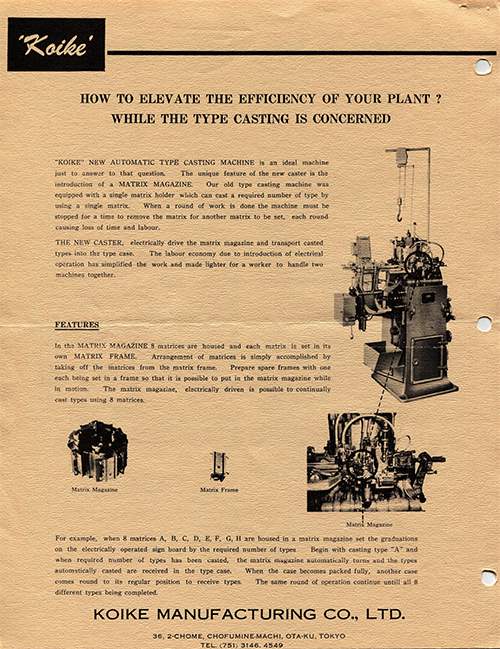
It definitely looks like a Thompson and
apparently is an example of Japanese ability
to "copy and improve." The leaf on the next
page was sent to me by Paul Duensing. He says
he got the leaf in the late 1950's and has no
knowledge as to whether the machine still is
manufactured.
The "change mats as you run" feature would be
great for Oriental ideograms, where the set
width remains constant. My guess is that it's
less useful for our Roman alphabet.3